
 KOR
KOR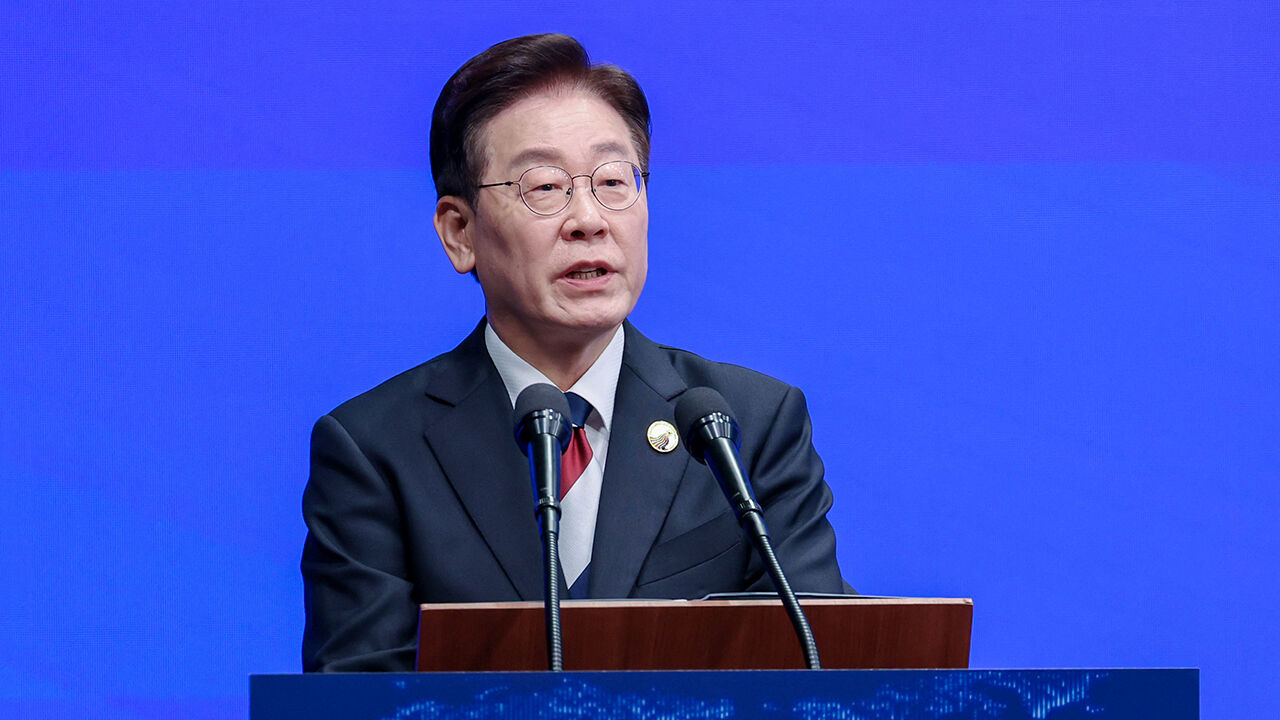
▲ President Lee Jae-myung delivers a speech at the 1st Korea-Central Asia Business Summit on September 16.
President Lee Jae-myung emphasized that South Korea and Central Asia must move beyond simple raw material trade to strengthen "full-cycle cooperation" in the critical minerals sector, spanning exploration, smelting, high-value material processing, and final product manufacturing.
President Lee stated this today (September 16) during his keynote speech at the Business Summit, held on the occasion of the 1st Korea-Central Asia Summit.
The Korea-Central Asia Business Summit brought together leaders and business delegations from five Central Asian nations: Uzbekistan, Turkmenistan, Kazakhstan, Tajikistan, and Kyrgyzstan.
President Lee touched upon the long-standing ties between South Korea and Central Asia, stretching from the Silla period to the settlement of ethnic Koreans (Koryoin), the dramatic growth in bilateral trade volume since establishing diplomatic relations in 1992, and the current popularity of "K-culture" spearheaded by Korean dramas.
"Now, young people in South Korea and Central Asia watch the same dramas and listen to the same songs," he noted. "Our relationship, which once saw only goods cross borders, is now expanding its horizons into full-scale cooperation where culture and people interact."
President Lee said that if South Korea and Central Asia "walk together, the path from 1,500 years ago will reopen as a new Silk Road." As specific measures, he proposed expanding cooperative trade items and investment sectors, building a cooperation framework spanning critical minerals and advanced manufacturing, and collaborating on future infrastructure.
In particular, regarding critical minerals, President Lee emphasized, "Amid the realignment of global supply chains, Central Asia is a treasure trove of critical minerals essential for producing electric vehicles, batteries, and semiconductors. When rich resources such as lithium and uranium meet our manufacturing capabilities, we can lead the global market."
He added, "Moving beyond simple raw material trade, we must strengthen full-cycle cooperation in the critical minerals sector, from exploration to smelting, high-value material processing, and final product manufacturing. The Korean government will actively support joint research and development and professional talent cultivation, leveraging the 'rare metals centers' currently being established at key regional hubs."
On infrastructure cooperation, he underscored, "South Korean companies, equipped with extensive construction experience and proven technology, are the optimal partners to join Central Asia's infrastructure innovation. By jointly establishing transportation and energy arteries and dense logistics networks across the vast continent, we must unlock Eurasia's potential."
Regarding the expansion of trade and investment, he stated, "We must broaden the scope of trade into new industries such as consumer goods, bio, and digital." In this regard, he highlighted the importance of dispatching trade missions to the region, lowering non-tariff barriers, and the roles of the "Korea Desks" being set up across all five Central Asian countries.
"If the five nations gathered today and South Korea pool their wisdom and join hands, we can accomplish anything together," President Lee said. "I will provide steadfast support to ensure your bold endeavors bear tangible fruit."
(Photo: Yonhap News)
※ Please note: This article was translated by AI and may contain errors.


 Video News
 Video News
 Video News
 Video News
 Video News