
 KOR
KOR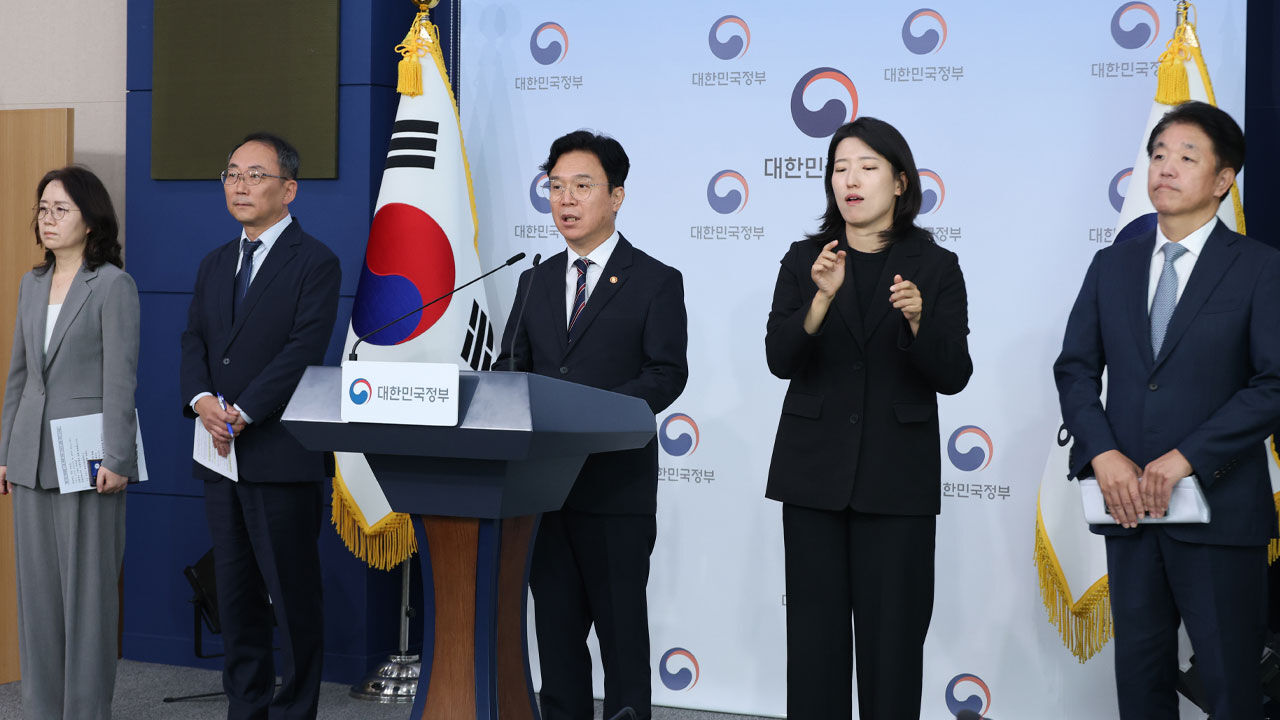
▲ Minister of Employment and Labor Kim Younghoon briefs reporters on the "Proposal for Social Dialogue regarding the Mega Special Zones Special Act" at the Government Complex-Seoul in Jongno-gu, Seoul, on the 15th.
The government publicly proposed today (the 15th) to hold a "one-point social dialogue" involving labor and management to discuss special exemptions, such as exceptions to labor regulations, under the Mega Special Zones Special Act.
Minister of Employment and Labor Kim Younghoon held a briefing at the Government Complex-Seoul and made the proposal, stating, "The labor exemptions being discussed in the process of drafting the Mega Special Zones Special Act are paths our society has not yet taken."
"Given that healthy labor is the driving force through which companies create value and our society moves toward sustainable growth, labor exemptions are a core element of the Mega Special Zones Special Act," Minister Kim emphasized.
"In the dialogue, we will be able to discuss not only labor exemptions but also any matters proposed by labor and management to protect workers' health rights and improve corporate productivity," he added, noting, "It will be a venue for dialogue and compromise where stakeholders directly discuss issues to strengthen industrial competitiveness and create good jobs."
The Ministry of Employment and Labor has explained this proposal to the Federation of Korean Trade Unions (FKTU) and the Korean Confederation of Trade Unions (KCTU)—the two major umbrella unions—as well as management organizations such as the Korea Enterprises Federation (KEF) and the Korea Federation of Small and Medium Business (KBIZ). The ministry plans to gather responses from various sectors and hold the first meeting at an early date.
Because the KCTU does not participate in the Economic, Social and Labor Council, the existing tripartite dialogue body, the ministry floated the idea of creating a separate social dialogue platform focused solely on this issue.
The government plans to have the Ministry of Employment and Labor, the Ministry of Trade, Industry and Energy, and the Office for Government Policy Coordination participate, and Minister Kim explained that he thinks the Economic, Social and Labor Council could also become a principal body.
Minister Kim made this proposal because the issue of significantly easing labor regulations in the special zones remains a major point of contention regarding the Mega Special Zones Special Act, which the government and the ruling party aim to introduce within this month and legislate within this year.
Minister Kim stated that the most urgent subjects for discussion are the "white-collar exemption," which would lift the 52-hour weekly work cap for high-income managers and research and development workers while excluding overtime, night, and holiday work allowances, and the "fixed-term 2+2" rule, which would extend the current two-year limit on employing fixed-term workers by another two years upon agreement with the workers.
While the business community argues that labor exemptions are necessary to secure the competitiveness of the mega special zones, the labor community has strongly opposed them, claiming that such exceptions will serve as a stepping stone to dismantling labor regulations across the board.
Because views between labor and management differ sharply on this issue, it remains uncertain whether the social dialogue will actually lead to a compromise.
Within the government, the Minister of Employment and Labor and the Minister of Trade, Industry and Energy have also exposed differences in their views on multiple occasions.
The Semiconductor Special Act, which passed the National Assembly last January, ultimately crossed the threshold of the National Assembly with the provisions regarding exemptions to the 52-hour workweek excluded after fierce confrontation between the ruling and opposition parties.
However, Minister Kim emphasized, "Tripartite dialogue has dialogue itself as its purpose. Regardless of whether a result is produced, the contents of the dialogue can be sufficiently reflected in the National Assembly's discussion process and prevent conflicts." He added, "The government will play the role of a facilitator for dialogue, providing objective data such as on-site fact-findings and enabling in-depth discussions."
Regarding the controversial issues, Minister Kim also remarked on this day, "The government's position has not been finalized," adding, "Personally, I hold a negative stance on the white-collar exemption."
Some critics point out whether the government is proposing social dialogue after having already set an answer so that the labor community is left with no choice but to accept the labor exemptions.
In response, Minister Kim said, "The mega special zones are a project upon which the national fortune rests and which must succeed. The more that is true, the more natural it is for the subjects who will share the results of the national fortune to participate in the policy-making process." He added, "It is neither an easy agenda nor an unsolvable problem."
Given that the ruling party and government aim for legislation within this year, some forecasts suggest that the legislation of the Mega Special Zones Act could happen first, with social dialogue taking place afterward.
An official from the Ministry of Employment and Labor stated, "If there is empathy and a will regarding the necessity for the parties to talk, a three-month period for social dialogue is sufficient."
The two major umbrella unions, which have expressed strong opposition to labor exemptions, opened the door in early August by demanding a social dialogue regarding the AI transition and the Mega Special Zones Act, as well as a meeting with President Lee Jae-myung.
Minister Kim explained that President Lee also requested during a tea meeting with the heads of the two umbrella unions at the Blue House on the 3rd that a solution be found through social dialogue concerning the mega special zones, and that the government's proposal for a one-point social dialogue is an extension of that effort.
The two major umbrella unions hinted at the possibility of dialogue taking place.
In a spokesperson's commentary, the FKTU stated, "As the party that proposed social dialogue, we will responsibly participate in the discussions so that balanced regional development and the strengthening of industrial competitiveness can lead to improvements in workers' quality of life." However, it emphasized, "The FKTU's participation does not mean acceptance of labor exemptions, and specific issues must be discussed through social dialogue."
Meanwhile, the KCTU stated that the Ministry of Employment and Labor requested its participation in the Economic, Social and Labor Council the previous day, adding, "What the KCTU proposed is a new social bargaining format based on the principles of consensus through deliberation and sectoral participation. We will go through careful discussion on the Ministry of Employment and Labor's stance to determine our organizational position."
(Photo: Yonhap News)
※ Please note: This article was translated by AI and may contain errors.


![The 'Crazy Race' of a Korean High Schooler That Shattered Japan Swimming's 'Solo Run'... [AG Then and There]](http://img.sbs.co.kr/newimg/news/20260915/202222542_300.jpg) Video News
Video News
 Video News
!["It Has Become a Sea of Tears, Are You Going Through Menopause?" Rep. Kim Seung-won Direct Hit Over Remarks [Baroi News]](http://img.sbs.co.kr/newimg/news/20260915/202222565_300.jpg) Video News
Video News
 Video News
