
 KOR
KOR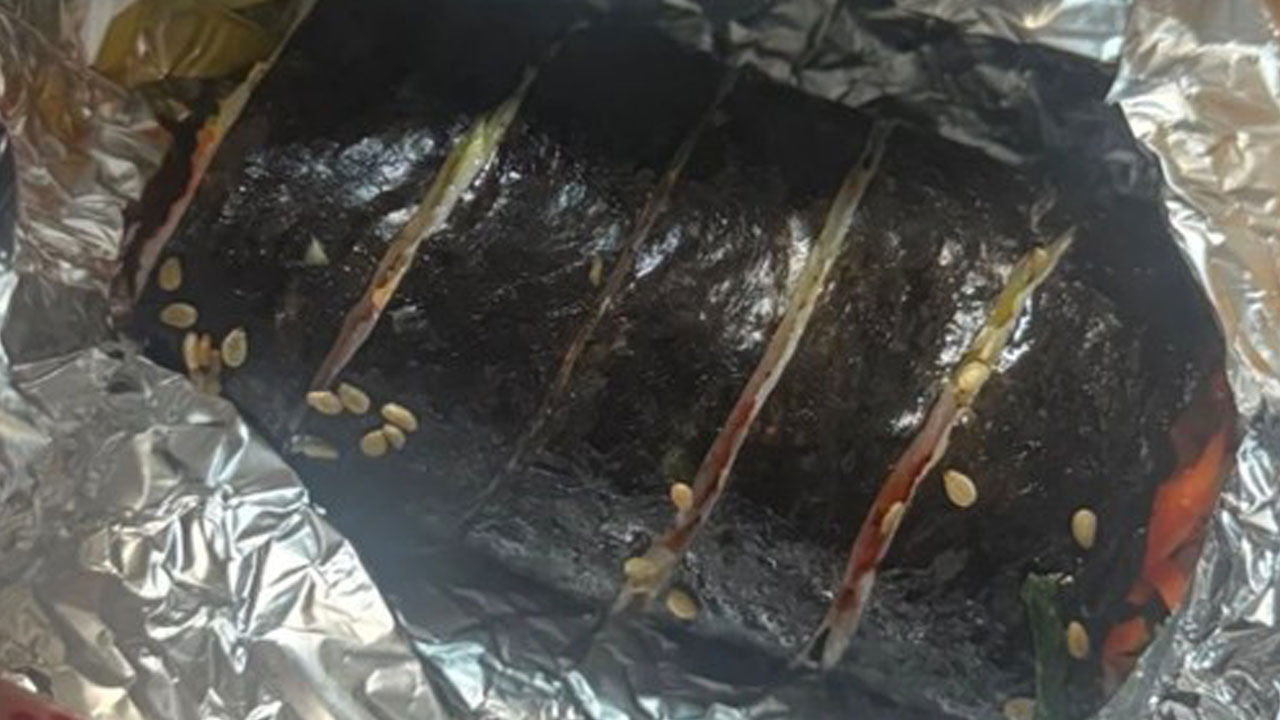
▲ 'Half-roll gimbap' shared online
As the "lunchflation" phenomenon—where a single lunch meal easily surpasses 10,000 won—persists, the dietary culture of the younger generation is rapidly changing.
"Downsizing" consumption is spreading as people look for ways to lower spending burdens, such as buying only half a roll of gimbap, purchasing coffee priced in the 1,000 won range, or opting for budget-friendly burgers.
Recently, an online community post about the rising demand for "half-roll gimbap" drew attention.
The post included a photo of a small-sized gimbap wrapped in aluminum foil and laid out.
It is sold for about 2,500 won, featuring five pieces, which is half the amount of a regular roll of gimbap.
Netizens reacted by saying it is reasonable considering prices exceed 5,000 won per roll, or that it is a good alternative to triangle gimbap.
Voices complaining about the burden of meal costs are also high near college towns and areas dense with office workers.
Kwon, a young person in their 20s, stated, "In the past, I didn't pay much attention to prices when choosing a menu, but these days, if it goes over 10,000 won, I hesitate. Since it's money going out every day, even a difference of a few thousand won feels significant."
The trend of cutting food expenses is prominent in fixed consumption goods like coffee and single-item meal menus.
Park Tae-jin, an office worker who drinks coffee in the 1,000 won range every lunchtime, said, "It feels burdensome to spend 4,000 to 5,000 won on coffee every day, so most of my colleagues also favor low-cost coffee brands."
Hamburgers have emerged as a cost-effective meal choice.
This is because they allow for meals under 10,000 won, priced around 5,000 to 7,000 won for set menus, and offer high satisfaction relative to calories.
College student Lee Min-jae explained, "It's good for a meal because it's relatively inexpensive and has enough calories."
Consumers closing their wallets can also be confirmed through market indicators.
According to the Fair Trade Commission's franchise business status statistics for 2025, as of the end of 2024, the number of franchises for major low-cost coffee brands—Mega MGC Coffee, Compose Coffee, and Paik's Coffee—reached 3,325, 2,649, and 1,712, respectively.
The number of newly opened stores was tallied at 657, 311, and 286, respectively.
According to the 2026 Baemin Food Service Trend released by Woowa Brothers, the operator of Baemin (Baedal Minjok), hamburger order volume from January to May this year increased by 14.2% compared to the same period last year, enjoying a boom.
Experts pointed out that while the phenomenon of low-cost, small-portion food items increasing due to high inflation is a self-help measure to reduce food expenses, it carries the risk of leading to biased meals.
Lee Hong-joo, a professor of consumer economics at Sookmyung Women's University, said, "As high inflation continues, demand for cheap products among price-sensitive consumers, such as the younger generation, has grown, which seems to have led to the appearance of low-cost, small-portion foods."
He added, "While it is positive in terms of lowering the burden of food expenses, excessive reliance can lead to choosing meals based heavily on price and fullness, reducing nutritional balance. Consumers need to look at the balance of their diets together, and businesses also need to develop products that combine cost-effectiveness with nutrition."
(Photo: Captured from online community 'Ruliweb', Yonhap News)
※ Please note: This article was translated by AI and may contain errors.



 Video News
![[자막뉴스] 고가주택 이상 거래 절반이 중국인…국내 대출 막자 외국인 들어왔다](http://img.sbs.co.kr/newimg/news/20260915/202222474_300.jpg) Video News
Video News


