
 KOR
KOR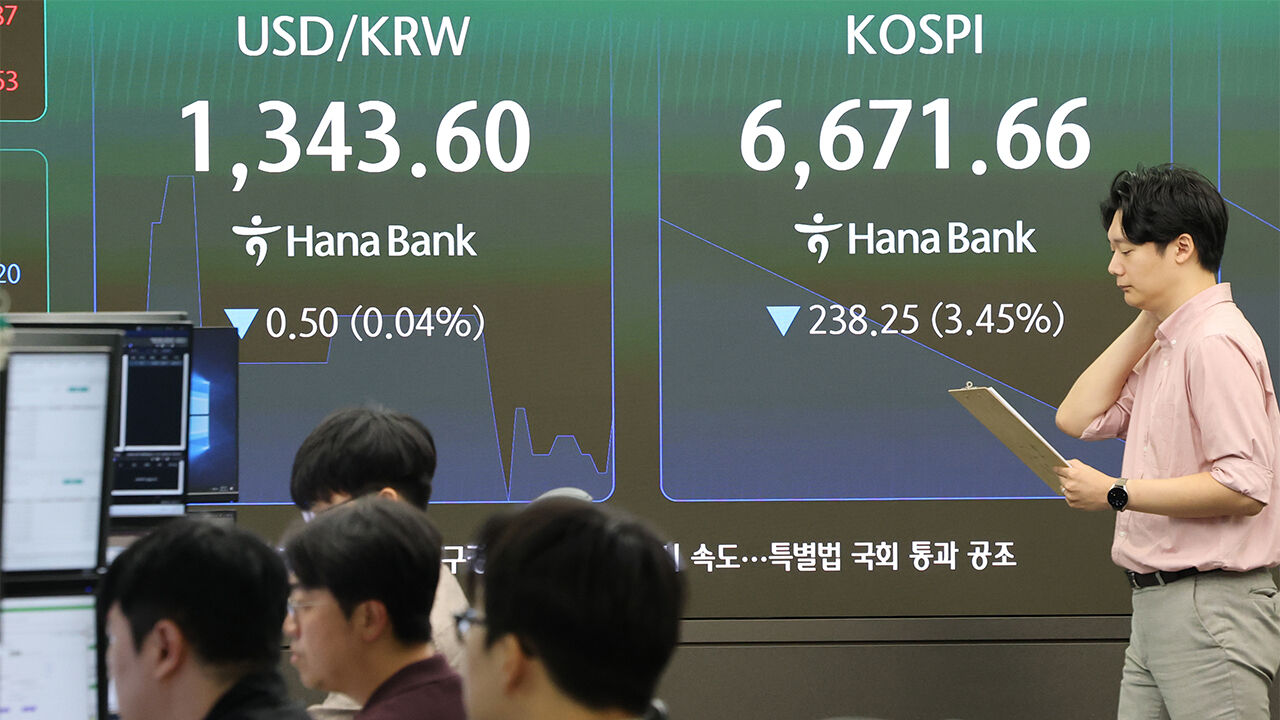
▲ Employees work at the dealing room of Hana Bank headquarters in Jung-gu, Seoul, on the 14th. The KOSPI opened more than 3% lower and slipped to the 6,600 range in early trading. As of 9:02 AM, the KOSPI stood at 6,677.23, down 232.68 points (3.37%) from the previous session.
The total market capitalization of South Korea's stock market has decreased by approximately 210 trillion won over the past month.
According to the Korea Exchange and Koscom Check on the 14th, the combined market capitalization of the KOSPI and KOSDAQ markets stood at 6,022 trillion 230 billion won as of 11:40 AM today.
The KOSPI market capitalization recorded 5,567 trillion 110 billion won, while the KOSDAQ market recorded 455 trillion 1120 billion won.
Compared to a month ago on August 14, when it was 6,234 trillion 778 billion won, this represents a decrease of 212 trillion 555 billion won (3.41%).
Compared to two months ago on July 14, it also decreased by 34 trillion 910 billion won (0.58%), and compared to June 22, when the KOSPI was surging toward an all-time high, a massive 1,971 trillion 173 billion won (24.66%) has vanished.
Until just a few months ago, the size of the domestic stock market expanded sharply.
The combined market capitalization of the KOSPI and KOSDAQ surpassed 6,000 trillion won for the first time in history on April 27, and then broke through 7,000 trillion won just 8 trading days later on May 11.
In June, it even briefly exceeded 8,000 trillion won during intraday trading.
The indexes followed the same trajectory.
The KOSPI started the year at the 4,000-point mark (KOSPI 4,000), broke through the 5,000-point mark for the first time in January, and then surpassed the 6,000-point mark in February.
After slowing down due to the aftermath of the US-Iran war, it quickly broke through the 7,000-point and 8,000-point marks in May, driven by a semiconductor-led rally.
After breaking through even the 9,000-point mark last June, it recorded an all-time intraday high of 9,385.59.
However, the atmosphere changed abruptly entering July.
The KOSPI experienced a record-breaking plunge, tumbling 22.19% throughout the month of July.
The index, which once exceeded the 9,000 line, plummeted as low as 5,262.77 in July.
Since then, while the KOSPI has recovered significantly from its lows, it has been fluctuating between the 6,000 and 7,000 ranges, struggling to establish a clear direction.
Market capitalization has likewise hovered around the 6,000 trillion won mark in line with this trend.
Although the domestic market capitalization remains up by 51.17%, or 2,038 trillion 457 billion won, since the beginning of the year, its size—which had ballooned to 8,000 trillion won just three months ago—appears to be struggling to settle as it fluctuates around the 6,000 trillion won level recently.
The sluggish performance of Samsung Electronics and SK Hynix, which account for a large portion of the domestic market capitalization, is particularly noticeable.
The market capitalization of both stocks, which once exceeded 2,000 trillion won, has now dropped back into the 1,000 trillion won range.
As of this time, Samsung Electronics' market capitalization stands at 1,482 trillion 31 billion won, a 30% drop compared to when it swelled to 2,119 trillion 275 billion won on June 18.
SK Hynix's market capitalization stands at 1,263 trillion 751 billion won today, which is also a 39% decrease compared to its peak of 2,080 trillion 378 billion won reached on June 22.
Recently, the domestic stock market has been sensitive to external variables such as concerns over prolonged high interest rates, rising international oil prices, geopolitical uncertainties, and a strong won.
Even when military tensions in the Middle East escalated in earnest starting last March and international oil prices surged, the KOSPI only fluctuated initially and maintained an upward trend after May, propelled by the semiconductor rally.
However, uncertainties related to semiconductors have recently been added, making it difficult to offset macroeconomic pressures solely through sector momentum as before.
Foreign supply and demand are also cited as core variables that will determine the future direction of the index.
(Photo: Yonhap News)
※ Please note: This article was translated by AI and may contain errors.



 Video News

![[자막뉴스] "피 토하고 폐 비대" 충격 결과…숨기고 승인해 93명 '생체 실험'](http://img.sbs.co.kr/newimg/news/20260914/202222078_300.jpg) Video News
Video News
 Video News
 Video News