
 KOR
KOR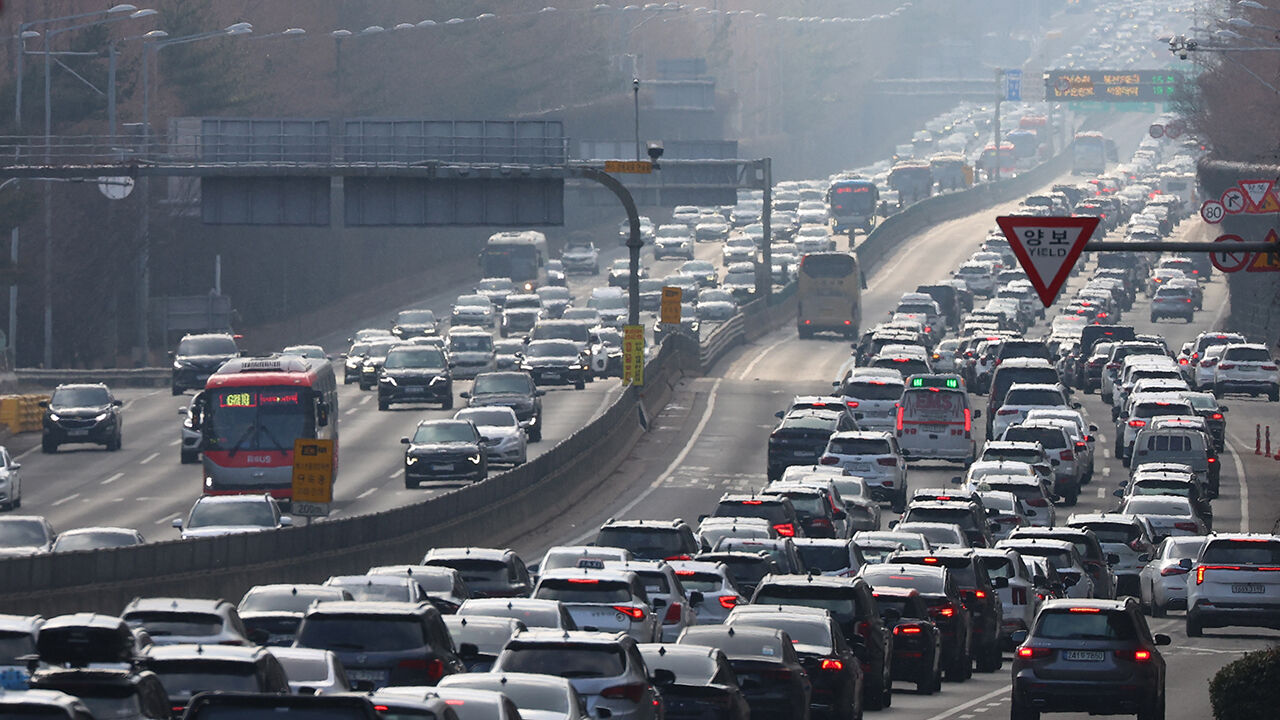
▲ Near Jamwon IC on the Gyeongbu Expressway in Seocho-gu, known for heavy traffic congestion in Seoul
A project to construct a 7.65-kilometer deep underground road stretching from the Gyeongbu Expressway in Yangjae-dong to the Olympic Expressway in Jamwon-dong, Seocho-gu—a chronically congested area in Seoul—is being pushed forward in earnest.
The plan aims to build a two-lane underground road with separated inbound and outbound lines to distribute traffic from the existing Gyeongbu Expressway and alleviate chronic traffic congestion in the region, with a goal of breaking ground in 2028.
The Seoul Metropolitan Government announced on the 10th that it has released the draft strategic environmental impact assessment for the Yangjae-Olympic Expressway underground road private investment project and will hold a public inspection until the 16th of next month.
The core of this project is to construct two underground roadways—inbound and outbound—spanning a 7.65-kilometer section from near Yangjae-dong, where the Gyeongbu Expressway ends and falls under Seoul's jurisdiction, to near the Olympic Expressway in Jamwon-dong.
According to the draft, the road width will be 9.25 meters, and a plan was proposed to excavate two-lane small-car-only roads in each direction.
The design speed is 90 kilometers per hour.
Regarding the specific route, the inbound line is structured to head north running parallel to the right side of the Gyeongbu Expressway, following the underground path of Gangnam-daero to connect with the Olympic Expressway near Hannam IC.
Gangnam-daero is a road connecting Yangjae Citizen's Forest Station, Yangjae Station, Gangnam Station, Sinnonhyeon Station, Nonhyeon Station, Sinsa Station, and Hannam IC, serving as one of the central axes of Gangnam's road network.
The outbound line is structured to enter the underground of Seochojungang-ro near Banpo Bridge on the Olympic Expressway, pass through areas such as Seoul National University of Education Station and Nambu Terminal Station, and exit near Samchongyo to connect with the existing road network.
The plan includes 10 access facilities: 2 on the Gyeongbu Expressway, 4 on the Olympic Expressway, and 4 on downtown roads.
Three vertical shafts, one tunnel management office, and one integrated operation management office are also planned.
The total length of the tunnels, combining the underground road mainlines and connecting roads, is 18.888 kilometers.
While reviewing the routes, the Seoul Metropolitan Government compared the current option (Option 1), which utilizes the underground spaces of Gangnam-daero and Seochojungang-ro, with an option passing directly beneath the existing Gyeongbu Expressway (Option 2), and concluded that Option 1 is suitable.
In the assessment report, the current option was highlighted for its advantages: it allows bidirectional tunnels to be constructed separately, distributing vibration loads during construction, and places tunnel entrances as far away from major residential areas as possible.
It was also evaluated as advantageous for bypassing major protected areas such as the Umyeonsan Wildlife Protection Area and distributing downtown traffic in the Gangnam area through the establishment of Citizen's Forest IC and Banpo IC.
Construction costs at the time of review were also analyzed to be approximately 1.0546 trillion won for the currently adopted option, which is lower than 1.3432 trillion won for Option 2 passing directly beneath the existing road.
The Seoul Metropolitan Government expects that the opening of the underground road will alleviate chronic traffic congestion on the Gyeongbu Expressway and produce the effect of dispersing surrounding road congestion.
The possibility of utilizing the space of the surface-level Gyeongbu Expressway and creating green areas was also presented as a major reason for promoting the project.
However, it is predicted that there will also be living environment impacts such as noise during the large-scale tunnel construction.
In response, the city stated that if deterioration of the surrounding environment is a concern, separate additional environmental conservation measures will be devised and implemented.
This project will be promoted through a Build-Transfer-Operate (BTO) private investment method, where a private entity constructs the facility, transfers ownership to the Seoul Metropolitan Government, and recovers investment costs by operating it for a certain period.
The construction period is planned for 66 months after commencement, and the private operation period after completion is planned for 40 years.
The total project cost is 1.1053 trillion won.
Among this, the construction cost is estimated at 949.1 billion won.
The Seoul Metropolitan Government will publicly inspect the draft strategic environmental impact assessment until the 16th of next month and receive resident opinions for one week following the end of the inspection.
Subsequently, resident briefing sessions will be held in Gwacheon on the 17th of this month, Seocho-gu on the 29th of this month, and Gangnam-gu on the 1st of next month, respectively.
An official from the Seoul Metropolitan Government said, "After completing the public inspection, we expect that construction can begin as early as 2028 through various procedures such as eligibility investigations and selection of preferred bidders," adding, "We will manage the project so that it proceeds substantially."
(Photo: Yonhap News)
※ Please note: This article was translated by AI and may contain errors.



 Video News


![Killed Friend with Dozens of Stab Wounds, But Claims "I Don't Remember" in Trial... What Was Jeong Jae-hwan's Intent? [Ranking News]](http://img.sbs.co.kr/newimg/news/20260911/202221563_300.jpg) Video News
Video News