
 KOR
KOR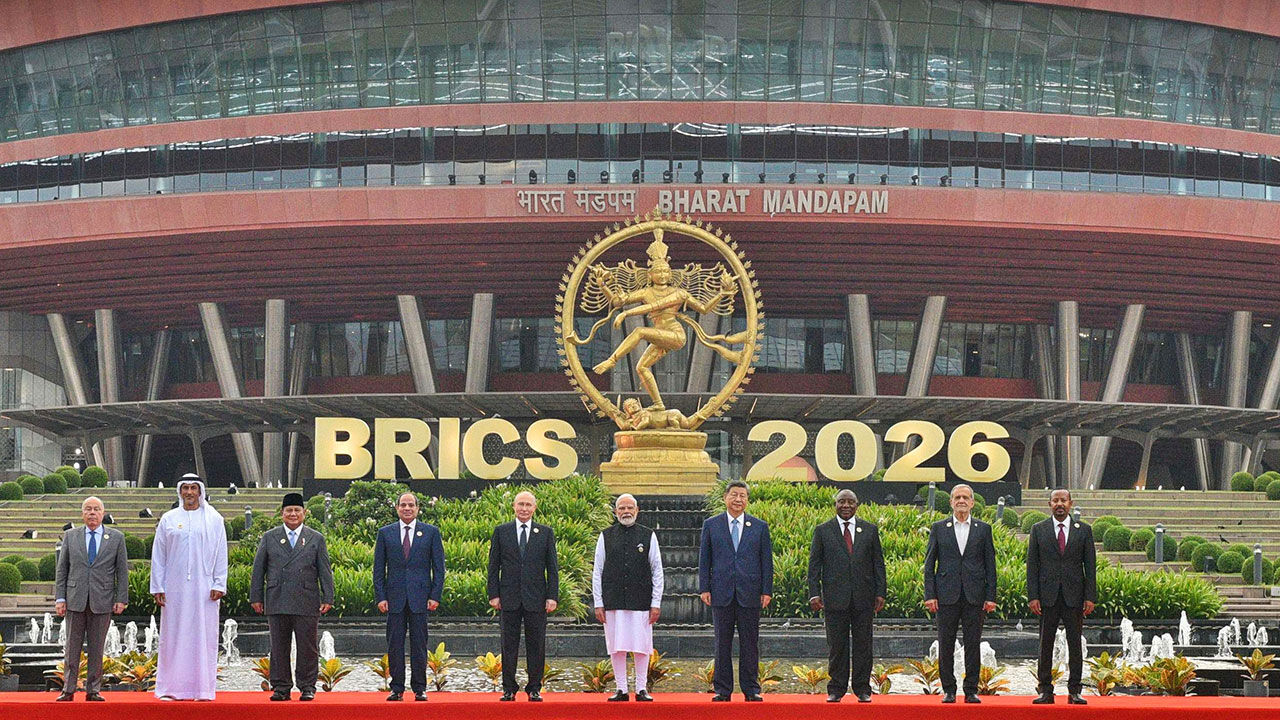
▲ BRICS leaders gathered together
Leaders of BRICS, a grouping of non-Western emerging economies led by China and Russia, have opposed unilateral sanctions that violate international law and called for restraint in the Middle East conflict.
According to foreign media reports including Russia's RIA Novosti and Reuters on the 12th (local time), Indian Prime Minister Narendra Modi announced that BRICS member states adopted a joint declaration at the 18th summit held in the Indian capital of New Delhi.
"The New Delhi Declaration has been adopted by consensus," Prime Minister Modi said, adding that "the joint declaration contains clear guidelines on the direction our efforts should take."
He repeatedly emphasized, "No member state raised any objections," and "The 2026 New Delhi Declaration was adopted unanimously."
In their joint statement, BRICS leaders stated their opposition to unilateral sanctions violating international law and urged restraint in the Middle East.
This is interpreted as targeting the United States, which has been engaged in a war with Iran since late February.
The BRICS leaders also expressed concern over the rising global risk of nuclear threats and conflicts.
Furthermore, emphasizing the need to strengthen energy security and ensure smooth energy supplies, they expressed serious concern over the increasing use of unilateral tariff and non-tariff measures that distort trade and violate World Trade Organization (WTO) rules.
Earlier at the opening session of the summit, Prime Minister Modi urged other member states to draw up an implementation plan containing 10 proposals to reform the global cooperation architecture by the next summit.
"The current global cooperation architecture is like a pyramid," he explained, stating, "Power and decision-making authority are concentrated at the apex, while countries that are affected by these decisions but unable to influence them are at the base."
Prime Minister Modi stressed that this implementation plan should be built around three pillars—representativeness, responsiveness, and rule-making—to increase the weight of emerging economies within international organizations.
He also argued that "reforming the United Nations Security Council can no longer be delayed."
Russian President Vladimir Putin similarly called for the expansion of the UN Security Council to include nations of the Global South (emerging and developing countries primarily in the Southern Hemisphere).
"We believe it is necessary to continue working with like-minded BRICS member states to improve the quality of the UN's work," he said, adding, "Naturally, expanding the Security Council, particularly by increasing the representation of Asian, African, and Latin American countries, will help achieve this."
"Today, nations of the Global South are on the front lines of global crises, yet they are left behind in the decision-making process," Prime Minister Modi urged. "The pyramid of privilege must be transformed into a platform for cooperation."
Chinese President Xi Jinping, President Putin, and other major country leaders all attended the opening session of the summit.
Prime Minister Modi, President Xi, and President Putin had an informal conversation while moving between events, RIA Novosti reported.
The three leaders reportedly shook hands, exchanged greetings, and talked briefly on the sidelines of the summit.
(Photo: AP, Yonhap News)
※ Please note: This article was translated by AI and may contain errors.



 Video News
 Video News
 Video News
 Video News
 Video News