
 KOR
KOR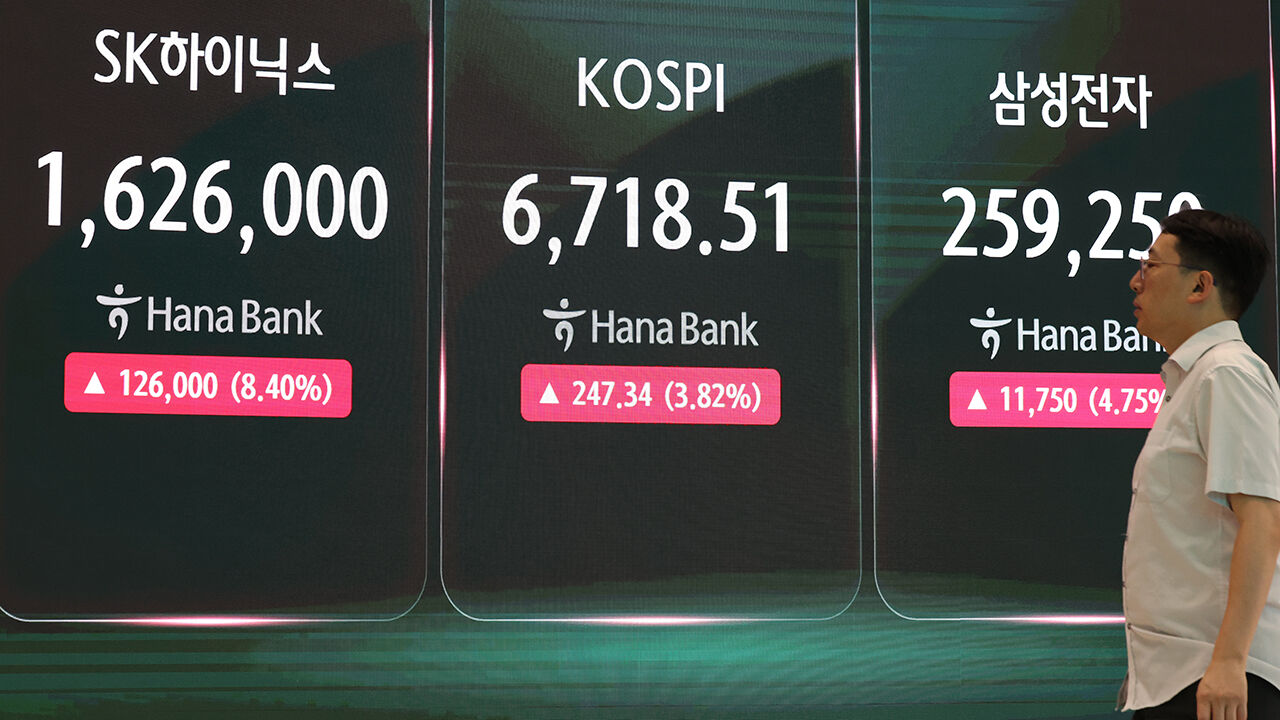
▲ People look at stock market index screens at the headquarters of Hana Bank in Jung-gu, Seoul, on the 10th.
The Bank of Korea (BOK) has assessed that investments in leverage exchange-traded funds (ETFs) have influenced the expansion of domestic stock price volatility.
In its monetary and credit policy report released today (the 10th), the BOK stated, "The surge in leverage ETF investments, driven by expectations of a trend-like stock price increase, acted as a factor amplifying stock price volatility from a supply and demand perspective."
It added, "Even in the international financial market, the expansion of leverage investments targeting domestic stocks led to unexpected ripple effects, such as an increase in domestic spot and futures transactions for hedging purposes."
This is interpreted as a somewhat shifted stance from the BOK's Financial Stability Report released last June, where it mentioned regarding single-stock leverage ETFs that "considering the current market capitalization and trading share of underlying assets, the impact on the market is limited."
However, the latest report also did not present more detailed analyses or evaluations regarding single-stock leverage ETFs.
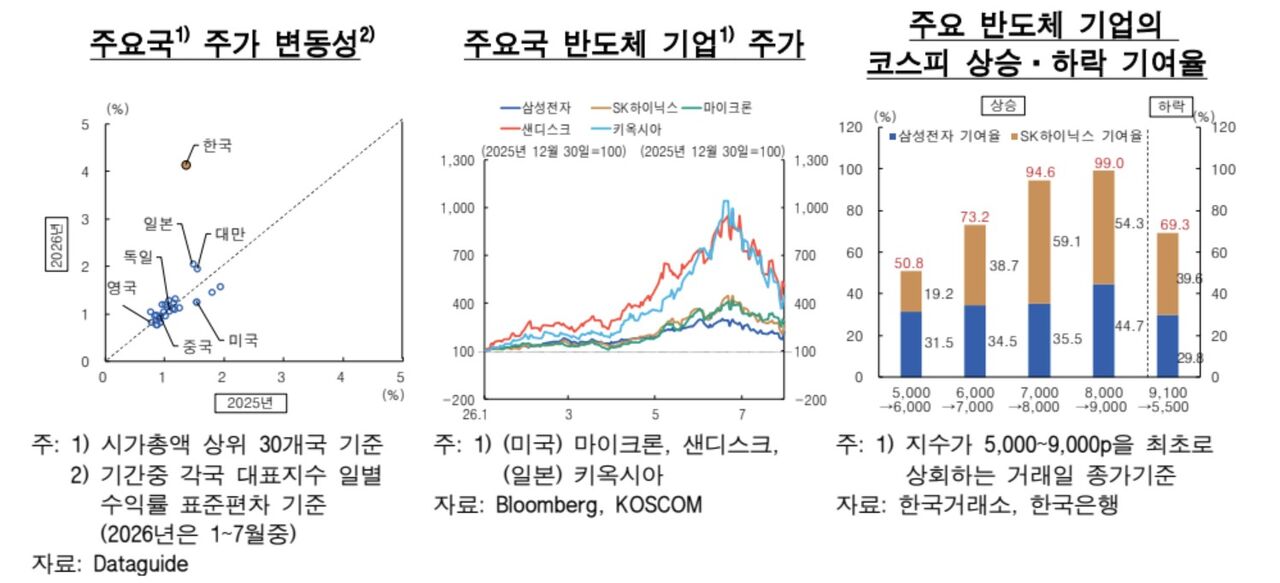
The BOK pointed out that the relatively sharp rise in the stock prices of a small number of semiconductor companies, such as Samsung Electronics and SK Hynix, increased overall stock price volatility.
It noted that while stock price sensitivity to changes in memory semiconductor industry forecasts increased, KOSPI also experienced a sharp correction as semiconductor company stock prices plunged after June.
For example, when the KOSPI soared from 8,000 to 9,000, the total contribution rate of Samsung Electronics and SK Hynix to the index rise was estimated to have reached 99.0%.
Samsung Electronics accounted for 44.7% and SK Hynix for 54.3%.
Conversely, when the KOSPI plummeted from 9,100 to 5,500, the downward contribution rate of Samsung Electronics (29.8%) and SK Hynix (39.6%) was relatively high at 69.3%.
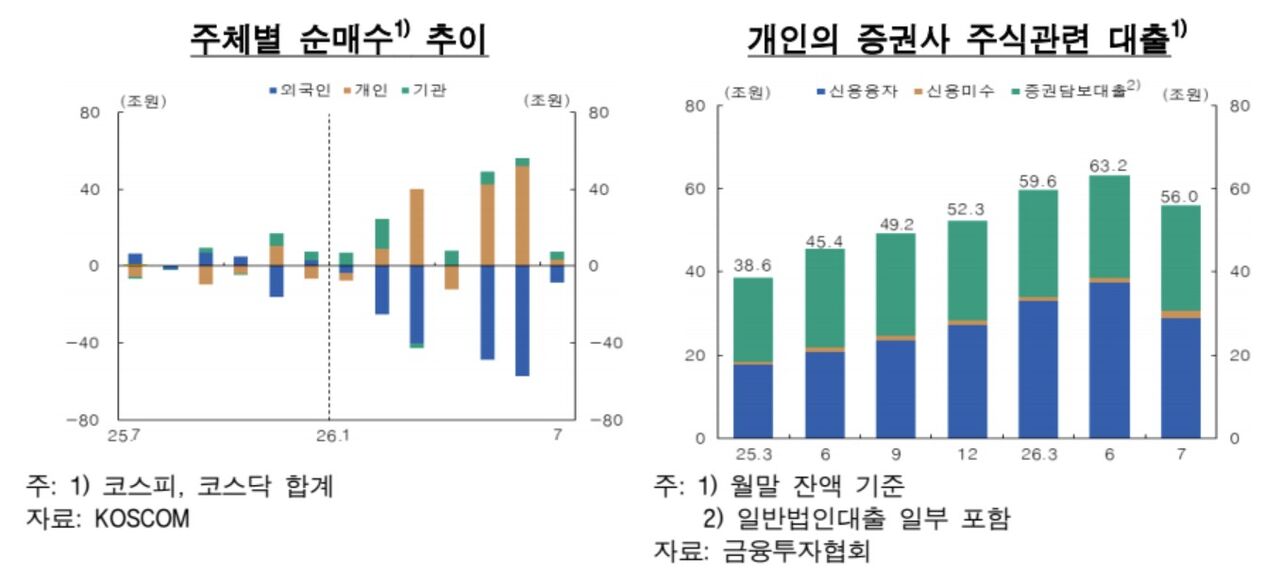
Large-scale technical selling by foreigners for profit-taking and portfolio rebalancing also brought about a deterioration in supply and demand conditions.
In addition, individual investors' debt-financed stock investments expanded to a record high level and then were liquidated, amplifying both upward and downward stock price movements.
The BOK suggested, "In the short term, we must strengthen monitoring of leverage ETFs and stock investments through borrowing, and in the medium to long term, enhance market resilience by improving the capital market structure, such as easing market concentration by specific industries and companies, and expanding the investor base."
Park Chong-woo, Deputy Governor of the BOK, said in a briefing that day, "We view that expectations for the memory semiconductor industry conditions had the greatest impact on stock price volatility."
He added, "Although the scale of leverage ETFs has decreased, it is not a situation to be complacent about, and we maintain our stance that continuous monitoring is required."
(Photo: Provided by BOK, Yonhap News)
※ Please note: This article was translated by AI and may contain errors.




 Video News
 Video News

 Video News