
 KOR
KOR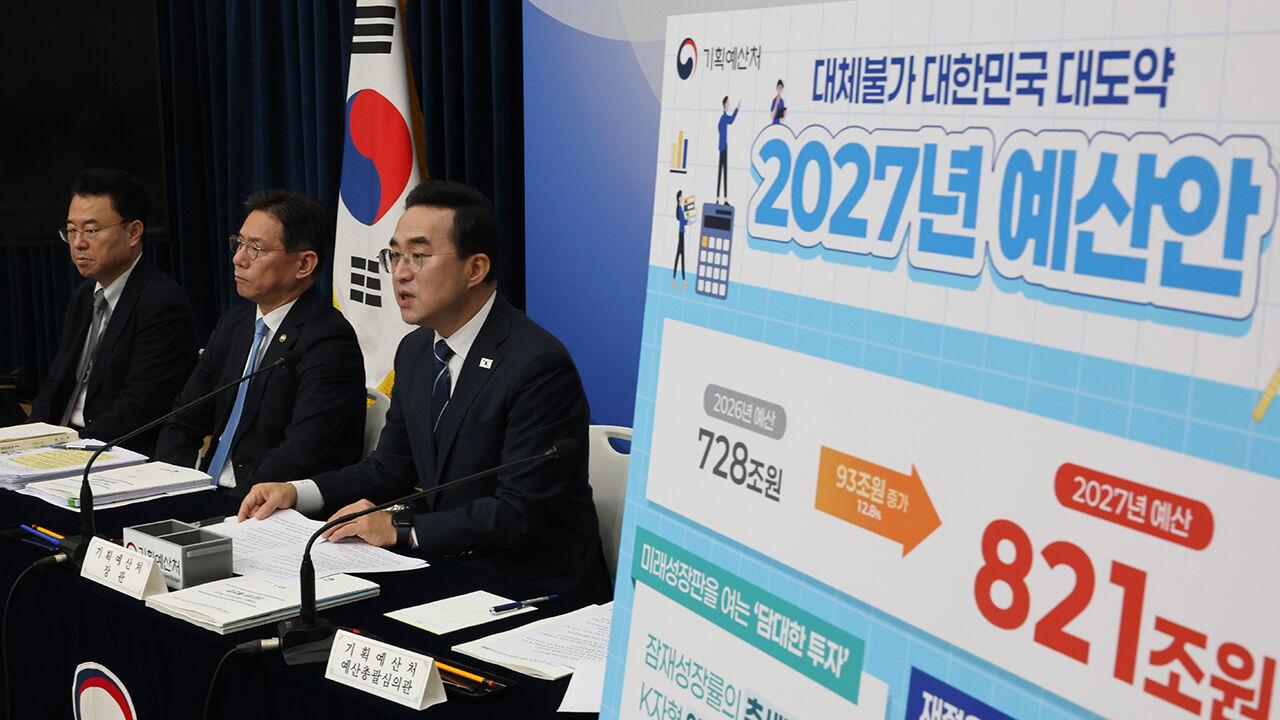
▲ Minister of Planning and Budget Park Hong-keun briefs reporters on the 2027 budget and the 2026–2030 national fiscal management plan at the Government Complex Sejong in Sejong City on August 28. From left: Kang Young-gyu, Director-General for Future Strategy Planning; Vice Minister Cho Yong-beom; and Minister Park Hong-keun.
Addressing government projections that deficit-covering debt will surge to the 1,300 trillion won range by 2030, Minister of Planning and Budget Park Hong-keun stated today (the 9th) that it is "fully manageable over the medium to long term."
Appearing on SBS Radio's "Kim Tae-hyun's Political Show" this morning, Minister Park remarked, "When it comes to debt, looking solely at the immediate scale or accumulation speed misses the point; what matters more is whether we have the capacity to service it."
In formulating next year's budget, the government estimated that deficit-covering debt will reach 1,117.1 trillion won in 2027 and steadily climb to 1,312.3 trillion won by 2030.
Minister Park emphasized that South Korea's general government debt (D2) stands at 54.4 percent of GDP, which is "about half" of the International Monetary Fund (IMF) advanced economy average of 108.2 percent.
He added, "Ultimately, the ratio of national debt depends on the growth of GDP, the denominator. Nominal GDP growth for this year alone was officially projected at 12.3 percent, and there is even the possibility of it going higher. Expanding our GDP is a critical issue."
Regarding opposition concerns that the 162 trillion won Future Response Fund—to be established using additional tax revenues—might be utilized as pork-barrel spending ahead of elections, Minister Park explained, "If we use all [additional revenues] merely to pay down debt, we will not have the funds required to make proper investments when the time comes," noting that efforts were made to strike a balance between economic growth and fiscal soundness.
"An AI super-gap technology hegemony war has begun, and we must make proper investments over these next two to three years to redesign our economic and social systems," he said, adding, "We need to break past the limitations of single-year, general-account-centric budgeting systems where we spend more when we earn more and less when we earn less."
Minister Park stressed that provisions in the bill allowing the Future Response Fund to be used for projects stipulated by Presidential Decree serve as "complementary safeguards to respond flexibly and agilely to urgent fiscal demands."
Citing an example where a new technology suddenly emerges, he explained, "It does not mean we cannot act simply because it is not specified in the law; rather, it means we will submit a project plan to the National Assembly, state that we intend to pursue such a project, and proceed upon receiving approval."
(Photo: Yonhap News)
※ Please note: This article was translated by AI and may contain errors.



 Video News
 Video News

 Video News
 Video News