
 KOR
KOR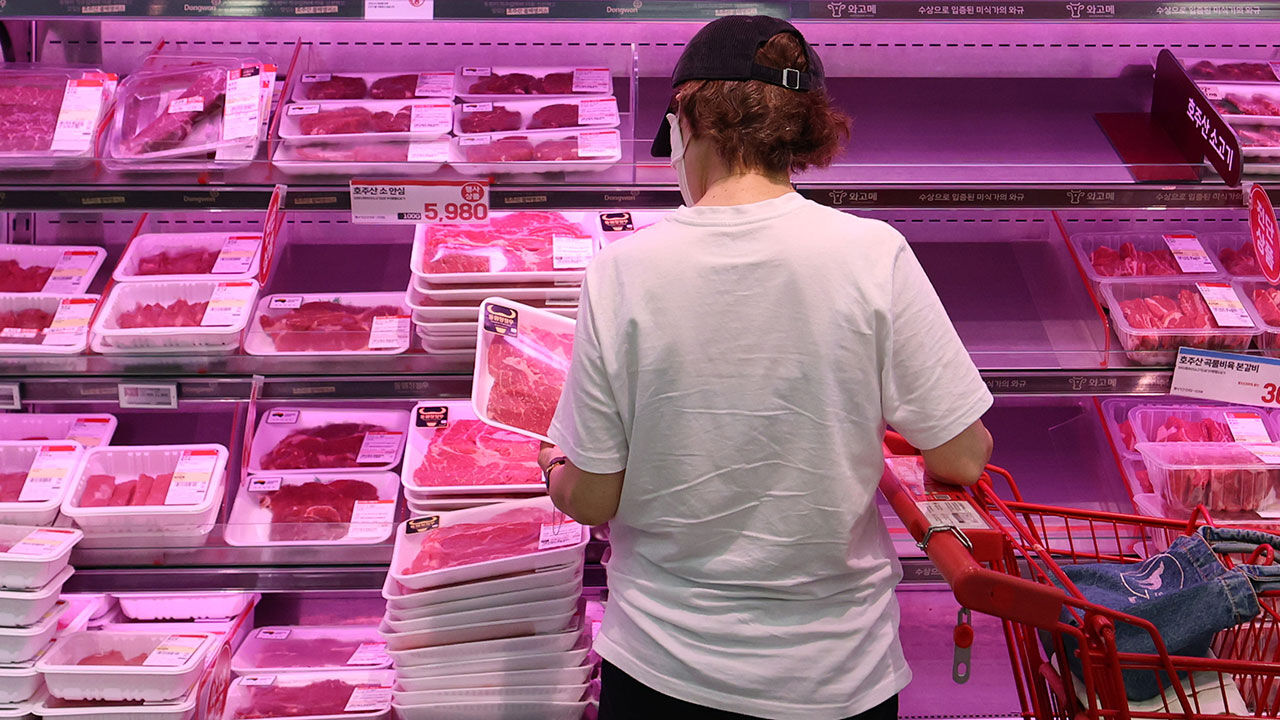
▲ A livestock product section at a large supermarket in Seoul
Consumer burdens are growing as livestock product prices maintain an upward trend ahead of the Chuseok holiday.
In particular, consumer prices for Hanwoo (Korean beef), which sees high holiday demand, have risen by around 20% compared to last year due to a combination of supply shortages from reduced cattle herds and peak Chuseok seasonal demand.
According to the Korea Rural Economic Institute (KREI) Agricultural Outlook Center on the 6th, the wholesale price of Hanwoo this year is projected to be around 22,500 won per kilogram, up 14.5% from the previous year.
In the fourth quarter, the wholesale price of Hanwoo is expected to stay at the 22,500 won per kilogram level, remaining 5.8% and 13.5% higher than last year and an average year, respectively.
KREI projected that the wholesale price of Hanwoo during the Chuseok peak season will also rise by 14.3% to 19.0% compared to last year, reaching 24,000 to 25,000 won per kilogram.
Consumer prices have also risen sharply.
According to period-specific price data from the Korea Institute for Animal Products Quality Evaluation, the consumer price of Hanwoo tenderloin stood at 15,308 won per 100 grams as of the 4th, representing a 19.9% increase from the same period last year.
Sirloin prices jumped by 22.6%, and brisket, mainly used for jangjorim (braised beef), rose by 17.7%.
The primary driver behind the rise in Hanwoo prices is the decrease in supply.
As Hanwoo prices plummeted several years ago, the number of cattle raised has continued to decline, leading to reductions in shipments and slaughter volumes.
Additionally, rising feed costs driven by higher international grain prices have also contributed to the price increases.
The number of Hanwoo slaughtered this year is 864,000 head, down 8.8% and 5.0% from the previous year and an average year, respectively.
The slaughter volume for the fourth quarter is also expected to be 178,000 head, 14.1% lower than the same period last year.
The downward trend in slaughter numbers is expected to continue for the time being.
According to KREI, the number of Hanwoo slaughtered next year will decrease by 4.1% from this year to 828,000 head, and a similar trend is projected to continue in 2028 at around 827,000 head.
An official from the Ministry of Agriculture, Food and Rural Affairs (MAFRA) said, "Due to the continuous decline in the number of cattle raised, this year's herd size is at its lowest level," adding, "It will not be until late 2027 or early 2028 that the herd size recovers to average levels, and an increase in the number of cattle raised is expected only by 2029."

Imported beef prices are also on an upward trajectory.
As Hanwoo prices rose, demand shifted toward relatively cheaper imported beef, while a decline in U.S. beef export volumes also acted as a factor pushing up prices.
The price of U.S. chilled chuck eye roll stood at 4,019 won per 100 grams, 20.1% higher than the same period last year.
Pork prices have stabilized compared to the beginning of the year when they surged significantly due to factors such as African Swine Fever (ASF), but they still remain high compared to last year.
The wholesale price of pork this year is expected to rise by 2.4% from last year to 5,800 to 6,000 won per kilogram, driven by factors such as a reduction in slaughter volume.
As of the 4th, the consumer price of pork belly (samgyeopsal) was 2,862 won per 100 grams, up 1.6% from last year.
Prices for pork shoulder butt and front leg meat are also maintaining higher levels than last year.
Although farm-gate prices for eggs are falling due to a recovery in production, consumer prices remain at elevated levels.
As of the 4th, the average consumer price for a tray of 30 eggs was 7,199 won, 3.7% higher than the same period last year.
Looking at annual average prices, the consumer price for a tray of 30 eggs rose from 6,562 won in 2024 to 6,789 won last year, and has recorded around 7,146 won so far this year.
An official from MAFRA stated, "Farm-gate prices are gradually declining as production has recovered starting last month," but noted, "However, as egg consumption has also increased, it will take some time for this to be reflected in consumer prices."
To stabilize egg prices, MAFRA plans to continue supplying imported fresh eggs until the Chuseok peak season and will consider additional imports depending on domestic price trends thereafter.
The government plans to stabilize prices ahead of the Chuseok peak season by increasing the supply of livestock products.
It will supply 22,000 tons of beef and 67,000 tons of pork, which is a record-high level.
For eggs, 4,900 tons—2.4 times the usual volume—are scheduled to be supplied.
(Photo: Yonhap News)
※ Please note: This article was translated by AI and may contain errors.




 Video News
 Video News
 Video News
 Video News