
 KOR
KOR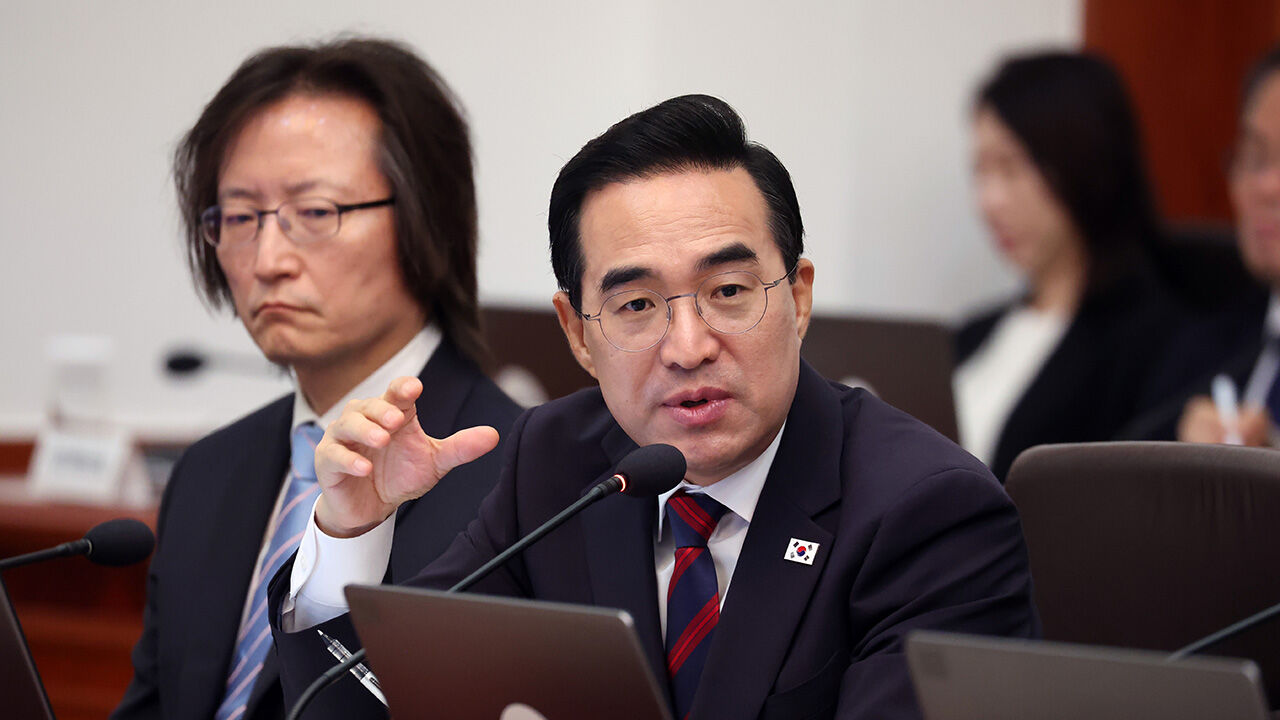
▲ Minister of Planning and Budget Park Hong-keun reports on the 2027 budget and the 2026–2030 National Fiscal Management Plan during a Cabinet meeting presided over by President Lee Jae-myung at the Blue House on the 1st.
Minister of Planning and Budget Park Hong-keun said today (the 1st) that the government's budget proposal for next year, approved at the Cabinet meeting, "simultaneously pursues the dual pillars of economic growth and fiscal soundness."
Speaking at a preliminary briefing held at the Government Complex-Sejong on August 28, Minister Park noted, "The 2027 budget plan is a fiscal plan that serves as a historical turning point by innovating the paradigm of fiscal management, making bold investments for the future, and boldly reforming outdated structures that no longer fit social changes."
In particular, he explained that the Future Response Fund, newly created on a scale of 162.3 trillion won (based on 2027 revenues) utilizing "additional tax revenues," is "a strategic investment platform to utilize massive tax revenues for productive expenditures and a fiscal stabilization device to enhance the efficiency of fiscal management."
Emphasizing the core focus of the new fiscal management system to be established moving forward, he stated, "Ultimately, the most fundamental and essential goal is how to build a growth-led fiscal virtuous cycle system," adding, "The Future Response Fund will intensively invest in four specific areas."
He went on to stress the necessity of a fiscal stabilization function, saying, "We must correct the flawed structure where tax revenues flowing in heavily during boom periods lead to temporary expansions in spending, or sluggish tax revenues during recessions lead to contractionary fiscal policies and economic slumps."
Regarding concerns that the government's choice of expansionary fiscal management while the Bank of Korea raises interest rates and moves toward monetary tightening is "out of sync," Minister Park asked observers to pay attention to whether the budget proposal places more emphasis on stimulating aggregate demand or expanding aggregate supply.
While acknowledging that there are aspects stimulating aggregate demand due to customized support for vulnerable groups and people's livelihoods, he said, "We have clearly made larger investments in how to rebound the potential growth rate—in other words, how to expand aggregate supply. We made sure to invest in increasing the overall capacity for economic growth."
"Ultimately, this goes hand in hand with the mid- to long-term goal of price stability," Minister Park added, noting, "The Bank of Korea Governor himself has mentioned that if our fiscal policy is an investment that enhances growth potential, it is by no means out of sync with monetary policy."
Diagnosing that the South Korean economy is standing at "a crossroads where structural low growth could become entrenched due to a shrinking working-age population and stagnant productivity," he suggested the direction that "we must connect the momentum of recovery to a trend rebound in the potential growth rate."
To achieve this, he introduced priority investment areas, stating that the government will provide all-out support for the three mega projects and artificial intelligence (AI), while intensively nurturing ultra-gap industries, including seven national strategic core technologies that will lead South Korea's future growth such as nuclear fusion, small modular reactors (SMRs), quantum technology, aerospace, and advanced biotechnology.
Minister Park promised, "We will significantly expand projects applying the principle of preferential treatment for regional areas, establish a super-region special account to support the 5-pole 3-special system, and expand comprehensive block grants that local governments can autonomously allocate." He also pledged to seamlessly implement the administrative integration incentives for Jeonnam and Gwangju, which the government previously announced at 5 trillion won annually and up to 20 trillion won over four years.
"At a time when alleviating K-shaped polarization—overcoming the difficulties of vulnerable groups such as young people and small business owners in the shadow of growth and spreading the warmth of growth across all generations, regions, and classes—is more desperate than ever," Park stated, adding that the budget proposal also contains measures to ensure the benefits of growth are shared equitably.
He noted that the budget was compiled so that next year's total expenditures would increase by a record-high 12.8% to reach 820.9 trillion won. However, due to a semiconductor boom, national tax revenues are projected to reach 584.4 trillion won, bringing the managed fiscal deficit relative to gross domestic product (GDP) down to the -0.1% range, a 3.8 percentage point (p) drop from this year.
Attaching significance to the plan, Minister Park remarked, "Even with the largest fiscal expenditure on record, the managed fiscal deficit over the past 20 years is the most favorable, meaning next year's budget achieves the dual goals of driving economic growth and enhancing fiscal soundness simultaneously. It is a symbolic and historic moment of catching two rabbits at once."
(Photo: Yonhap News)
※ Please note: This article was translated by AI and may contain errors.




 Video News


 Video News