
 KOR
KOR
A ruling recognizing a delivery rider as an employee under South Korea's Labor Standards Act was recently finalized. ( ☞ [Reporter's Notebook] First Final Ruling on Employee Status of Delivery Rider… 'Platform Control' Made the Difference) This ruling does not mean all platform workers are immediately recognized as employees, as it was a judgment based on the specific working relationship between a particular company and an individual rider. However, what the court examined in this decision is clear: rather than merely looking at whether a contract labels the relationship as an 'independent contractor' or 'self-employed,' courts must examine how the company actually assigned tasks, set compensation, and intervened in the execution of work.
The issue lies in what comes next. For a worker to claim they were "controlled by the platform," evidence demonstrating how they actually worked is required. However, materials that can show how the app assigned orders, evaluated performance, or imposed account restrictions and penalties are mostly held inside the platform itself. It is difficult for workers to obtain this information. Ultimately, the principle of "looking at the actual working relationship" leads to the question: "Who should prove that reality, and with what evidence?" Overseas jurisdictions have grappled with similar dilemmas.
The EU Asked 'Who Should Prove It'

Through its Platform Work Directive in 2024, the European Union established that focus should be placed on how work is actually performed rather than the status stated in a contract. It also mandated considering whether automated monitoring or decision-making systems were utilized. Most notably, if facts indicating platform direction and control are established in accordance with national laws, collective agreements, or practices, an employment relationship is legally presumed to exist. Here, "presumption" does not mean all platform workers are immediately classified as employees. Once facts demonstrating platform direction and control are found, the burden shifts to the platform to prove that an employment relationship does not exist, easing the burden on workers who previously had to prove every single fact.¹
What, then, specifically constitutes platform 'control'? Foreign courts have examined the extent to which platforms dictate prices, terms, evaluations, and sanctions during the actual working process after the app is turned on. Key examples include the Uber case in the United Kingdom and the Glovo case in Spain.
In the Uber case decided by the UK Supreme Court in 2021, there were elements that could suggest drivers were independent contractors. Drivers were labeled as independent contractors under their agreements and could decide when to log on to the app. However, circumstances changed once they logged on and began working. Uber set the fares and contractual terms, while also monitoring ride acceptance rates and passenger ratings. Drivers could receive warnings or be logged off the app for a set period if their acceptance rate dropped, and their relationship with Uber could be terminated if their ratings remained low. The UK Supreme Court observed how much Uber controlled pricing, contractual terms, and task performance while the app was on, classifying the drivers as "workers" under UK labor law. "Worker" is a broader legal category than "employee," granting rights such as the minimum wage and paid leave.

The Glovo case decided by the Supreme Court of Spain in 2020 followed a similar pattern. Riders used their own motorcycles and mobile phones, selected their working hours on the app, and were able to reject orders. However, the Supreme Court examined how this discretion functioned in practice. Glovo evaluated riders with a score that factored in customer feedback, the efficiency of recent deliveries, and whether they worked during peak hours. Future task assignments and earnings could vary based on these ratings. Furthermore, Glovo determined customer fees, rider compensation, and payment methods. Taking these circumstances together, the Supreme Court ruled that an employment relationship existed between Glovo and the riders.
Shim Jae-jin / Professor at Sogang University Law School
"Delivery companies argue that humans did not give direct orders, but creating and modifying algorithms in itself can serve as a means of control and instruction. How apps and algorithms actually dictate work is a factor to examine when determining subordination, and the recent domestic ruling can be seen in that same context."
The debate goes a step further. If a worker is deemed an employee based on a comprehensive assessment of their actual working relationship, including platform control, they can receive protections under existing labor laws. However, instances where workers are not recognized as employees remain. In other words, when individuals work as independent contractors under contract but platforms determine the conditions of their work, what minimum standards should apply? In the United States, New York and Seattle have addressed this issue through separate regulations.
New York, Seattle, and Australia Defined 'What Must Be Followed'
However, when calculating the aggregate payment across the entire platform, waiting time is not excluded. For instance, if the total trip time for all riders is 700 hours and total waiting time is 300 hours, the platform must pay the collective group of riders an amount equal to or exceeding the combined 1,000 hours multiplied by the minimum pay rate. This does not mean each rider is individually paid an hourly wage for their specific waiting time. While the minimum amount guaranteed to each individual rider is calculated based on trip time, waiting time is factored into the total minimum payout aggregate that the platform as a whole must bear. What is significant in New York's case is that the system institutionalized which hours must be accounted for in pay calculations, even for gig-based piecework.
Seattle established rules governing the process of offering and rejecting work. Platforms must provide necessary details in advance, such as compensation and travel distance, when offering tasks, and they are prohibited from penalizing workers for rejecting offered jobs. Workers can also cancel tasks they have already accepted if there is a valid reason. This is because having 'accept' and 'reject' buttons on an app does not alone guarantee substantive discretion. If workers do not know how much they will earn or how far they must travel, or if rejecting work leads to penalties, it is difficult to freely choose tasks despite having nominal choice. Seattle addressed this by mandating advance information and prohibiting penalties for turning down work.
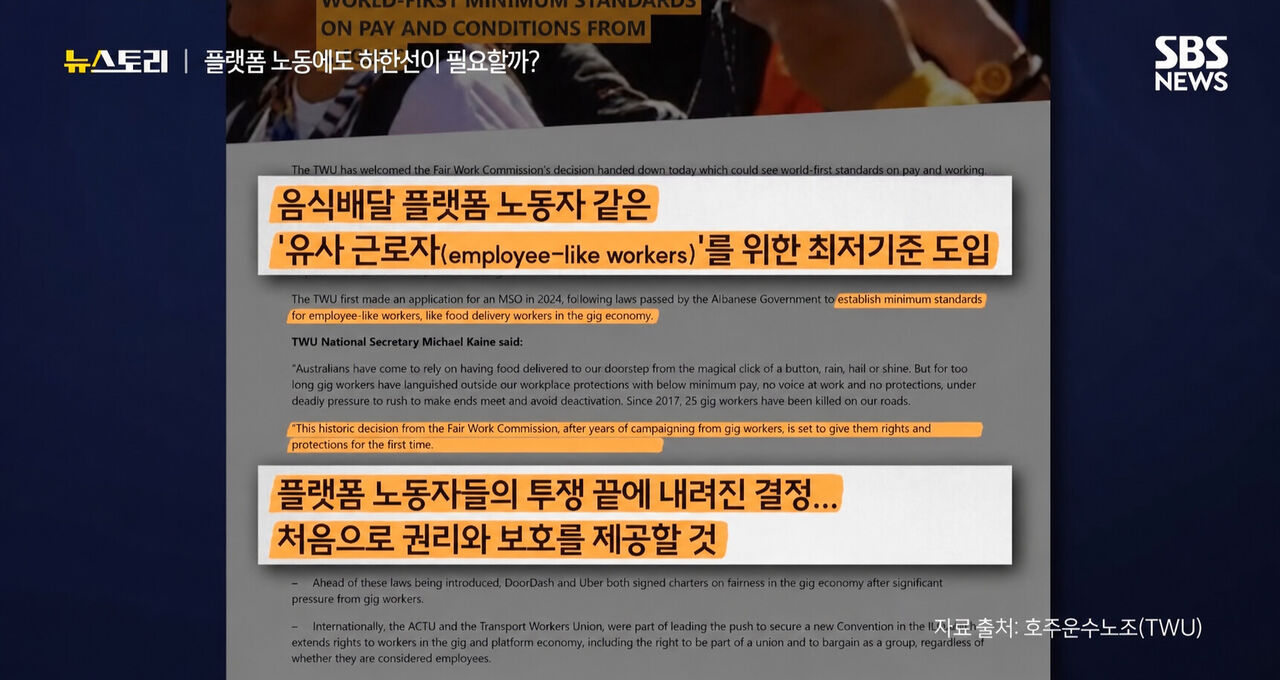
Australia took another approach by creating a distinct legal category: "employee-like workers." Legally, employee-like workers are contractors, not employees. However, not all platform contractors qualify. To be classified as an employee-like worker, an individual must meet at least two criteria among: low bargaining power relative to the platform, pay levels equal to or lower than employees performing comparable work, or low control over when and how work is performed. This category specifically separates contractors who have relatively low independence in their relationship with platforms.
The Fair Work Commission is empowered to set legally binding minimum standards applicable to these employee-like workers. Under this authority, the first minimum standards order for the on-demand delivery sector took effect on August 17, 2026. The standards extend beyond pay to include record-keeping, insurance, information sharing, consultations when altering key working conditions, and dispute resolution procedures. Minimum pay is calculated not based on the total time the app is turned on, but on "engaged time," the time recorded in the app as performing tasks. If the amount actually received during a pay period falls below the minimum amount calculated based on this time, the platform must pay the difference.
This does not convert employee-like workers into standard employees. They remain contractors and decide for themselves which tasks to accept and when. Distinct minimum standards apply to key terms of work such as pay, insurance, and information provision.³ In the end, rather than stopping at determining whether platform workers are employees or not, Australia enabled the application of separate standards that platforms must follow if contractors meet certain criteria.

Jung Heung-jun / Professor of Business Administration at Seoul National University of Science and Technology
"It is difficult for all platform workers to be immediately recognized as wage-earning employees following this domestic ruling. What is ultimately needed are separate protective measures applied to them. Fundamentally, how pay is determined, whether they can work safely, and how their right to be free from discrimination is guaranteed are key issues."
Determining employee status remains important in platform labor. However, solely evaluating contractual titles is insufficient to capture the full reality of dispatching, pay determination, evaluations, and sanctions conducted through apps. While this recent finalized ruling provided the answer that one must look at the substantive working relationship rather than the nominal contract, the remaining question is how to establish the documentation and procedures to verify that reality. Questions also remain for cases where workers are not recognized as employees. Overseas jurisdictions did not leave these situations outside the scope of protection, addressing them through separate standards such as minimum pay, information provision, task choice, and dispute resolution. Ultimately, future debates will center not only on 'who is an employee,' but also on what rules should apply to platform workers who are not employees. (End)

¹ Directive (EU) 2024/2831 of the European Parliament and of the Council on improving working conditions in platform work. It regulates the actual performance of platform work, automated monitoring and decision-making systems, and procedures for legal presumption and rebuttal of employment relationships, with a transposition deadline into member states' domestic laws by December 2, 2026.
² References official materials including the City of New York minimum pay rate for delivery workers and Seattle's App-Based Worker Minimum Payment Ordinance.
³ Fair Work Commission, 'On-Demand Delivery Services Minimum Standards Order,' August 2026.
References
Shim Jae-jin, "Introduction to Overseas Case Law on Platform Work ②: UK Supreme Court Judgment of February 19, 2021," Labor Rights Institute Issue Paper 2022-01, 2022.
Yoon Ae-lim, "A Comparative Legal Review of Supreme Court Precedents on Platform Work and Employee Status," Korean Journal of Labor Law, Vol. 81, Korean Society of Labor Law, 2022.
Jeon Hyeong-woo, "Protection of Platform Workers in the U.S. and the Role of Labor Law: Focused on the Relationship between Local Government Legislation and Federal Law," Master's Thesis, Graduate School of Seoul National University, 2024.
※ Please note: This article was translated by AI and may contain errors.




 Video News
 Video News

 Video News