
 KOR
KOR
[Anchor]
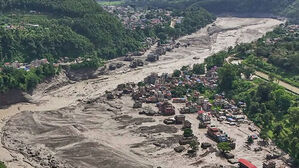
The recent catastrophic flood struck with a mixture of soil, rocks, and even chunks of ice. It was fundamentally different from floods caused by heavy rain alone, and its destructive power is estimated to be more than double.
Reporter Seo Donggyun has the details.
[Reporter]
The scale of the damage in the Nepal flood grew because it was not just water, but a debris flow that swept through.
It is called a debris flow because water is mixed with soil, gravel, and massive chunks of rocks.
In high-altitude regions like Nepal, chunks of ice broken off from glaciers can also get mixed in.
Footage filmed at Illgraben in Switzerland, located in the Alps, shows that the energy of a debris flow is so immense that even giant boulders roll down effortlessly.
A debris flow has a density 1.5 to 2 times greater than ordinary water.
Because it is correspondingly heavier for the same volume, even when colliding at the same speed, its momentum is doubled—meaning it packs twice the destructive power.
This is why entire buildings vanished, bridges were torn apart in a single blow, and power plants were completely destroyed.
Especially like a snowball growing as it rolls, a debris flow also increases in volume the farther it travels.
[Kim Jae-jung / Head of the Geotechnical Disaster Experiment Team, National Disaster Management Research Institute: (Debris flows) entrain and sweep along remaining ground materials around valleys as they move. Unlike typical landslides, the very scale of the damage is extensive.]
In soil experiments conducted by the National Disaster Management Research Institute, a brick building was completely collapsed by a debris flow that traveled only a short distance.
The United States Geological Survey classifies debris flows exceeding 10 meters per second, or over 36 kilometers per hour, as very rapid.
However, analyses indicate that the speed of the debris flow in the recent Nepal flood reached 70 kilometers per hour, and over 100 kilometers per hour in some fast sections.
With an estimated 20 billion liters of massive debris flow striking at such speeds, heavy damage was inevitable.
By the time one notices a debris flow cascading down, it is already too late, and people must detect precursor signs to evacuate in advance. However, because the glacier collapse occurred across the border in China, even this was far from easy.
(Video Editing: Lee Hong-myung, PD: Kim Do-gyun, Han Seung-ho, XR: Park Cheon-woong, Kim Min-young, Choi Jae-young)
※ Please note: This article was translated by AI and may contain errors.
Debris Flow Twice as Destructive as Water Worsened Nepal Flood Damage

Copyright Ⓒ SBS. All rights reserved. 무단 전재, 재배포 및 AI학습 이용 금지


Trending Now
-

Police Conduct Reenactment Experiment Over Suspicions of Impossibility of Hanging from Palm Tree Trunk
-
Video News
Flood Warnings Issued at Night... Death and Missing Toll Exceeds 3,000
-
Video News
Heavy Rain Expected Starting Early Tomorrow... Over 200mm in South Chungcheong
-
Another 20-Something Man Missing in Jeju; Vehicle Found Near Port Lighthouse
-
Legal Void in Platform Labor: How Other Countries Set Separate Standards

 Video News
 Video News

