
 KOR
KOR
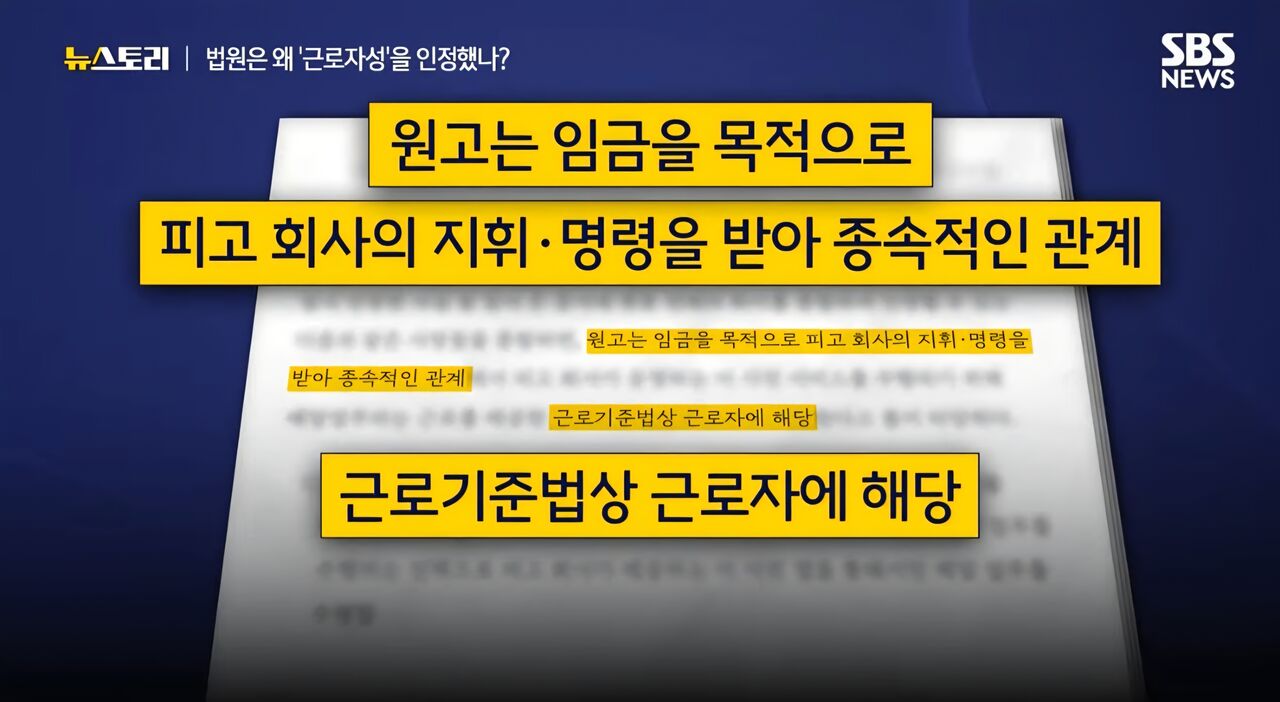
On July 3, 2026, the Seoul High Court overturned the first-instance ruling and recognized the rider as an employee under the Labor Standards Act. Consequently, the court judged that the contract termination in December 2021 was not a termination of a consignment contract, but a dismissal of an employee. It ruled that the dismissal was invalid because the company had failed to give written notice specifying the grounds and timing of the dismissal. The ruling was finalized on July 29 after the defendant company chose not to appeal to the Supreme Court. The plaintiff's side explained that much of the evidence that formed the basis of the appellate court's decision—including the app, dispatch control software, and witness testimony—had already been submitted in the first instance, but the two courts evaluated them differently. The appellate court examined not only the fact that the rider could choose orders, but also how the actual dispatching was carried out under the company's algorithm and managerial instructions, control, and penalties.
Beom Youkyung / Legal Representative for the Plaintiff in the Delivery Rider Dismissal Invalidation Lawsuit
"Much of the evidence had already been submitted in the first instance. We requested the preservation of evidence for the application and dispatch control software held by the defendant company, demonstrated them in court, and called witnesses. Many of the pieces of evidence cited in the appellate court's written judgment to establish the facts had also been submitted in the first instance. Ultimately, I believe the difference lay in how the already submitted evidence was evaluated and what rationale was used to make the judgment. While some factual details changed, it was the legal evaluation that differed."
Behind the 'Freedom to Choose Orders' Was Platform Dispatch Control
The right to choose orders is a key point demonstrating this assessment. It is true that the rider could directly select one of the orders displayed on the app screen. However, the order list displayed to a specific rider was automatically configured by an algorithm according to criteria predetermined by the company. The administrator software also included a feature that concealed orders from specific affiliated merchants from particular riders, and administrators could directly cancel dispatches that had already been made. The court found that although the rider could select from the orders displayed on the screen, they were not entirely able to decide what orders would be presented to them. Furthermore, administrators could block or re-grant a specific rider's ability to cancel a dispatch on their own.
The consequences of cancellation also differed. When an administrator canceled a dispatch, no penalty was imposed on the rider, but if the rider directly canceled the dispatch, they bore a financial penalty. Even when a rider requested a dispatch cancellation, the administrator determined whether the reason was justified and decided whether to cancel it directly or make the rider cancel it themselves while incurring a penalty. Based on this, the appellate court concluded that the final decision-making power over dispatch cancellations was exercised by the company.

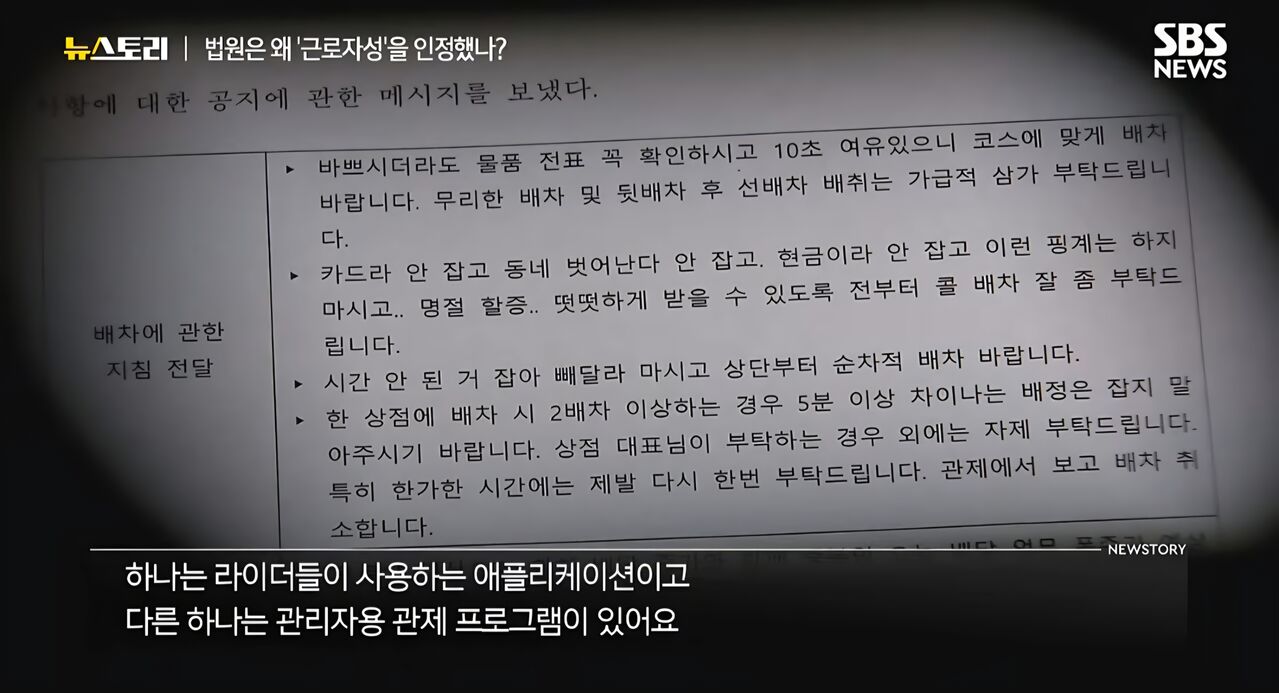
Supervision was also carried out during the work process following dispatch. The company was able to check the rider's location, movement route, and the number of deliveries underway in real time through the control software. When it determined that a route was inefficient, it contacted the rider to recommend canceling the dispatch, and administrators even canceled dispatches directly. During peak order hours, it urged riders to report to work or return to duty. In group chat rooms, specific instructions were repeatedly given, such as fulfilling older orders in sequence or not taking dispatches with a gap of more than five minutes when bundling two or more deliveries from a single store. The court judged that the computer system monitoring real-time location information functioned not merely to check delivery status, but as a means of supervising the rider's work performance.
In particular, the limit on bundled deliveries was not simply a matter of work methods. For riders paid per delivery, the number of deliveries they could handle at one time was directly linked to their income. The company lowered the maximum limit of bundled deliveries for riders with poor work performance, such as frequent absences or failure to follow instructions. When the limit is reduced, the number of deliveries and income that can be generated in the same amount of time also decrease. The appellate court viewed adjusting the bundled delivery limit as a means of exercising strong control over the rider's financial interests and work performance methods. It also evaluated this as a primary means of management and supervision to enforce compliance with company instructions.
Beom Youkyung / Legal Representative for the Plaintiff in the Delivery Rider Dismissal Invalidation Lawsuit
"The company used two programs. One was an application used by riders, through which they could choose which products to pick up and deliver, or cancel selected dispatches. The other was a dispatch control program for administrators. The moment a rider used the app, collected GPS information was displayed in real time on the administrator program. Administrators could see where and how riders were moving, and if an inefficient route occurred, they would even cancel dispatches."
The compensation structure was another important factor examined by the appellate court. The calculation method for basic delivery fees and specific criteria based on distance and region were set by the company, and surcharges based on region, time slot, and weather were also established by the company. Penalties and commissions were likewise determined according to the company's standards and internal policies. Consequently, the rider could not arbitrarily alter the calculation method or payment criteria for delivery fees with users or affiliated merchants. Nor could they generate additional profit by directly soliciting business from users outside of the app in question. To be sure, when a rider made more deliveries, their income increased accordingly. However, what the rider could decide was primarily how many deliveries to make, while how much they received per delivery was determined according to criteria set by the company. In other words, while they could increase their income by working more, the structure did not allow them to set prices directly or secure separate clients to generate extra profit. Thus, the appellate court did not view the variation in income based on delivery count as a business risk borne by an independent contractor in the course of operations. It determined that it was closer to an outcome resulting from operational policies designed by the company. Taking these points together, the court ruled that the rider could not be considered an independent contractor simply because there was no fixed base salary and compensation was paid per case.
However, once employee status was recognized, the next question arose: how much wage should be awarded for the dismissal period? Because this rider had neither a fixed monthly salary nor prescribed working hours, it was difficult to calculate a monthly wage using standard methods. Therefore, instead of looking only at income from the three months immediately preceding the dismissal, the court calculated average monthly earnings based on income over the entire period actually worked. The court reasoned that given the short working period and fluctuations in income depending on peak seasons and weather, it was difficult to determine normal earning levels solely from the preceding three months. Next, it evaluated which expenses should be deducted from actual income. Motorcycle lease fees, repair costs, and fines were deducted, but industrial accident compensation insurance premiums were not. This was because the court deemed industrial accident insurance premiums to be a cost that should be borne by the employer, the company, rather than the employee. In other words, the court calculated the monthly wage for the dismissal period by first determining the reference period for income and then assessing which expenses should be excluded from actual revenue.

The Freedom to Open an App Does Not Alone Make One a Sole Proprietor
The significance of this ruling lies in the fact that it did not deny employee status merely because the rider could log into the app and choose whether to accept orders. The court noted that on the surface, it appeared that the rider could log into the app whenever they wanted, choose when to rest and whether to accept orders, and finish work whenever they wished. In reality, however, the court found that the company consulted on working hours with the rider in advance, encouraged reporting to work and returning to duty, and imposed disadvantages if predetermined working hours were not observed. Rather than looking at the existence of choices in isolation, the court examined how those choices were exercised within the structure of actual operational management and sanctions.
In particular, the court explicitly stated that when judging the employee status of platform workers, consideration must be given to the characteristics of labor management, in which algorithms and multiple business participants are involved in allocating tasks and determining how work is performed on online platforms. In this case, not only the app's algorithm and control software, but also concrete instructions and dispatch control from administrators, penalties, and adjustments to bundled delivery caps served as grounds for concluding that substantial direction and supervision existed.
Beom Youkyung / Legal Representative for the Plaintiff in the Delivery Rider Dismissal Invalidation Lawsuit
"I believe this ruling serves as a precedent showing how far a court can go when interpreting the law in conformity with the Constitution. There are times when courts avoid making proactive judgments and lean on legislative remedies, but this ruling seemed closer to an attitude of breaking through via legal interpretation if possible. Because platform workers perform their jobs under new forms of digital control, it may appear as though they are not subject to an employer's direction and supervision, but it may simply be that traditional work is being performed while only the methods of management and control have been digitized. If so, I think it is more accurate to call it an illusion rather than innovation."
(To be continued in Part 2)

Replay Broadcast ☞ [News Story] Contracted as a Boss, but in Reality a Worker? (Camera & Video Editing: Kim Tae-hoon)
※ Please note: This article was translated by AI and may contain errors.





 Video News