
 KOR
KOR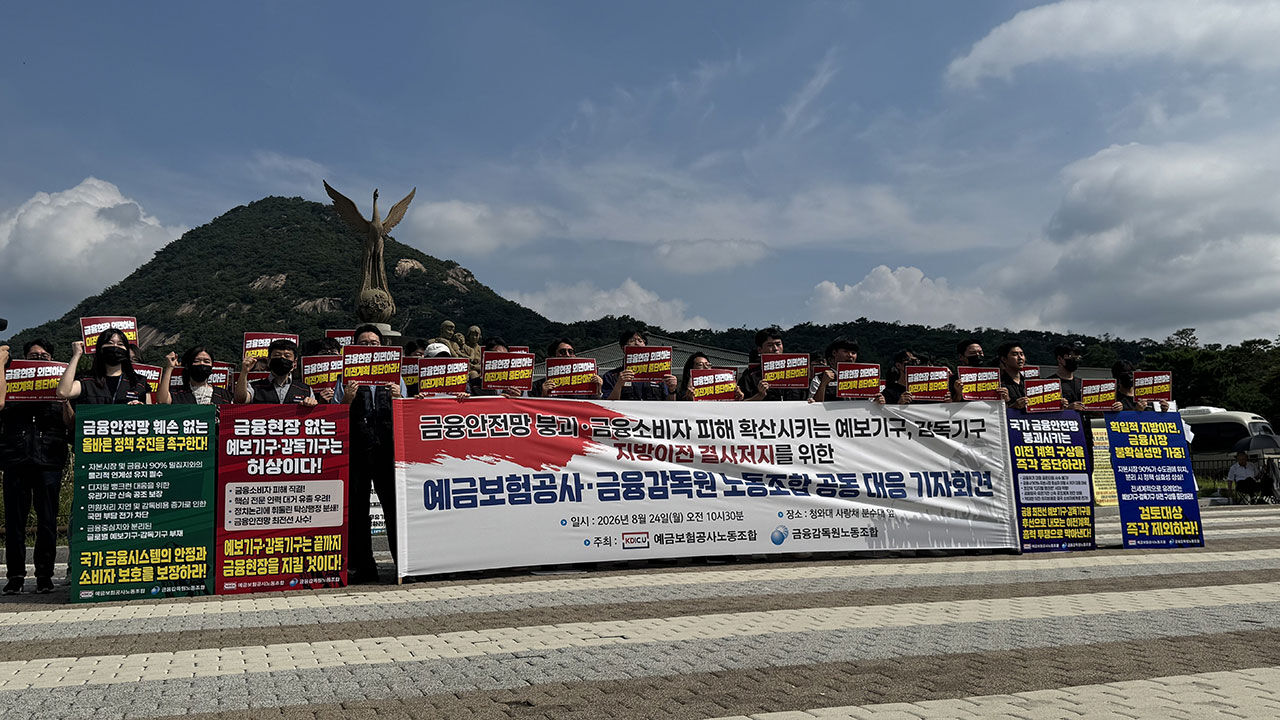
▲ The labor unions of the Korea Deposit Insurance Corporation and the Financial Supervisory Service hold a joint press conference opposing their relocation outside the capital region in front of the Cheong Wa Dae Sarangchae in Jongno-gu, Seoul, on the 24th. (Photo: Yonhap News)
The labor unions of the Korea Deposit Insurance Corporation (KDIC) and the Financial Supervisory Service (FSS) urged today (the 24th) that both institutions be excluded from the government's second round of public institution relocations to regional areas.
Holding a joint press conference in front of the Cheong Wa Dae Sarangchae in Jongno-gu, Seoul, this morning, the unions argued, "The locations of the KDIC and the FSS are matters of financial stability and financial consumer protection."
They stated, "The headquarters of the financial companies protected by the KDIC and inspected by the FSS are concentrated in the capital region, and financial infrastructure such as legal and accounting firms and IT specialist institutions, along with financial companies and regulatory authorities, is also gathered in the capital area," adding, "The damage that will occur after institutions guarding the financial system leave the financial front lines will ultimately fall entirely on the public."
They pointed out that rapid crisis response is crucial, but the physical distance between institutions could delay decision-making, ultimately resulting in harm to the public.
They also emphasized that the financial stability and supervisory authorities of major advanced financial economies, such as the United States, the United Kingdom, and Japan, are located in their capital cities.
They expressed concerns over the departure of specialized personnel.
According to a survey conducted by the FSS labor union targeting 1,538 union members regarding their perceptions of regional relocation, 82.5% of employees under the age of 40 stated they would actively consider changing jobs if the organization were relocated.
This figure is higher than the rate across all age groups (69.7%).
In a survey conducted by the KDIC union among its internal members, the willingness to continue working in the event of a relocation was merely 12% for junior staff with less than five years of tenure and 9.5% for Grade 5 working-level staff.
The unions pointed out, "A majority of the working-level staff are personnel with verified expertise in finance and law, such as accountants, lawyers, and actuaries, and they possess experience navigating historical financial crises such as the savings bank crisis," adding, "The drain of expertise directly translates to the loss of consumer protection functions."
Furthermore, they noted that the fallout from forced relocations of workplaces is being passed down to the younger generations, including those in their 20s and 30s.
This is because, amid a high prevalence of dual-income couples, relocating workplaces is closely tied to marriage, childbirth, and careers.
In a story shared by the KDIC during the event, a working-level employee appealed, "I have lost the courage to have a child due to the regional relocation," and explained, "My husband, who has a job in Seoul, cannot move down to the provinces, and if the relocation becomes a reality, I would have to endure pregnancy, childbirth, and childcare entirely alone in an unfamiliar area without any local connections."
The employee added, "Regional relocation forces people to give up their jobs, breaks apart families, or drives them to the risk of career interruptions, thereby making them give up on having children," criticizing it as "anachronistic administration."
Kim Young-heon, head of the KDIC labor union, stated, "More than 70% of bank deposits protected by the KDIC are concentrated in Seoul and the capital region," and urged, "Immediately halt attempts to relocate the KDIC, the heart of financial stability."
Kim Sang-woo, head of the FSS labor union, also emphasized, "I am worried that the regional relocation of the FSS will cause us to miss the opportunity for the financial industry to take a leap forward," adding, "The nation's core infrastructure must be stationed at the front lines where its functions can operate effectively."
Plans for the second round of regional relocation for central administrative agencies, including the Financial Services Commission, are expected to be deliberated at a Cabinet meeting as early as the 25th.
Depending on how the situation unfolds, the FSS and KDIC are considering additional solidarity actions and have left open the possibility of cooperating with other institutions targeted for regional relocation.
Meanwhile, the FSS labor union plans to hold a closed-door rally at the FSS headquarters this afternoon to oppose the regional relocation.
(Photo: Yonhap News)
※ Please note: This article was translated by AI and may contain errors.





 Video News

 Video News