
 KOR
KORWe reported to you last month that permeable paving blocks, installed to prevent flood damage, are failing to function properly. There has been debate over whether the drainage failure is due to sand and dust accumulation over time or if they were defective from the beginning. We put this to the test.
First, we bring you an exclusive report by our Climate and Environment Specialized Reporter, Jang Se-man, and we will discuss this in more detail shortly.
[Reporter]
Banpo Hangang Park in Seoul, where the installation of permeable blocks was completed last month.
An iron rod is inserted into the gaps between the ground to pry out the blocks.
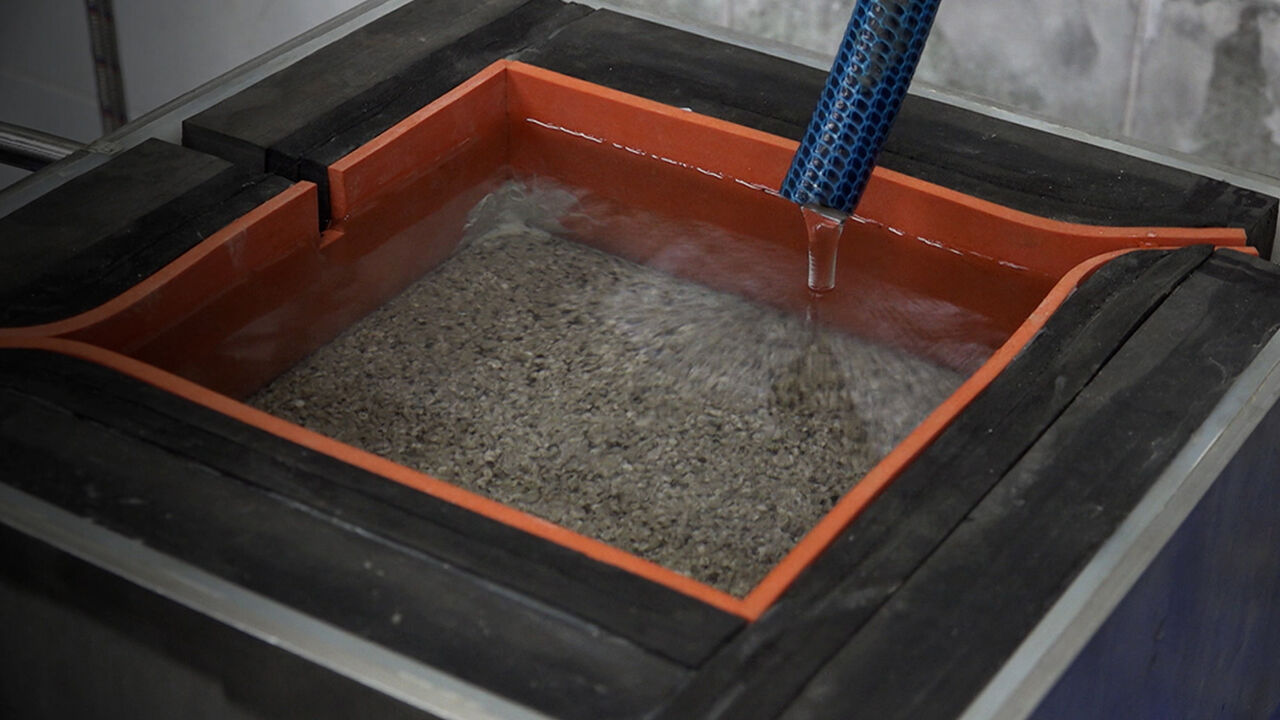
Permeable blocks were collected from three recently completed construction sites, including this one, and taken to a testing institution.
To be selected as supply-grade permeable blocks, products must pass tests by a specialized institution and submit a test report to local governments.
The blocks here are also products selected through such a process, and we will test them using the exact same methods as the original test reports.
The test results showed that samples from all three locations fell short of the passing criteria.
At sites where a drainage rating of Grade 2 or higher was required for delivery, the blocks received a Grade 3 and an out-of-grade judgment. At sites where Grade 3 or higher was required, they received Grade 4 or "unjudgable," indicating virtually no drainage.
Permeable blocks work by allowing water to drain through countless microscopic pores inside them. Prolonged use can cause foreign substances like sand and dust to clog these pores.
However, experts point out that since these samples were installed anywhere from one to four months ago, it is difficult to attribute the clogging to contamination after installation.
[Park Ji-won / Democratic Party Representative: Because we sought out and tested blocks from the most recently constructed sites, we have no choice but to conclude that they were defective products from the very beginning, and that such defective products must be widely distributed.]
Within the industry, there are open whispers that suppliers secure test reports with normal products, only to use low-quality, substandard products during actual construction.
Critics point out that post-verification to check whether blocks identical to those that passed the tests were actually used is lacking.
[Choi Kyung-young / President of the Low Impact Development Association (Adjunct Professor at Seoul National University): It is necessary to immediately conduct on-site verification during completion inspections to check whether permeable capacity is actually being demonstrated when the blocks are installed on-site.]
It has been about 10 years since permeable blocks were introduced in Seoul, and they now account for 15 percent of all sidewalk blocks. A thorough investigation seems necessary to assess their current performance and find out why these issues slipped through the cracks.
(Video Editing: Lee Sang-min, VJ: Shin So-young, Oh Se-gwan)
---
[Anchor]
Q. Why install permeable blocks instead of regular sidewalk blocks?
[Jang Se-man, Reporter: In urban areas like Seoul, concrete and asphalt cover the ground, making it difficult to see natural soil. When heavy rain hits, the soil cannot absorb rainwater, which can increase flood damage. Conversely, when heatwaves or droughts strike, the lack of moisture retained in the ground prevents it from cooling down, exacerbating heatwave damage. That is why permeable blocks with drainage functions are installed so that the soil beneath the sidewalk blocks can retain rainwater.]
Q. What is the Seoul Metropolitan Government's stance on the installation of blocks differing from test results?
[Jang Se-man, Reporter: There is no official response yet on whether defective products were supplied from the start. Instead, the Seoul city government notes that when installing sidewalk blocks, fine-grained sand called joint filler is placed between the blocks as a buffer. They are focusing on the possibility that this fine sand blocked the drainage pores. However, experts argue that if the joint sand used temporarily during construction is enough to clog the pores, the product itself is already defective. For reference, a long-term tracking study by the Seoul Institute showed that it generally takes about five years for normal products to experience a decline in performance.]
Q. What are the alternatives regarding the installation of defective permeable blocks?
[Jang Se-man, Reporter: In large-scale construction projects, there is a supervision system to verify the materials used. However, block replacement projects are relatively small in budget and often fall outside the scope of supervision. Therefore, experts say that when local governments conduct completion inspections after construction, they should not stop at visual inspections but properly verify performance. In addition, although regulations require performance checks on already installed permeable blocks to be conducted once every two years, it turns out this has not actually been taking place. There is a clear need to examine the overall operational reality of the permeable block system.]
※ Please note: This article was translated by AI and may contain errors.



 Video News
 Video News
 Video News
 Video News
 Video News