
 KOR
KOR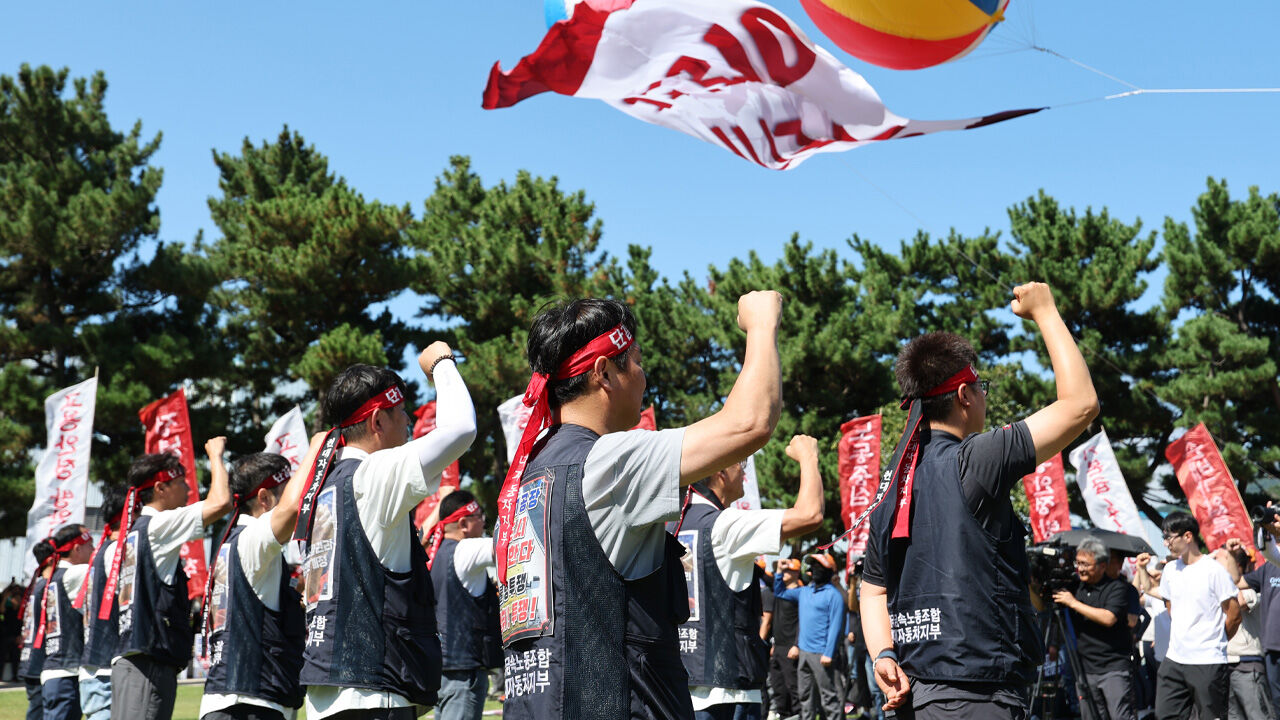
▲ Hyundai Motor Union Rally for General Strike
The Hyundai Motor labor union (the Hyundai Motor branch of the Korean Metal Workers' Union) went on a full strike today (August 21) due to setbacks in this year's wage negotiations.
This marks the first time in 10 years that the Hyundai Motor union has staged an 8-hour full strike since the collective bargaining in 2016.
Following the union's full-strike directive for the day, technical (production) workers of the morning shift, who normally start work at 6:45 AM, did not report to work at all.
The afternoon shift, which begins work at 3:30 PM, is also not reporting to work.
Consequently, all production lines at the Ulsan, Jeonju, and Asan plants are completely halted for the entire day.
Since both the morning and afternoon shifts are striking for 8 hours each, the actual production lines will be suspended for 16 hours today.
Including office workers as well as production staff, approximately 39,000 union members are participating in the strike.
The union has occasionally staged partial strikes lasting two to six hours since the initial collective bargaining session on May 6 to pressure management, but this is the first time it has staged an 8-hour strike.
This also marks a return to a full strike for the first time in 10 years, following the full strike carried out for a day on September 26 during the 2016 wage negotiations.
The union's leadership and delegates visited in front of the Hyundai Motor Group headquarters in Yangjae-dong, Seoul, to directly pressure the company and participate in the joint strike rally for the automotive industry hosted by the Korean Metal Workers' Union.
With today's full strike, the Hyundai Motor union's cumulative strike hours for this year have increased to 60 hours.
The time during which production lines have been halted is double that, at 120 hours.
Considering that Hyundai Motor produces approximately 460 units per hour, the automotive industry estimates that the cumulative production disruption has reached 55,200 vehicles, with cumulative sales losses exceeding 2.3 trillion won based on the average selling price per vehicle.
As the union has already announced partial strikes of four hours each for August 24 to 25, production disruptions are expected to accumulate further.
The problem is that the deadlock in this year's wage negotiations is persisting.
Labor and management resumed negotiations on the 18th of this month—about 40 days after failing to reach an agreement at their 15th bargaining session—but once again failed to narrow their differences.
Lee Jong-cheol, head of the union branch, stated, "We will resume negotiations only when an advanced negotiation proposal is presented," leaving it uncertain when representatives from labor and management will meet again.
The year in which the Hyundai Motor union staged the most strikes over the past decade was 2016, when the union-standard strike hours reached 106 hours and production disruptions based on production lines amounted to 212 hours.
The three main issues of contention between labor and management this year are a 50% increase in bonuses, the reinstatement of union members dismissed for illegal activities during past union activities, and the extension of the retirement age.
These are demands that the union has put forward to management in this year's wage negotiations, separate from wage increases.
Management takes the stance that these agendas are unrelated to this year's wage negotiations, that there is no justification for reinstating legally dismissed union members, and that it is not easy for labor and management to first reach a conclusion on extending the retirement age, which should be discussed by the political circle first.
However, the union demands that bonuses must be increased because the proportion of fixed wages, such as base pay, among the wages received by members is only 54.8%, forcing them to suffer through overtime and special work just to maintain a living wage.
The union maintains that the retirement age has been extended through past labor-management agreements, and that the reinstatement of dismissed workers is essential to build trust in labor-management relations.
The union stated, "The company's retained earnings based on last year stood at 101.3 trillion won, which is not a level that cannot handle the costs associated with increasing bonuses and extending the retirement age."
On the other hand, the company maintains its position that it cannot accept the union's demands without legal grounds or rational criteria.
As a result, although working-level staff are reportedly communicating with each other since official negotiations between labor and management were cut off, no progress has been made.
The union plans to hold a central dispute countermeasures committee meeting on August 25 to discuss whether to launch additional strikes if management does not present a new negotiation proposal.
(Photo: Yonhap News)
※ Please note: This article was translated by AI and may contain errors.



 Video News

 Video News
 Video News
 Video News