
 KOR
KOR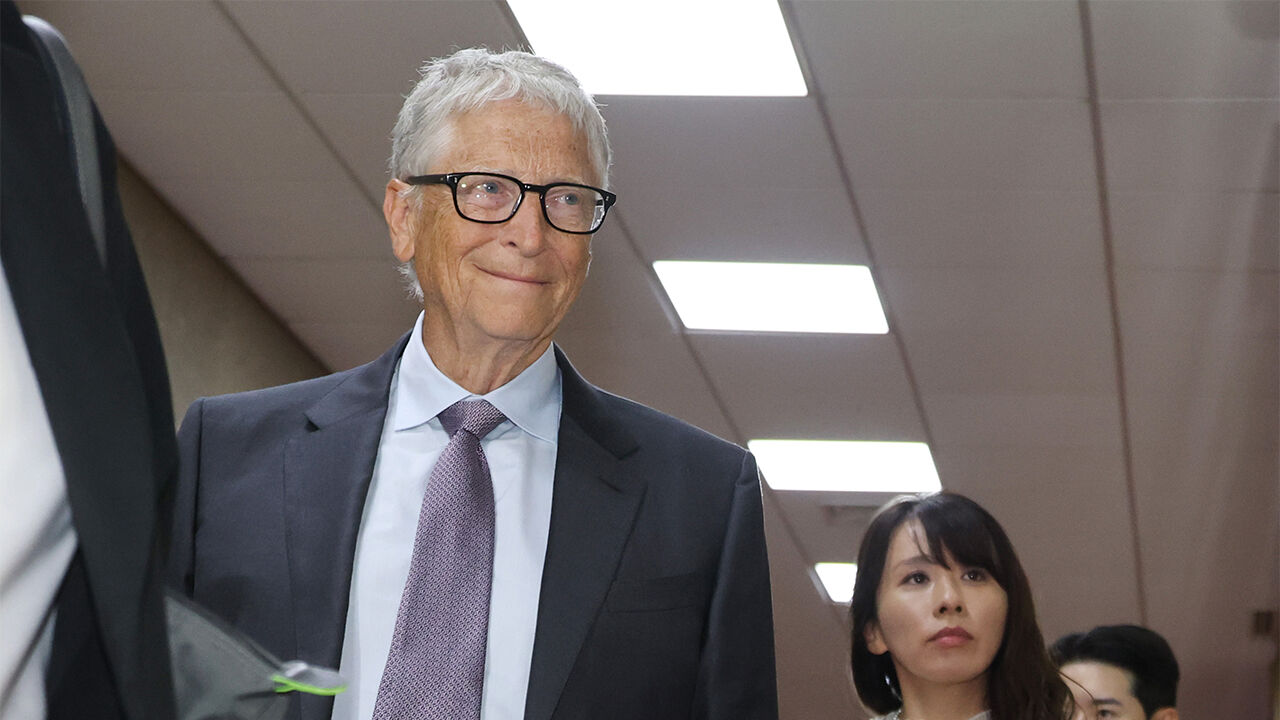
▲ Bill Gates, co-chair of the Gates Foundation, walks toward the National Assembly Speaker's office on the 14th to meet with National Assembly Speaker Cho Jung-sik.
Bill Gates, co-founder of Microsoft and founder of the next-generation nuclear reactor company TerraPower, met with key political and business figures in South Korea on the 14th, the second day of his visit, to discuss cooperation on small modular reactors (SMRs).
This marks Gates's first visit to South Korea in a year, following his previous trip in August of last year.
While last year's visit focused on discussing the potential and direction of cooperation for next-generation nuclear energy, this year's trip carries greater weight as it comes after TerraPower has achieved concrete results in its next-generation nuclear business.
In fact, this visit is creating an atmosphere where practical business cooperation with South Korean companies such as SK Innovation, HD Hyundai, and Doosan Enerbility is gaining full momentum.
On the morning of this day, Gates visited the National Assembly to pay a courtesy call on National Assembly Speaker Cho Jung-sik, followed by a meeting with Prime Minister Han Sung-sook at the Government Complex-Seoul in the afternoon.
He then met with Minister of Trade, Industry and Energy Kim Jung-gwan in Seoul to discuss ways to expand Korean corporate participation in TerraPower's SMR business.
Minister Kim emphasized, "To secure the economic viability of SMRs through standardized deployment, combining TerraPower's standard design with South Korea's highly reliable mass-production supply chain is essential," adding, "Based on the foundry-grade nuclear manufacturing and construction ecosystem built over the past 50 years, South Korea will become an optimal partner for TerraPower."
Minister Kim also asked Gates to show interest so that not only large corporations but also small and medium-sized enterprises (SMEs) can become core parts of TerraPower's supply chain.
Following this governmental consensus, concrete business cooperation was also achieved.
Immediately following the meeting, a signing ceremony was held for the "Terms of Agreement for Global Joint Business Promotion Contract" between TerraPower and SK Innovation, attended by Minister Kim, Gates, and SK Group Chairman Chey Tae-won.
With this agreement, SK Innovation will fully participate in TerraPower's SMR business in the United States and global markets.
HD Hyundai Chairman Chung Ki-sun also met with Gates on this day to accelerate efforts in targeting the U.S. SMR market.
HD Hyundai announced that Chairman Chung, Gates, TerraPower CEO Chris Levesque, and Hyundai Engineering & Construction CEO Lee Han-woo met in Seoul to discuss cooperation measures for the commercialization of the Natrium reactor.
Chairman Chung stated, "Based on a cooperative framework encompassing technology, manufacturing, and EPC (engineering, procurement, and construction), we will be able to accelerate the commercialization of next-generation reactors," and added, "Through self-developed technologies and collaboration with global companies, we will actively respond to the increasing demand for SMR power generation."
HD Hyundai plans to accelerate investments in production facilities ahead of commercialization, with the goal of establishing a production system capable of supplying 2 to 3 reactor vessels annually in the future.
Founded by Gates in 2008, TerraPower applies technology that uses sodium as a coolant instead of water, unlike traditional light-water or heavy-water reactors, significantly enhancing power generation efficiency and safety.
Its power generation capacity per module is 345 megawatts (MW), which is enough electricity to supply approximately 250,000 households.
In March, TerraPower obtained a construction permit for Unit 1 in Kemmerer, Wyoming, from the U.S. Nuclear Regulatory Commission (NRC).
This marks the first instance of a commercial-scale next-generation nuclear reactor receiving a construction permit in the United States.
Domestic companies have steadily expanded their cooperation foundation with TerraPower through investments and other means.
Previously, in August 2022, SK Innovation and holding company SK Inc. invested 250 million dollars (approx. 380 billion KRW) in TerraPower to become its second-largest shareholder.
In March 2023, SK Innovation, Korea Hydro & Nuclear Power (KHNP), and TerraPower signed a business agreement for the development and commercialization of next-generation SMRs, cooperating on the demonstration and commercial reactor development of fourth-generation SMRs based on the sodium-cooled fast reactor (SFR) developed by TerraPower.
HD Korea Shipbuilding & Offshore Engineering, an affiliate of HD Hyundai, invested 30 million dollars (approx. 45 billion KRW) in TerraPower in November 2022.
HD Hyundai has already won an order for one TerraPower reactor vessel and is currently manufacturing it.
In May, the companies signed an MOU under which TerraPower provides Natrium reactor technology, HD Hyundai manufactures primary equipment, and Hyundai Engineering & Construction handles EPC.
Doosan Enerbility announced on the same day that it has signed a manufacturing contract for core equipment for Natrium reactors with TerraPower.
Doosan Enerbility will manufacture the reactor protection vessel, reactor support structure, and reactor internal structures for TerraPower's Natrium reactor.
Doosan Enerbility built its foundation for cooperation with TerraPower after signing a contract in December 2024 to review the manufacturability of core equipment for TerraPower's first SMR (Unit 1) and subsequently carrying out design improvement work.
SMRs are next-generation technologies that have drawn attention as power sources for demand centers like large data centers because they are easier to build and safer than large nuclear power plants.
They have been cited as the optimal solution to resolve the power shortages driven by artificial intelligence (AI).
Currently, over 100 SMRs are under development worldwide.
Companies across the globe, regardless of nationality, are forming alliances and pooling their utmost efforts to secure dominance in the newly forming SMR market.
An official from the Ministry of Trade, Industry and Energy stated, "Amid changes in the global nuclear power market, Korean companies' investments in overseas SMR reactor types, business development, and entry into supply chains are highly significant in terms of diversifying nuclear exports," and added, "In particular, the current early stage of SMR supply chain formation is considered the golden timing for Korean companies to enter overseas SMR supply chains, and through this meeting, it is expected that not only large enterprises but also small and medium-sized nuclear enterprises will actively enter global supply chains."
(Photo: Yonhap News)
※ Please note: This article was translated by AI and may contain errors.



 Video News
 Video News
 Video News
 Video News
 Video News