
 KOR
KOR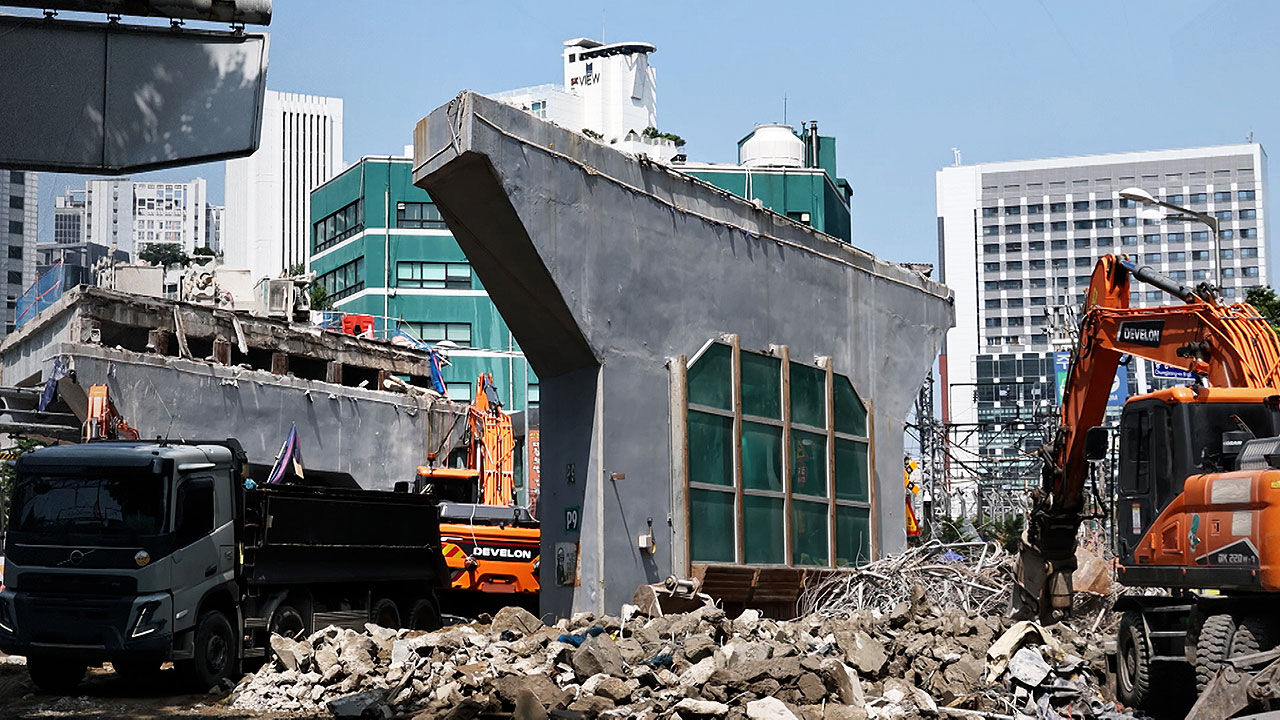
▲ The site of the Seosomun Overpass collapse accident
Regarding the collapse of the Seosomun Overpass last May, which resulted in six casualties, the government has confirmed safety management violations and requested an investigation into related organizations, including the Seoul Metropolitan Government.
The investigation revealed a total breakdown in safety management: the construction contractor and supervising firm proceeded with work without approval at the time of the accident, the Seoul Metropolitan Government failed to report dangerous situations, and the Korea Railroad Corporation (Korail) conducted a lax railway operation safety consultation.
The Ministry of Land, Infrastructure and Transport announced on the 14th that, following a special inspection of the Seosomun Overpass demolition work, it has requested the Seoul Metropolitan Police Agency's Metropolitan Investigation Unit to investigate related institutions—including the Seoul Metropolitan Government, Korail, the construction company, and the supervising firm—on charges of professional negligence resulting in death and injury, and obstruction of business.
The Ministry explained that it uncovered numerous violations following an intensive special inspection conducted jointly with the Korea Transportation Safety Authority from June 4 to 19.
First, investigations showed that the "structure safety inspection work" performed by the contractor and supervising firm at the time of the accident was carried out without Korail's approval.
According to Korail regulations, a basic work plan must be approved one month prior to work, and a railway operation safety consultation agreement must be approved on the day of the work. However, the accident occurred while work was underway without these approvals.
In addition, the "S9 slab overturning prevention installation work," which was consulted on the day of the accident, was confirmed to have been conducted by falsely drafting documents as if it had been approved, even though it was not included in the basic work plan.
Although the number of workers was listed as 4, 13 workers were actually deployed without authorization.
Korail was also found to have failed to properly review the railway operation safety consultation agreement.
While the basic work plan consultation agreement drawn up in May listed work for the S8 section on the upper bridge and the P7 section on the lower bridge, the railway operation safety consultation agreement submitted by the contractor and supervising firm on the day of the accident specified work on the S9 section where the accident occurred.
Nevertheless, Korail carried out the consultation without verifying the discrepancy in work details between the safety consultation agreement and the basic work plan consultation agreement.
Issues were also pointed out in how the Seoul Metropolitan Government handled the dangerous situation prior to the accident.
Under the Ministry of Land, Infrastructure and Transport's notice "Operational Guidelines and Performance Conditions for Reporting Acts within Railway Protection Zones," when an emergency occurs, the Seoul Metropolitan Government must immediately suspend construction and notify the国家铁道공단 (National Rail Authority) and Korail to request the suspension of train operations.
However, investigations revealed that despite being notified in advance by the contractor of a 2.9 cm level difference that triggered the bridge collapse, the city took no action until the accident occurred.
In addition to requesting investigations into the Seoul Metropolitan Government, Korail, the contractor, and the supervising firm, the Ministry of Land, Infrastructure and Transport also issued 2 corrective orders and 4 improvement recommendations to Korail and the National Rail Authority.
The National Rail Authority was recommended to receive and review safety management plans and review results prior to accepting reports of acts within railway protection zones for high-risk work that requires submitting a safety management plan.
Related regulations were also supplemented to require the National Rail Authority and railway operators to conduct joint on-site inspections for high-risk (Grade A) construction work that directly affects railway safety.
Korail was recommended to improve work procedures and establish a management system to ensure that reviews of reports on acts within railway protection zones are completed within the processing deadline (15 days).
Furthermore, Korail was instructed to thoroughly verify whether the documents attached during railway operation safety consultations—such as the basic work plan consultation agreement and safety suitability review results—match, and to clearly indicate risk grades for high-risk construction work so that the degree of hazard can be easily recognized during operation safety consultations.
Cho Sung-kyun, Director General for Railway Safety Policy at the Ministry of Land, Infrastructure and Transport, stated, "The Seosomun Overpass collapse accident could have had its damage reduced if only the approval procedures adhering to principles had been followed." He added, "Through the requests for investigation into related organizations, we will strictly hold them accountable and concentrate all our efforts not only on safety management within railway protection zones, but also on strengthening overall railway safety to prevent similar accidents from recurring."
※ Please note: This article was translated by AI and may contain errors.



 Video News
 Video News
 Video News
 Video News
 Video News