
 KOR
KOR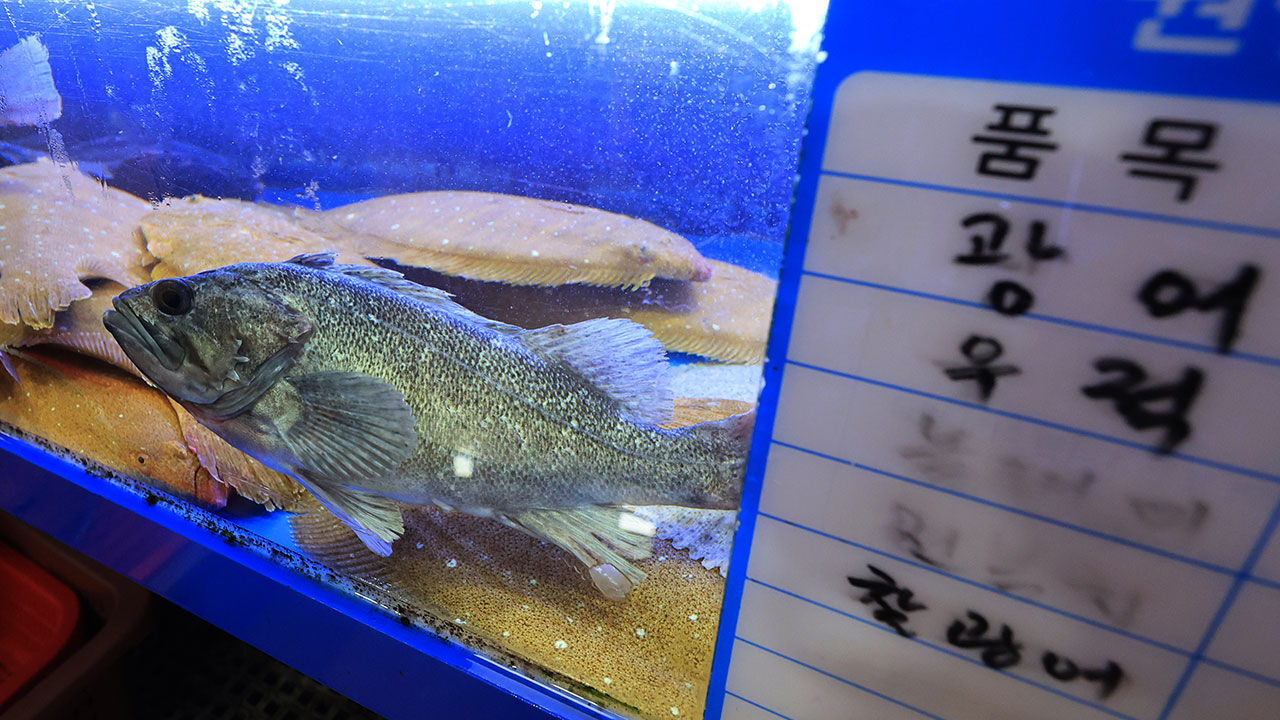
▲ Live fish, such as bastard halibut and rockfish, are on display at a store in the Noryangjin Fisheries Wholesale Market in Seoul.
Seafood prices are fluctuating as extreme heatwaves heat up the ocean, even leading to mass mortalities at some fish farms.
Because the ocean heats up more slowly than land with a time lag, forecasts suggest that the heatflation (inflation caused by heatwaves) phenomenon in seafood will become even more pronounced in September.
According to the major supermarket industry on August 9, a 300-gram plate of sliced raw flounder is being sold at supermarkets for around 25,000 won.
For products sold in chunks with reduced processing steps of fine slicing, prices are in the 23,000-won range at E-Mart and the 26,000-won range at Lotte Mart.
Compared to early May when E-Mart held a discount event selling 360 grams of sliced raw flounder in the 19,000-won range, prices have risen sharply over the past three months.
May is the period when raw flounder prices are lowest during the year due to an increase in the catch of wild flounder.
Wholesale prices have also been rising recently.
According to the Noryangjin Fisheries Weekly Seafood Trends by the National Federation of Fisheries Cooperatives (Suhyup), the average auction winning price for 1 kilogram of farmed flounder from July 27 to August 1 was 22,300 won, up 2.29% from a week earlier.
Compared to July of last year, it rose by 13.2% the following year.
This is interpreted as the aftermath of continuing heatwaves, such as the death of some 21,000 cultured flounders at a fish farm in Jeju at the end of last month.
The optimal water temperature for flounder is 18 to 25 degrees Celsius, and when it exceeds 27 to 28 degrees Celsius, damage can occur due to high water temperatures.
Wild gizzard shad saw a surge in market prices as the catch decreased because the number of individuals approaching the coast dropped due to the high water temperature phenomenon occurring in the Yellow Sea.
The average auction winning price for 1 kilogram of live gizzard shad at the Noryangjin Fisheries Market the previous day was 17,000 won, up 10,000 won significantly from August 2 of last year (7,000 won) when live gizzard shad auctions were held.
Wholesale prices for rockfish, whose farms are mainly located in the South Sea, are also staying high.
According to Suhyup Noryangjin, the median auction winning price for 1 kilogram of rockfish as of the 6th was 25,000 won.
Because the ocean heats up and cools down more gradually than land, the period when water temperatures around the Korean Peninsula are at their highest is from late August to early September.
Consequently, the impact of high prices driven by heatwaves is projected to grow larger in September.
If catches decrease due to heatwaves, wholesale prices rise, which inevitably triggers a chain reaction of rising raw fish prices at large supermarkets and raw fish restaurants.
An official in the distribution industry stated, "The impact of high water temperatures has only just begun and we expect the effect to be greatest in September," adding, "For raw fish ingredients, high market prices will continue, centered around flounder and rockfish."
(Photo: Yonhap News)
※ Please note: This article was translated by AI and may contain errors.




 Video News
 Video News

