
 KOR
KOR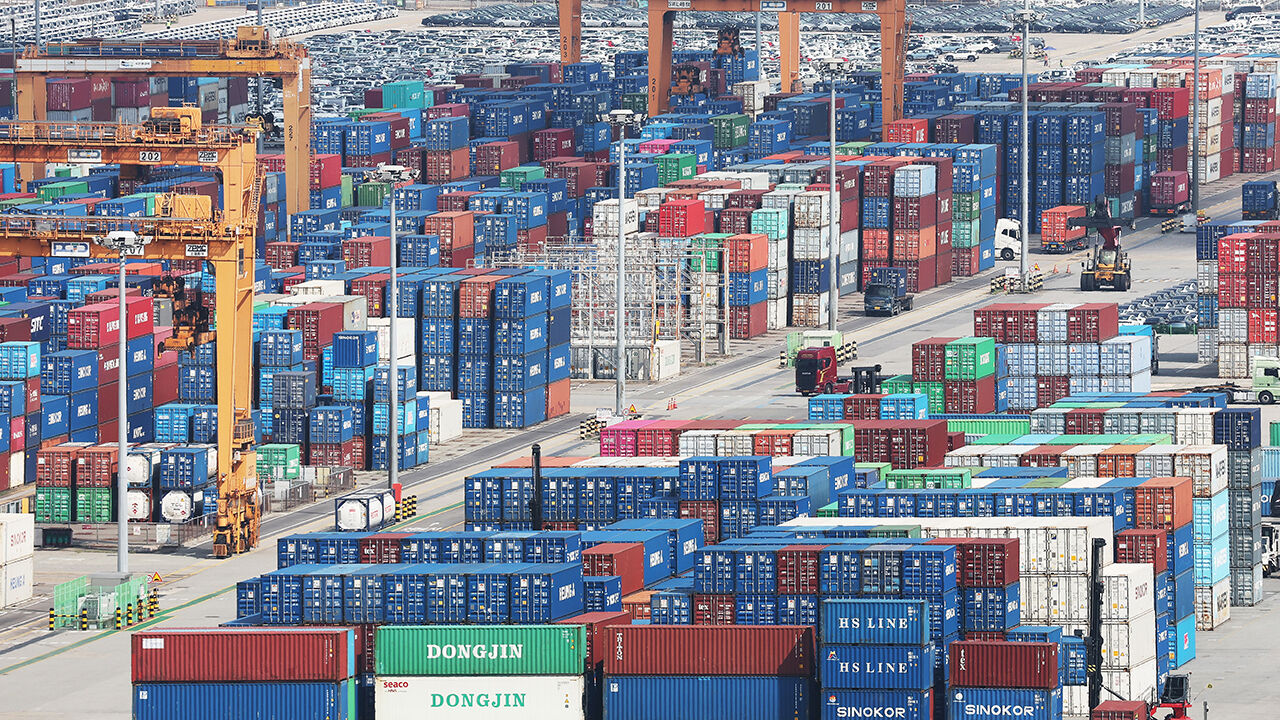
▲ Containers stacked at Pyeongtaek Port
Driven by a boom in semiconductor exports, South Korea's international trade recorded an all-time high surplus exceeding 70 trillion won in June.
According to the preliminary balance of payments statistics released by the Bank of Korea (BOK) today (August 6), the current account surplus for June stood at $49.73 billion, which is approximately 70.8 trillion won.
Following the previous monthly high of $38.61 billion in May, the country extended its record-breaking surplus streak for two consecutive months.
The cumulative current account surplus for the first half of the year through June reached $191.01 billion, nearly four times the $47.87 billion recorded during the same period last year.
This means the country has achieved more than three-quarters of the BOK's projected annual current account surplus of $250 billion for the year in just half a year.
Breaking down the June current account by category, the goods balance recorded a record surplus of $478.9 billion.
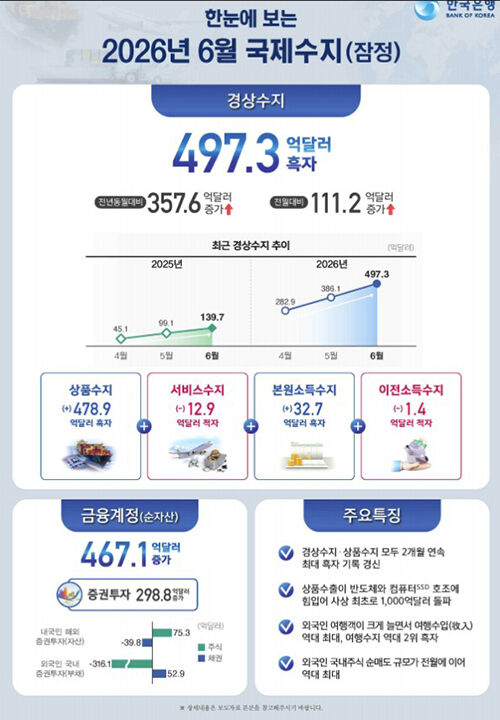
The previous record was $378.6 billion in May.
Exports surged 84.5% from a year earlier to $112.37 billion.
Amid sustained high export growth in semiconductors and information and communications equipment, exports of machinery, precision equipment, and passenger cars also shifted to an upward trend.
This marks the first time that monthly goods exports have surpassed $100 billion.
By item, based on customs clearance, high growth rates were posted by computer peripherals (SSD, 282.7%), semiconductors (196.9%), and wireless communication devices (60.6%).
By region, exports increased to Southeast Asia (105.7%), China (92.0%), the United States (78.6%), Central and South America (36.1%), the European Union (EU, 31.8%), and Japan (15.8%), while exports to the Middle East dropped by 8.5%.
Imports also rose 38.6% to $64.48 billion, though the growth rate remained lower than that of exports.
Capital goods imports grew 35.3%, led by semiconductors (64.1%), information and communications equipment (44.0%), semiconductor manufacturing equipment (42.4%), and transportation equipment (3.2%).
Raw material imports climbed 30.5%, primarily driven by coal (63.0%), crude oil (50.3%), chemical products (28.8%), gas (22.4%), and petroleum products (22.3%), while consumer goods imports also increased by 16.4%.
The services account recorded a deficit of $1.29 billion.
The deficit was smaller than the $2.90 billion deficit a year earlier, but larger than the $1.09 billion deficit the previous month.
Within the services account, the travel balance posted a surplus of $440 million.
After posting a surplus of $140 million in March for the first time in 11 years and 4 months, shifting to a deficit of $30 million in April, and returning to a surplus of $50 million in May, it recorded a surplus for two consecutive months.
As the number of inbound travelers increased while outbound travelers decreased due to rising fuel surcharges, travel receipts swelled to the second-largest scale on record.
The primary income account surplus widened from $2.17 billion in May to $3.27 billion in June.
This expansion was driven by an increase in the dividend income surplus from $1.15 billion to $2.56 billion.
Net assets in the financial account (assets minus liabilities) increased by $46.71 billion, marking the largest increase on record, surpassing the previous high of $36.99 billion set in March.
For direct investment, overseas investments by domestic residents increased by $8.01 billion, and domestic investments by foreign nationals rose by $4.63 billion.
In portfolio investment, overseas investments by domestic residents grew by $3.56 billion, centered on stocks, while domestic investments by foreign nationals dropped sharply by $26.32 billion, mainly in stocks.
Foreign investment in domestic stocks plummeted by $31.61 billion, marking the largest decline on record.
Driven by profit-taking sales and other factors, it broke the record for the largest net selling ever.
Foreign investment in debt securities saw its increase narrow from $6.40 billion in May to $5.29 billion in June due to the impact of quarter-end maturities, despite inflows of funds tracking the World Government Bond Index (WGBI).
(Photo courtesy of BOK, Yonhap News)
※ Please note: This article was translated by AI and may contain errors.



 Video News
 Video News
 Video News
 Video News
 Video News