
 KOR
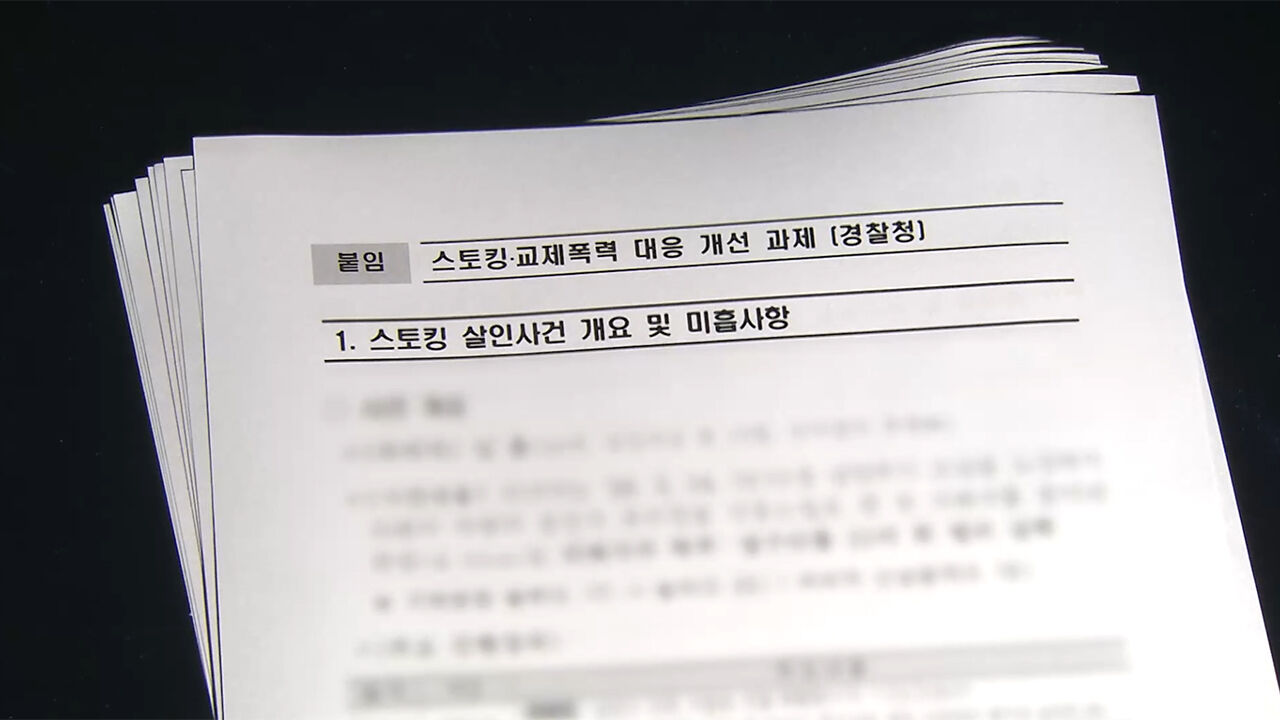
KORWe have obtained a document that the police leadership reported to Cheong Wa Dae a month before the Jang Yoon-gi incident occurred. It contained content stating that upon receiving a report of stalking crimes, they would immediately register the case and actively secure the suspect's custody. However, when the Jang Yoon-gi incident broke out, the contents of this document were not implemented. Prosecutors have launched an investigation into whether the National Office of Investigation under the Korean National Police Agency ordered the downsizing of the case to cover up such failures.
Reporter Kim Deok-hyeon has the exclusive report.
On March 14, Kim Hoon, the perpetrator of the Namyangju stalking murder, murdered a woman in her 20s whom he had previously dated.
[President Lee Jae-myung: Wasn't it because of a complacent response that we failed to prevent a horrifying crime? Please hurry to implement airtight institutional supplements.]
Two weeks later on March 27, a relevant countermeasure meeting was held at Cheong Wa Dae, and SBS obtained through a lawmaker's office the document that the National Police Agency reported to Cheong Wa Dae at the time.
The police pointed out as problematic cases where victims of relational crimes, including stalking, reported incidents but the police arbitrarily closed them without formally registering the cases.
To improve this, they reported that upon receiving related reports regardless of police station jurisdiction, they would immediately register the cases, and also presented plans to conduct basic investigations to secure the custody of high-risk groups.
However, these contents reported by the National Police Agency to Cheong Wa Dae were not implemented during the process of responding to Jang Yoon-gi's stalking crime that occurred about a month later.
On May 3, a Vietnamese woman, A, reported to the police when Jang Yoon-gi, who had sexually assaulted her, appeared near her home again.
Jang Yoon-gi's crime appears to fall under the "high-risk group" mentioned in the Cheong Wa Dae report document, but the dispatching police officers did not officially register the case and closed the scene after only "sending a warning text message."
Having received only the warning text message, Jang Yoon-gi threw away his mobile phone and freely loitered around the area, and murdered the late Lee Chae-won about 28 hours after the stalking report.
As mentioned in the Cheong Wa Dae report document, if the police had registered the case immediately upon the stalking report, classified her as a high-risk group, and moved to secure the suspect's custody, Jang Yoon-gi's murder could have been prevented.
The prosecutors, who recently secured the document, suspect that the National Office of Investigation of the police may have ordered the downsizing of the Jang Yoon-gi case to hide the fact that the investigation was not conducted according to the Cheong Wa Dae report.
Park Sung-joo, then head of the National Office of Investigation, explained to SBS that the order for "separate allocation" was "intended to have the competent department thoroughly investigate whether there were additional stalking victims."
(Video reporting: Yoon Hyung, Video editing: Shin Se-eun, Design: Seo Hyun-jung, Lee Ga-jin, Data provided by the office of Representative Park Soo-min)
---
It has been confirmed through SBS reporting that just a day before Jang Yoon-gi murdered the late Lee Chae-won, the police missed even their last chance to prevent the crime. There is a guideline called "post-callback" which mandates calling the reporter back the next day after receiving a stalking victim report, but the police failed to follow this. Prosecutors view this as another reason why the police leadership ordered the downsizing of the case.
Exclusive report by Reporter Shin Yong-il.
In October 2021, ahead of the enforcement of the Stalking Punishment Act, the National Police Agency distributed "Measures to Strengthen Response to Stalking Crimes" to frontline police stations.
These measures state that upon receiving a report of a stalking crime, a call must be made to the reporter on the "very next day."
The purpose is to check the victim's current status, assess the possibility of additional harm, and guide them through support measures via the so-called "post-callback."
However, it was confirmed through SBS reporting that the police, who received a stalking report from a Vietnamese woman two days before Jang Yoon-gi murdered the late Lee Chae-won, not only failed to register the case immediately but also failed to conduct the "post-callback" that should have been done the day after the report.
The problem is that the victim, the Vietnamese woman, submitted a complaint to another police station on May 4, the day after the report, stating that she had been sexually assaulted by Jang Yoon-gi.
If the "post-callback" had been made the day after the report as per the manual, the fact that he committed sexual assault along with stalking would have been grasped, leading to attempts to secure Jang Yoon-gi's custody and likely preventing the additional crime.
The police, who missed the last chance to stop Jang Yoon-gi's murder crime, were found to have contacted the Vietnamese victim on May 5, after the late Lee Chae-won had already died.
Gwangsan Police Station explained, "There were so many stalking reports at the time," and "As we proceeded with 'post-callbacks' sequentially, it seems to have been delayed by a day."
Having confirmed through interviews with relevant persons that the "post-callback" action was delayed at the time, prosecutors are reportedly viewing this as one of the reasons why the police leadership ordered the downsizing of the Jang Yoon-gi case.
(Video reporting: Yang Hyun-chul, Video editing: Lee So-young, Design: Hwang Se-yeon)
---
Legal affairs team reporter Kim Deok-hyeon is here with us.
Q. What is the significance of the "March 27 Cheong Wa Dae Report Document"?
[Reporter Kim Deok-hyeon: This document contains what the National Police Agency reported to Cheong Wa Dae after President Lee Jae-myung strongly reprimanded the police's poor response to the Namyangju stalking crime. It was a report conducted under truly grave circumstances, so when core contents mentioned in the report document were not implemented in the "Jang Yoon-gi incident" about a month later, the police leadership had no choice but to feel a heavy burden. Prosecutors suspect that the reason the National Office of Police Investigation ordered "separate allocation" to prevent sexual crimes from coming to light during the handling of the Jang Yoon-gi case was out of concern that the failures in initial response to the stalking case would be exposed.]
Q. The last chance, "post-callback"... What if it had been properly observed?
[Reporter Kim Deok-hyeon: Yes, that is correct. All the more so because looking back at the entire process of the Jang Yoon-gi incident, it was the last chance to prevent the tragic death of the late Lee Chae-won. Jang Yoon-gi's murder crime took place at 12:08 AM on May 5. The Vietnamese woman who reported the stalking damage on the night of May 3 filed a complaint for sexual assault damage at another police station the next day, the 4th. If Gwangsan Police Station had simply called the victim back on the 4th, the day the complaint was filed, they could have easily grasped the fact of the sexual assault and initiated a full-scale pursuit. I cannot help but feel regret, wondering if they could have apprehended Jang Yoon-gi or at least prevented the murder, given that he wandered around his usual areas on the night of the 4th.]
Q. Is the prosecution's investigation heading toward the "police leadership"?
[Reporter Kim Deok-hyeon: Prosecutors are targeting the leadership of the National Office of Investigation as the higher-ups responsible for abuse of power. Officials at Gwangsan Police Station claim they merely received and followed the order for separate allocation, and that it was the National Office of Investigation that spearheaded the case downsizing. In particular, prosecutors believe that the fact itself that the National Office of Investigation ordered separate allocation has been objectively confirmed through messages of officials from the office. However, to apply the charge of abuse of power to the National Office of Investigation, it is necessary to clarify whether there was an "unfair purpose" behind the order—that is, the "motive." Prosecutors view the contents we reported today as evidence that can arouse suspicion of an unfair motive.]
(Video editing: Lee So-young, Design: Seo Hyun-jung)
※ Please note: This article was translated by AI and may contain errors.



 Video News

 Video News
 Video News
 Video News