
 KOR
KOR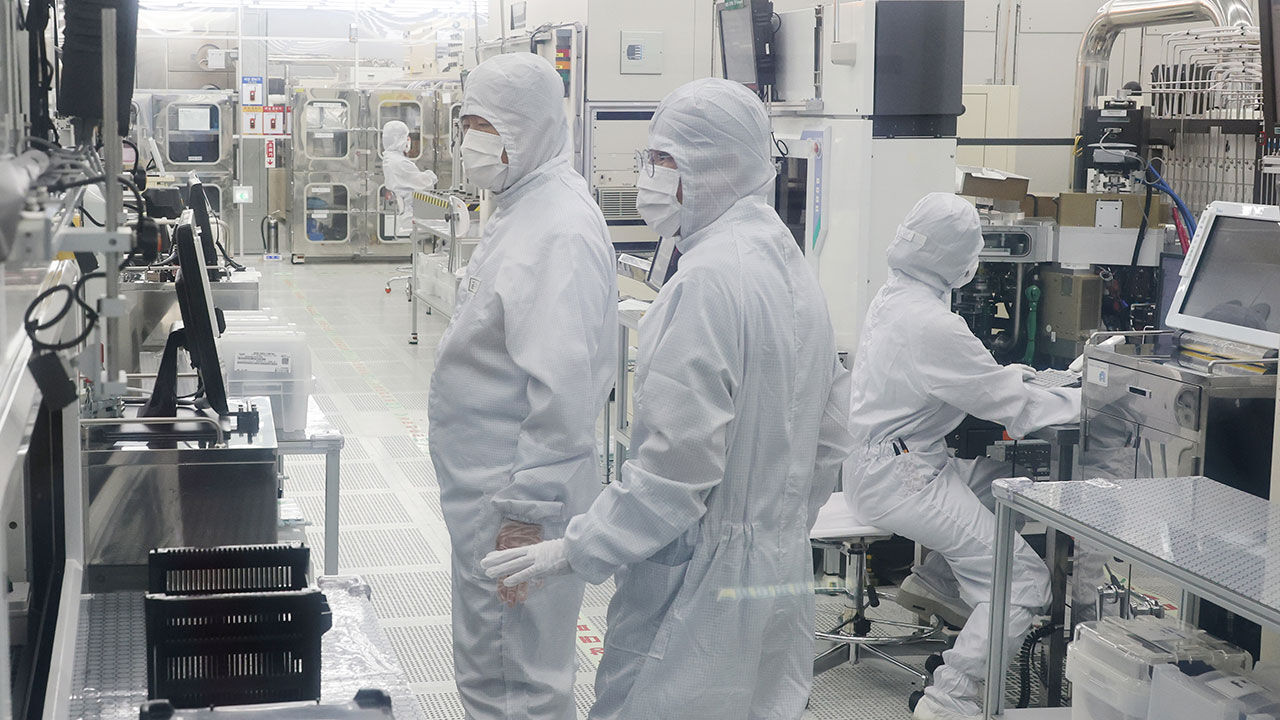
▲ A semiconductor fab at the Nano Technology Institute in Yuseong-gu, Daejeon (Photo: Yonhap News)
The tax system is being overhauled to strengthen growth engines and help small and medium-sized enterprises (SMEs) and venture firms build competitiveness.
The plan aims to utilize the tax system to favor promising industries and support productive finance, creating a stepping stone for the Korean economy to take a leap forward by raising potential growth rates.
The Ministry of Economy and Finance announced in its 2026 tax reform plan released today that securing future growth engines is one of its core tasks, and that it will support the enhancement of core industry competitiveness through tax special exceptions.
To this end, a domestic production tax credit will be established to promote the expansion of production in sectors or items with vulnerable domestic foundations.
Special exceptions will be newly created under the Restriction of Special Taxation Act to provide income and corporate tax credits based on production volume until the end of 2036 for items selected across six major fields: solar power, wind power, secondary batteries, semiconductors, core materials, and AI robot components.
This support is designed to stably secure industrial foundations that are strategically important for economic security and green transition (GX) and have a major impact on the national economy.
Eligible items will later be prescribed by Presidential Decree.
To receive the special exceptions, requirements such as direct domestic production and direct domestic sales by domestic residents must be met, and the credit amount is calculated by multiplying the production volume by the benchmark credit amount.
The system is designed so that regions are categorized into the capital area, non-capital area metropolitan cities, other non-capital areas, and preferential non-capital areas, allowing regional areas to enjoy up to 1.5 times the tax benefits of the capital area.
The credit amount will be reduced phase by phase over the final three years to encourage companies to adapt to the post-exception environment.
Hydrogen, which is one of the national strategic technology sectors subject to high tax credit rates of 30 to 50 percent for R&D and 15 to 30 percent for investments respectively, will be expanded and reorganized into "future energy."
The plan is to expand the supported fields beyond hydrogen to include small modular reactors (SMRs) and micro modular reactors (MMRs) to stably secure energy sources required for the three major megaprojects.
If petrochemical industry companies reorganize their businesses, investment, dividend, and mutual growth promotion taxes will be reduced by 50 percent up to two years after the reorganization ends, thereby easing the burden of restructuring.
If assets are sold for the purpose of investment for business reorganization or repayment of financial debt, the corporate tax deferral on capital gains will be expanded from a 4-year deferment with 3-year installment inclusion in taxable income to a 5-year deferment with 4-year installment inclusion.
Automotive-related tax systems will also be partially changed in line with changing times, such as permitting value-added tax input tax credits for autonomous passenger cars purchased or leased for R&D, and raising the depreciation limit for eco-friendly business passenger cars to 10 million won per year for electric and hydrogen vehicles while lowering it to 7 million won for internal combustion engine vehicles.
The system is being meticulously revised to help small and medium-sized enterprises and venture firms grow and settle down.
Tapering sections will be newly established for the special tax reduction for SMEs and the tax credit for production costs of video and webtoon content.
Currently, when a company graduates from SME status, benefits end immediately after a five-year grace period, but going forward, companies will be given time to adapt by enjoying reduced benefits for three years after the grace period before they end.
This is aimed at helping achieve a soft landing by reducing the shock experienced from sudden changes in the tax system.
SMEs acquiring safety equipment will be allowed to shorten the standard useful life for depreciation within a range of 50 percent.
Although a 25 percent reduction is currently possible, this eases the burden by allowing investment funds to be expensed at an earlier stage.
The period during which venture firms can receive investment tax credits when making new stock investments will be expanded from within 7 years of establishment to within 10 years, encouraging business expansion and investment revitalization.
If a domestic corporation directly invests in a venture firm located in a population-decrease region or population-decrease interest region, the corporate tax credit rate will be raised from 5 percent to 7 percent.
In addition, tax exemption special exceptions for capital gains on stocks held by venture investment companies will be applied on a permanent basis.
To vitalize the capital market and support asset building, a new Productive Finance Individual Comprehensive Asset Management Account (ISA) will be created with an annual contribution limit of 20 million won and a total limit of 200 million won, targeting residents aged 19 or older or workers aged 15 or older.
Investment targets will be limited to domestic assets, while interest and dividend income will be fully tax-exempt and benefits such as youth income deductions will be expanded.
A low-rate separate taxation special exception of 9 percent will also be introduced with a contribution limit of 100 million won for dividend income generated by investing in Corporate Growth Investment Vehicles (BDCs).
This is restricted to dividends distributed by 2029 for those who sign up for dedicated accounts from next year onward, and excludes individuals who have been subject to comprehensive financial income taxation even once in the preceding three taxable periods.
(Photo: Yonhap News)
※ Please note: This article was translated by AI and may contain errors.



 Video News
 Video News
 Video News
 Video News
 Video News