
 KOR
KOR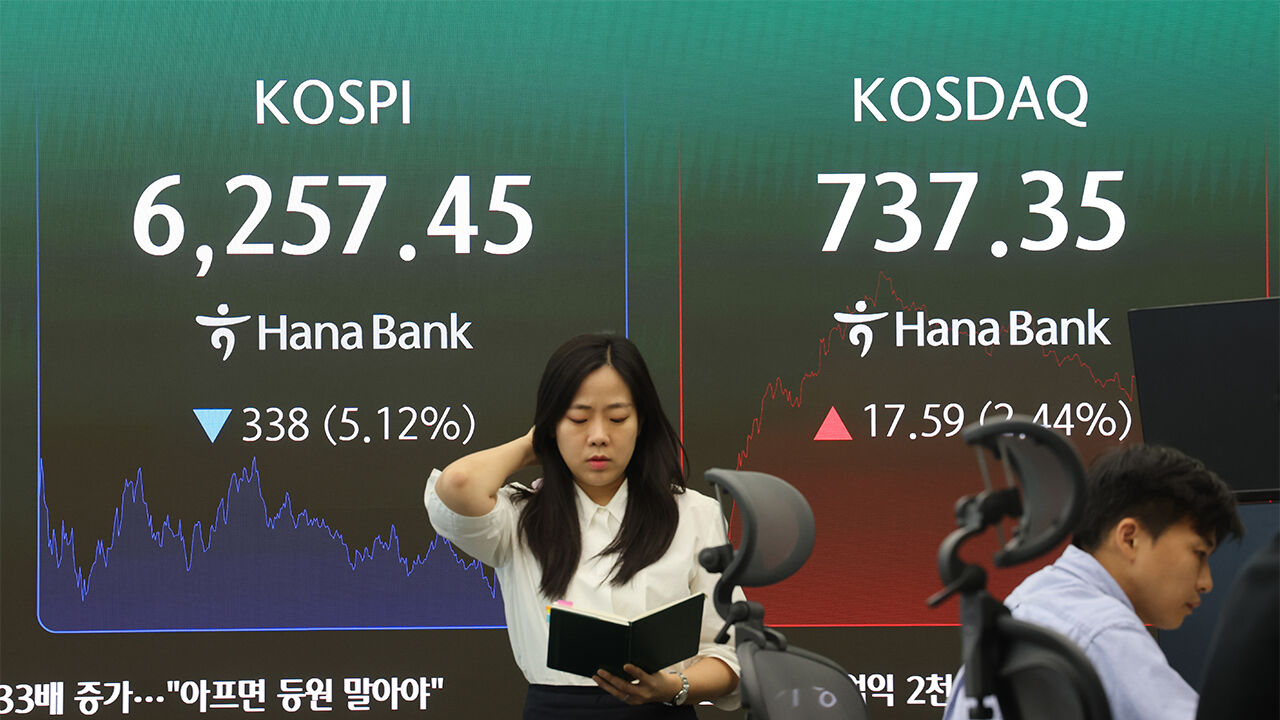
▲ An employee works at the dealing room of Hana Bank in Jung-gu, Seoul, on August 3, as the KOSPI drops more than 5% to fall back to the 6,200 range following a record-breaking surge the previous trading session.
The KOSPI, which experienced massive fluctuations of plunging and surging last week, showed renewed volatility with another sharp decline of over 5% today (August 3).
This volatility in the stock market persists despite the financial authorities implementing measures targeting single-stock leverage, which had been pointed out as a primary culprit for the exacerbated fluctuations.
In contrast, the KOSDAQ maintained a rare bullish atmosphere, extending its sharp surge for a second consecutive trading session.
Today, the KOSPI finished the session down 338.00 points, or 5.12%, at 6,257.45.
After plunging for three consecutive days starting July 28, the index ended the final trading session of last week on July 31 with a record surge of 1,001.89 points (17.91%) to close at 6,595.45, marking the largest gain and percentage increase in history.
Consequently, today's drop is largely interpreted as a result of profit-taking following the historic surge.
SK Hynix, which hit the daily price limit (29.95%) on July 31, and Samsung Electronics, which soared 26.81%, dragged down the index by plunging 8.76% and 8.79%, respectively.
Foreign investors, who drove the rebound of the South Korean stock market by net purchasing a whopping 7.241 trillion won in the previous session, turned to net sellers today, offloading 2.8429 trillion won.
While institutions also net sold 1.9477 trillion won, selling dominance was prominent among financial investment (1.5561 trillion won), investment trusts (473.3 billion won), and pension funds (20.4 billion won).
Considering that a significant portion of financial investment supply and demand comes from retail funds through exchange-traded funds (ETFs), this can be seen as massive profit-taking driven by the short-term surge.
On the other hand, retail investors stood alone as net buyers, purchasing 4.6531 trillion won primarily centered around the electrical and electronics sector, betting on an additional rebound in the domestic stock market.
Unlike the KOSPI, which continued to show high volatility, the KOSDAQ maintained its strength.
Today, the KOSDAQ closed up 17.59 points, or 2.44%, at 737.35.
The index, which surged 11.63% the previous trading session, continued its strong rebound by soaring up to 757.60, a 5.26% jump at one point during intraday trading.
As a result, a buy sidecar was triggered in the KOSDAQ market, temporarily suspending the effect of program purchase quotes for five minutes during the morning.
Some market observers speculate that regulatory measures, such as raising the basic deposit, helped calm the phenomenon of capital flowing out of KOSDAQ and into single-stock leverage ETFs.
Major stock markets in other Asian countries generally followed trends similar to South Korea.
Japan's Nikkei 225 index, which jumped 4.03% on the final trading day of last week, fell 0.94% today.
Taiwan's Weighted Index rose 0.62% today following a 7.98% surge on July 31, but TSMC fell 2.27% in the aftermath of its 9.98% surge in the previous session.
Although the three major New York stock market indices closed last week on a strong note, the limited spillover of warmth into the semiconductor sector appeared to put the brakes on the rebound momentum.
On July 31, the Dow Jones Industrial Average rose 0.53%, the S&P 500 index gained 0.70%, and the Nasdaq advanced 1.00%.
Concerns that big tech's blood-soaked competition in AI infrastructure would not yield sufficient profitability relative to investment scale subsided as users of Microsoft's office assistant AI service, 365 Copilot, surged and Amazon's cloud business posted record growth.
However, Kioxia, a Japanese semiconductor company, posted lower-than-expected earnings, stoking worries about a slowdown in NAND memory price hikes. Combined with mounting profit-taking pressure from the sharp rebound, the Philadelphia Semiconductor Index managed only a 0.07% gain.
Ultimately, major Asian stock markets, including South Korea, appear to have given up some of their gains by inheriting this atmosphere.
Another background cited for today's sharp drop is that, despite positive news such as global investment bank Morgan Stanley recently upgrading its investment opinion on South Korean stocks to Overweight in a recent report, domestic and foreign investors still harbor significant caution regarding the South Korean stock market, which has exhibited abnormally high volatility over the past month or so.
Morgan Stanley diagnosed that with market concentration and leverage rapidly unwinding, the KOSPI now retains 36% upside potential to reach its target of 9,000 points.
Pointing out that the recent sell-off stems from technical factors rather than impaired fundamentals, it analyzed that the liquidation of leveraged ETFs, hedge fund borrowings, and retail investors' margin debt balances has passed its midpoint.
Domestic stock market experts also generally forecast that the domestic stock market will raise its floor and enter a recovery path in August.
Today, the KOSPI 200 Volatility Index finished down 4.23% at 80.78.
The index had previously spiked to an intraday high of 93.27 on July 29, when the KOSPI plunged for two consecutive days.
(Photo: Yonhap News)
※ Please note: This article was translated by AI and may contain errors.





 Video News
