
 KOR
KOR
Four days after learning of her pregnancy, Ms. A underwent an abortion procedure at another OB-GYN clinic. This was after being turned down by two previous clinics where she had inquired about an abortion. Ms. A was 36 weeks pregnant at the time. Still, the reason she sought out a third clinic and chose to terminate her pregnancy was that she lacked financial means and had no confidence in her ability to raise a child if she gave birth.
Ms. A uploaded a vlog video documenting the entire process of the surgery to YouTube. The title was <Total Surgery Cost 9 Million Won, 120 Hours Like Hell>. After watching Ms. A's video, the Ministry of Health and Welfare requested a police investigation. Following an investigation, law enforcement handed Ms. A over to trial. The charge was 'murder.' The prosecution alleged that Ms. A 'murdered' the fetus by undergoing an abortion procedure. This was the first time murder charges were brought against a woman who chose to terminate a pregnancy.

Reversed Verdict... First Instance '3-Year Prison Sentence' → Second Instance 'Acquittal'
The key issue was 'how much Ms. A knew' at the time of the abortion procedure. This is because her range of awareness allows an assessment of her intent. Depending on whether 1) she believed the fetus would be stillborn through a Cesarean section, or 2) she knew the fetus could be born alive, the charges applied to Ms. A and the resulting sentencing would completely differ. If Ms. A proceeded with the surgery knowing the fetus would be born alive, murder charges would apply.
Ms. A consistently maintained, "I did not know the fetus would be born alive." She asserted that at the time of the procedure, she believed the fetus would be delivered stillborn. In fact, before the surgery, Ms. A asked the broker who connected her to the clinic whether the fetus would be stillborn and received a response to the effect that it would be delivered stillborn.
First Instance Court: "Ms. A Had Intent to Murder Fetus"
The court also cited the fact that Ms. A signed a consent form for the disposal of the fetal remains. According to Supreme Court precedents, intent to murder can be recognized even without a specific purpose or motive to kill, as long as one recognizes the possibility or risk that someone could die as a result of their actions. Accordingly, the first instance court recognized Ms. A's criminal intent for willful negligence murder.
Appellate Court: "Ms. A Believed Fetus Would Be Stillborn... Had No Intent to Murder"
The court noted that there was "no evidence that Ms. A knew the broker's claim that 'the fetus would be stillborn' was made without consulting medical personnel." Because she was told by the broker that 'the fetus would be stillborn,' the court reasoned that Ms. A literally believed the fetus would be stillborn. Furthermore, the court viewed Ms. A's signing of the consent form for fetal body disposal not as endorsing the medical staff's killing of a live-born child, but as "appearing to be standard content delegating the handling of fetal remains."
The vlog video Ms. A posted on YouTube also served as evidence for the ruling. The court stated, "If Ms. A had known that the procedure involved delivering the fetus via C-section and then artificially killing it, posting a video on a YouTube channel would be an extraordinarily unusual act that is difficult to understand." Thus, the YouTube video supported Ms. A's claim that 'she believed the fetus would be delivered stillborn.'

Court Recognizes 'Abortion Decision = Constitutional Right to Self-Determination'
Senior Judge Kim Yong-seok (Criminal Division 5, Seoul High Court)
A pregnant woman's right to decide whether to maintain her body and pregnancy status constitutes the right to self-determination derived from general personality rights guaranteed by the Constitution.
This was stated directly by the court at the end of the sentencing hearing. The court ruled that a mother's right to decide whether to continue a pregnancy is a 'right to self-determination.' The intent was that a woman's decision to maintain or terminate a pregnancy is a 'right to self-determination' guaranteed by the Constitution and must be protected as such.
The court stated that it would 'consider in sentencing the fact that this case originated from mother Ms. A's intent to terminate the pregnancy.' It emphasized that Ms. A's decision to undergo an abortion must be distinguished from the actions of the medical staff who killed the fetus born alive. As a result, Ms. A was acquitted, while the hospital director who placed the fetus in a freezer and the operating surgeon were sentenced to 4 years and 2 years and 6 months in prison, respectively.
"Tragedy Encountered Amid Legislative Void, Hope It Serves as Catalyst for Public Discourse"
Attorney Kim Myeong-seon (Legal Representative for Ms. A)
Rather than finding meaning merely in overturning the personal criminal penalty for mother Ms. A to an acquittal, I hope this case serves as an opportunity for public discourse on how much confusion the medical community and pregnant women have been thrown into amid the ongoing legislative void following the Constitutional Court's decision of non-conformity regarding abortion law, leading to such tragedies.
These remarks were made at a press conference immediately following the second-instance ruling by Attorney Kim Myeong-seon, legal counsel for Ms. A. As Attorney Kim noted, although the Constitutional Court issued a ruling of non-conformity with the Constitution on criminal abortion 7 years ago, replacement legislation has still not been enacted. Abortion remains neither explicitly legal nor illegal. Social consensus and standards regarding up to how many weeks an abortion is permitted, or what medications, procedures, or surgeries a pregnant woman can choose for an abortion, have not been established. Nothing has been decided.
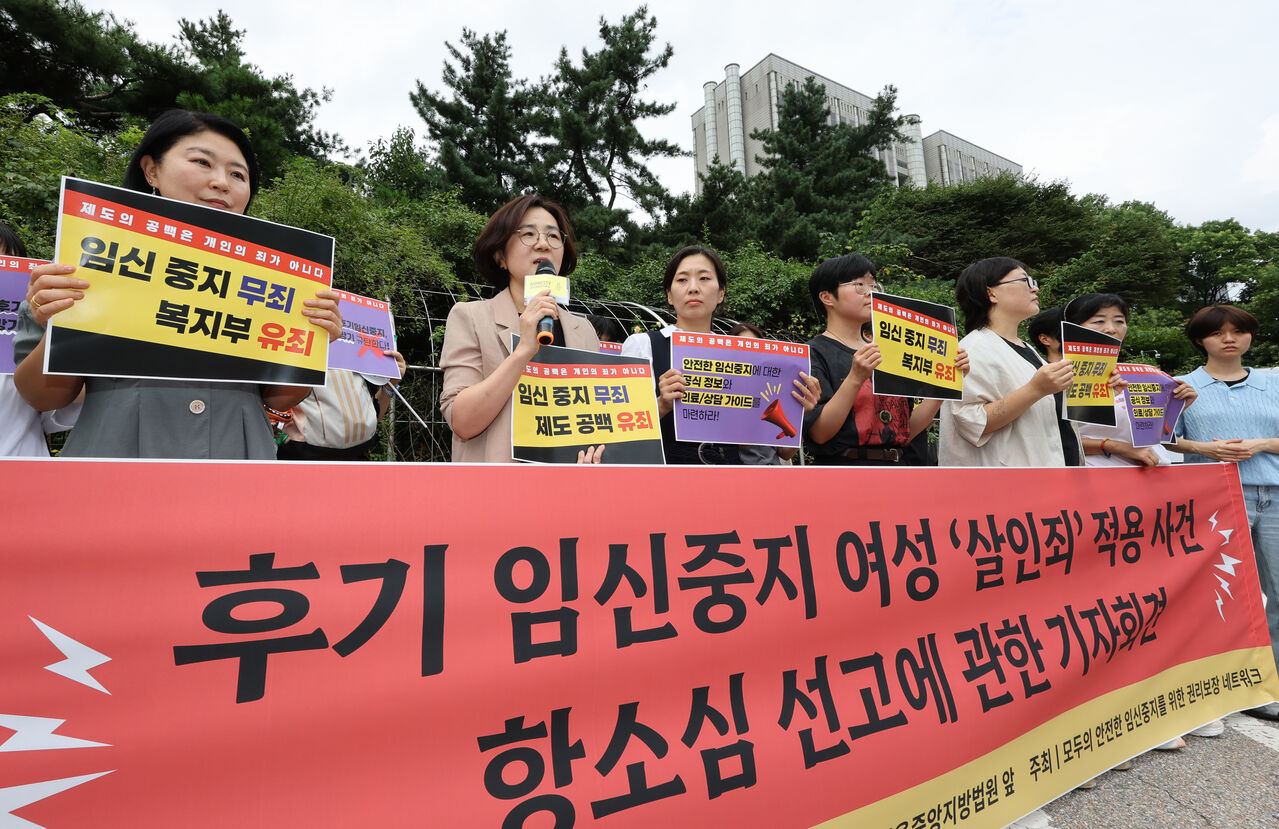
In the meantime, many pregnant women in crisis have emerged in society. Socioeconomically isolated, Ms. A was also one of these pregnant women in crisis. It was difficult to receive support from a partner or family, and she was in no position to manage maintaining the pregnancy through childbirth. Furthermore, she realized her pregnancy late. (Ms. A visited an OB-GYN clinic after not having a period for 3 months, but heard no mention of 'pregnancy' at the clinic. She was diagnosed with polycystic ovary syndrome, which can cause irregular periods. This is why she was completely unaware of her pregnancy until weeks 34 to 36.)
Although the government enacted a law allowing pregnant women in crisis to give birth anonymously, Ms. A was unable to receive institutional support under the law. Ms. A discovered her pregnancy in late June 2024, but the law did not take effect until mid-July 2024. Receiving no personal assistance, legal support, or institutional aid, Ms. A ultimately chose to undergo an abortion at 36 weeks of pregnancy.
What If Safe Information Regarding Abortion Had Been Provided?
When a tragedy occurs to an individual due to the absence of social systems, to what extent can society hold that individual responsible? It makes one reflect on whether society is trying to fill the systemic gap created by 7 years of state inaction simply by labeling it an individual's 'moral flaw.' Although the abortion criminal code was ruled unconstitutional, women's abortions remain a subject of condemnation, with the possibility of punishment for 'murder' persisting. Women must not be forced into unwanted childbirth simply because of a lack of information or financial inadequacy. On July 28, the prosecution filed an appeal against the acquittal of Ms. A. Now, the judgment rests with the Supreme Court.
※ Please note: This article was translated by AI and may contain errors.






 Video News
 Video News