
 KOR
KOR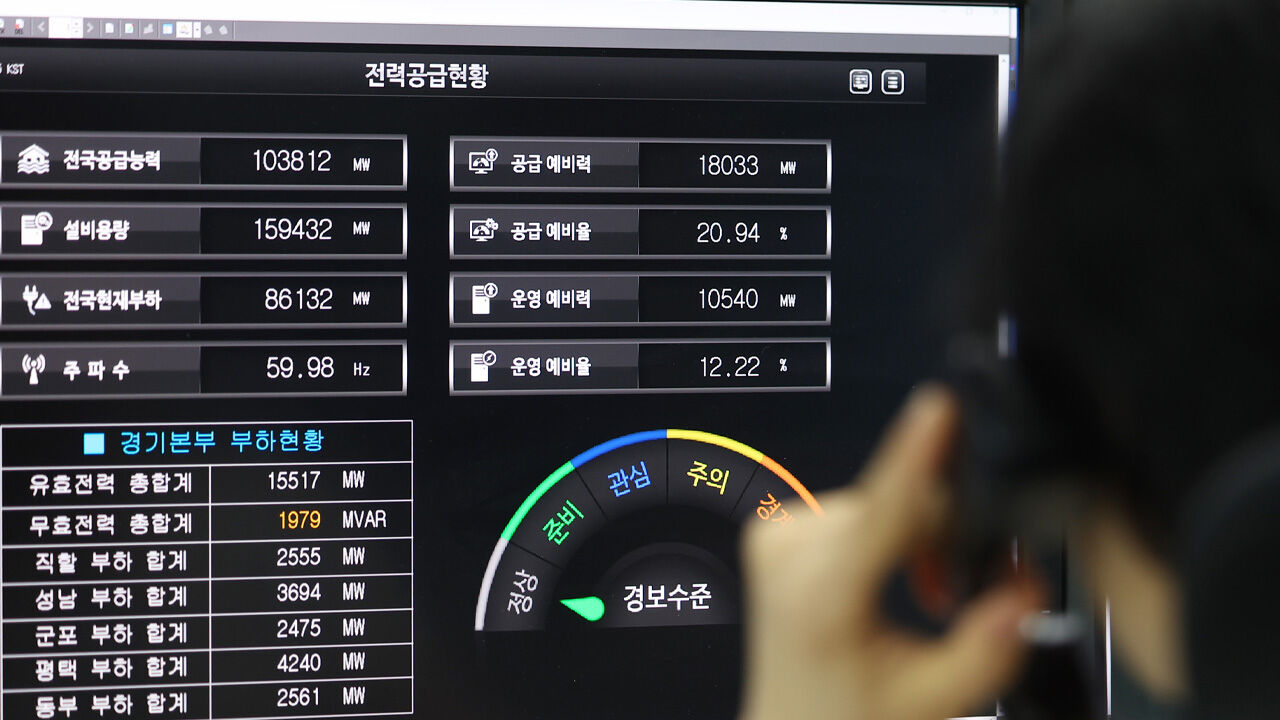
▲ Officials monitor the power supply and demand status at the Grid Operation Center of KEPCO's Gyeonggi Provincial Office in Yeongtong-gu, Suwon-si, Gyeonggi-do on the 13th of last month, as electricity demand increases amid a continuing heatwave.
Even as heatwaves persist across the country, with temperatures in Yangsan, Gyeongsangnam-do exceeding 40°C for five consecutive days, electricity supply and demand are being maintained relatively stably.
However, as the government forecasts that power demand will reach its peak during the third week of August, power authorities have also activated an emergency response system to monitor the situation.
According to the Korea Power Exchange today (the 2nd), the time of peak power generation today is expected to be between 7:00 PM and 8:00 PM, with peak power projected to reach 82.7 gigawatts (GW).
The Korea Power Exchange explained that the supply reserve during this time slot will be 18.7 GW (a reserve margin of 22.6%), ensuring that power supply and demand will remain stable.
The supply reserve margin is calculated by dividing the supply reserve—which is the available supply capacity minus electricity demand—by the peak demand, and it indicates how much leeway the power grid has.
Normally, a supply reserve margin of 10% or higher is considered a stable level.
On the 13th of last month, peak power reached 92.9 GW and the supply reserve margin dropped to 11%, but higher reserve margins have been maintained since then.
During July 27 to 30, when peak power remained in the 90 GW range, the reserve margin was 14% to 15%.
An official from the power authorities explained, "It appears that there are currently no issues with power generation relative to demand," adding, "During the summer, we are securing reserve margins by ensuring that generators do not stop for reasons such as inspections as much as possible."
However, as full-fledged heatwaves continue, electricity consumption driven by increased cooling demand is also expanding gradually.
The monthly average peak power jumped from an average of 71.5 GW in June to 83.9 GW last month, and is recording 82.9 GW this month.
Previously, the Ministry of Climate, Energy and Environment projected that electricity demand could rise between 94.1 GW and 98.8 GW during the third week of August.
If the forecast holds, it could record the highest electricity demand in history, surpassing the 97 GW of 2024.
The Ministry of Climate and Environment stated that even if power demand reaches the projected maximum, there will be no problems in managing supply and demand.
It explained that this summer's power supply has been increased to 107 GW, up 2 GW from last year, and that even if peak power demand reaches 98.8 GW, the reserve margin will be 8.2 GW, which is at a "manageable level."
It also noted that an additional 8.8 GW of reserve resources has been prepared in case reserve margins become insufficient.
The government has designated the period from June 29 to September 18 as the power supply and demand countermeasure period, maintaining an emergency response posture with related organizations.
Korea Electric Power Corporation (KEPCO) has also established a facility stability plan to prepare for summer disaster types, including heatwaves.
(Photo: Yonhap News)
※ Please note: This article was translated by AI and may contain errors.



 Video News
 Video News
 Video News
 Video News
 Video News