
 KOR
KOR![The Public Official Election Act's Crime of Publishing False Information: Is It Flawed? [Evening Briefing]](https://img.sbs.co.kr/newimg/news/20260728/202206587_1280.jpg )
| Article 250, Paragraph 1 of the Public Official Election Act (Crime of Publishing False Information) Any person who, with the intent to be elected or to have another person elected, publishes or causes to be published false information regarding the birthplace, family relationships, status, occupation, career, property, conduct, or affiliated organizations of a candidate, their spouse, lineal ascendants or descendants, or siblings, shall be punished by imprisonment for not more than five years or by a fine not exceeding 30 million won. |
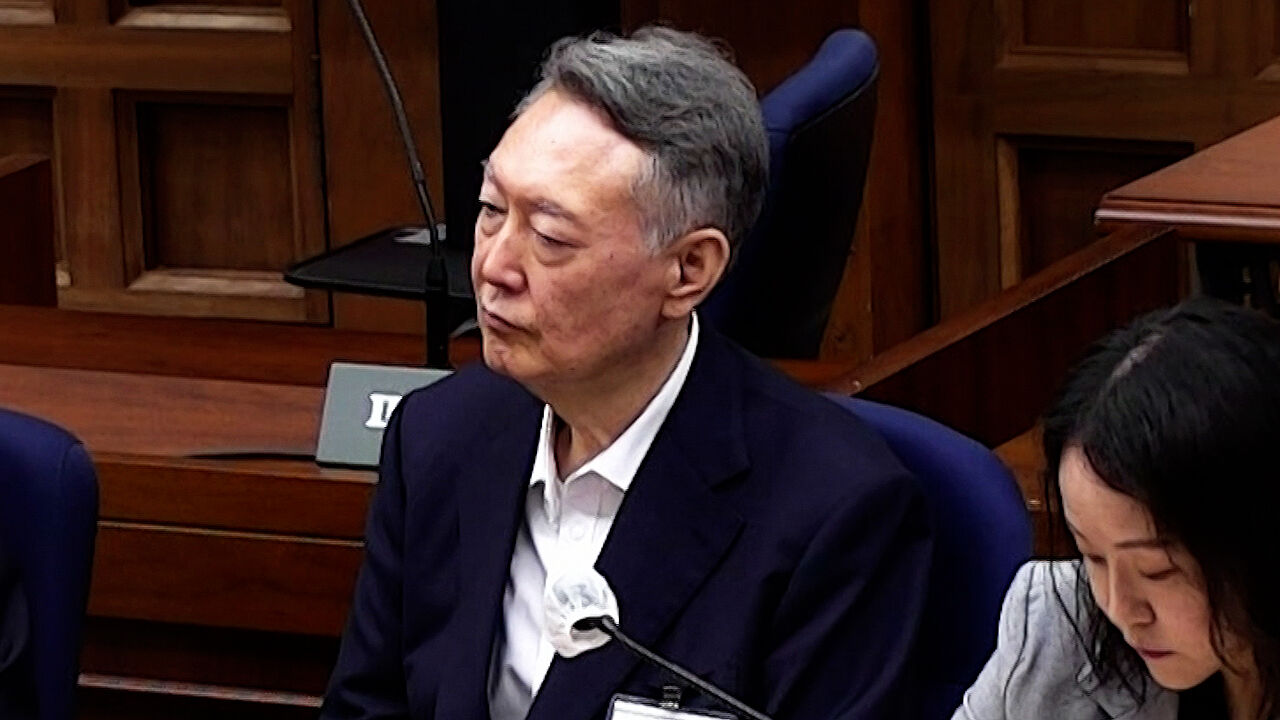
Former President Yoon Suk Yeol was found guilty in his first-trial ruling regarding this charge and received a suspended prison sentence. If this ruling is upheld by the Supreme Court, his presidential election will be nullified, and the People Power Party will be required to return 39.7 billion won in election expenses reimbursed at the time to the national treasury.
Coincidentally, President Lee Jae-myung has also stood trial on charges of committing the same crime. His rulings were split with a guilty verdict in the first trial and an acquittal in the second, but the trials were suspended after the Supreme Court remanded the case with a guilty intent. If a fine of 1 million won or more is finalized, there would be no revocation of his election since he lost the election in question, but the Democratic Party of Korea would still have to return 43.4 billion won in election expenses to the state. Former and current presidents who ran in the 2022 presidential election have both been convicted or faced rulings under the exact same charge. This starkly demonstrates how powerful an impact this law holds in the political arena.
1. Details of False Information Publication Charges Against Former and Current Presidents
① Former President Yoon Suk Yeol Found Guilty in First Trial
Two remarks made by former President Yoon during debates and interviews held during his presidential campaign became problematic. The first was his denial during a Kwanhun Club debate in December 2021 that he introduced lawyer Lee Nam-seok to former Yongsan Tax Office chief Yoon Woo-jin, who was under investigation for bribery charges. The court determined that former President Yoon made false explanations despite having directly arranged contact.
The second was his explanation during an interview in January 2022 that he only came to know Geonjin-beopsa (Jeon Seong-bae) through an introduction by a party official and had never met him together with Kim Keon-hee. The court acknowledged that he published false information to lead voters astray, despite having maintained a long-term acquaintance and received advice.
② President Lee Jae-myung: Supreme Court Remand with Guilt Intent
President Lee Jae-myung also faced scrutiny over remarks he made during press interviews and other occasions during the 2022 presidential campaign. The first involved remarks about the "manipulated golf photo" related to the late bureau chief Kim Moon-ki. President Lee commented regarding a photo capturing circumstances of him playing golf with bureau chief Kim Moon-ki during an overseas business trip, stating that the "photo was manipulated." The Supreme Court ruled that the remark constituted the publication of false information by making voters perceive that he "did not play golf during the overseas business trip."
The second part involved his statement that there was "pressure and intimidation from the Ministry of Land, Infrastructure and Transport" during the process of changing the land use designation of Baekhyeon-dong. The Supreme Court judged that the change in land use was pursued independently by Seongnam City and that there was no intimidation from the Ministry, making it a false statement that distorted core facts.
2. Controversy Surrounding the 'Crime of Publishing False Information' and Analysis of Pros and Cons for Revision
Demands for regulatory easing through revisions and arguments for maintaining the status quo are clashing fiercely over Article 250 of the Public Official Election Act. Criticism that it excessively restricts the words and actions of election candidates collides with counterarguments that it is necessary for voters to make proper judgments.
① Arguments in Favor of Revision
The core argument is that it suppresses freedom of expression. The claim is that if careless word choices, exaggerations, or multi-faceted expressions arising from live broadcasts or impromptu question-and-answer sessions are subjected to judicial punishment, the political speech of candidates will be excessively chilled.
There are also concerns that it violates the principle of clarity under the principle of legality. Explaining matters such that determining falsehoods extends beyond simple "facts" to subjective evaluations of "behavior" or "context" can lead to convictions or acquittals depending on the judiciary's subjective interpretation, thereby reducing legal predictability.
The judicialization of politics is also raised as an issue. Critics point out that while revisions of election results should be achieved through verification and judgment by voters, the phenomenon where complaints and accusations by defeated parties and judicial rulings overturn election results or lead to the return of massive election expenses can distort the will of voters.
② Arguments Opposing Revision
The argument is that it is necessary to protect election fairness and voter rights. Critics argue that if intentional lies regarding a candidate's morality, suspicions of corruption, and past conduct are left unchecked, voters will cast ballots based on misinformation, undermining the value of democratic elections.
They also put forward the preventive effect against black propaganda. They state that strict criminal punishment regulations must exist to deter candidates from spreading irresponsible fake news or black propaganda in elections.
3. Overseas Response Cases Regarding Publication of False Information
Countries that developed democratic election systems earlier than South Korea take legal approaches quite different from ours regarding the balance between freedom of political expression and election fairness.
First, the United States places freedom of political speech and expression as its highest value through the First Amendment. Therefore, laws criminally punishing lies by public office candidates do not exist, and even if enacted, they would be ruled unconstitutional. Even in civil lawsuits such as defamation, priority is given to democratic debate and the verification roles of voters and the press to the extent that plaintiffs must prove "actual malice" for damages to be recognized.
Germany strictly penalizes defamation, insults, and hate speech under its criminal code. However, cases where criminal punishment leading to the nullification of an election is imposed on grounds of political arguments or explanatory remarks made by candidates during election campaigns are extremely rare. Most issues are resolved outside the judicial framework through warnings by constituency election commissions, political debates, and fact-checking by the media.
The United Kingdom has a clause in its public official election act prohibiting the publication of false information regarding an opposing candidate's character or reputation. However, it is applied restrictively to cases where "the purpose of harming the opponent is clear."
4. The Core is Balance
Ultimately, the essence is to establish an environment where voters can make judgments based on accurate information while striking an appropriate balance so as not to excessively restrict political expression or undermine the ultimate decision-making power of voters. Many legal experts suggest considering the following legal revisions:
① Specifying the Requirement of 'Malicious and Manipulative Purpose'
Simple lapses in memory, exaggerations, impromptu answers, and ambiguities in expression should be excluded from punishment targets. Instead, the constituent requirements should be strictly narrowed down to "cases where clearly manipulated and fabricated false information was disseminated with the purpose of directly influencing the election."
② Diversification of the Penal System
We must move away from the fragmentary sanction method of "a fine of 1 million won or more resulting in nullification of election and return of election expenses." It is necessary to introduce flexible sanctions such as fines, corrective orders, and guarantees of the right to reply depending on the degree of violation to reduce side effects where the judiciary directly dictates presidential election results.
③ Strengthening Independent Fact-Checking and Autonomous Verification Systems
Rather than relying on the judiciary's legal judgments, political and social verification functions should be revitalized by introducing methods such as immediately disclosing fair fact-checking results by the media and election commissions to voters through election bulletins or the National Election Commission website.
Had the martial law crisis not occurred and former President Yoon not been impeached, this ruling would have been a political nuclear bomb opening up the possibility of a sitting president's election being nullified. Would this truly be desirable? Would it be right to apply the law differently out of fear of that outcome? It is likely a hypothetical worth referencing when reviewing the necessity of legal revisions.
※ Please note: This article was translated by AI and may contain errors.


 Video News
 Video News
 Video News
 Video News
 Video News