
 KOR
KOR
▲ Water being sprayed onto a livestock shed amid a heatwave
"We leave the fans running all day and keep spraying water, but there is nothing we can do."
As extreme heatwaves approaching 40°C continue day after day, livestock farmers are struggling to protect their animals.
Farmers are desperately trying to lower temperatures inside the barns even a little by continuously operating large fans, misting systems, and ventilation fans, while repeatedly spraying water on the roofs.
They are supplying fresh water, immunity boosters, and nutrients, and even inspecting electrical facilities to prevent power outages, but these efforts fall short of overcoming the intense heat.
Lee, who raises 90,000 chickens in Gyeongju, said in a phone call, "Before the heat, about 10 chickens died naturally per day, but now about 300 die every day."
"Even with all the methods to lower the temperature like spraying water and running fans, it is an extraordinary weather, so how can they endure?" he said, adding, "I contacted other poultry farms, and they are all in a similar situation."
As the prolonged heatwave leads to continuous deaths of chickens and pigs, the distress among farmers is deepening.
In Gyeongsangbuk-do, damage is rapidly increasing with some 75,000 livestock dying due to the heatwave this year.
According to Gyeongsangbuk-do and local governments today (the 28th), a total of 75,283 livestock have died across the province due to the heatwave as of the morning of the previous day.
The casualties include 5,400 pigs and 69,883 chickens.
There are no reported damages to cattle so far.
Last year, 160,878 livestock (28,367 pigs and 132,511 chickens) died from heatwaves in Gyeongsangbuk-do.
Authorities are concerned that livestock damage will exceed last year's level as this year's unprecedented heatwave rages fiercely.
Shim Chang-seob, head of the Pohang branch of the Korea Pork Producers Association who raises 3,500 pigs in Pohang, said, "It seems that pig deaths have increased by about 15% this summer compared to usual."
He stated, "The local government supported us to install air conditioners in the barns, but just as people catch air-conditioningitis if the temperature is too low, the pigs struggle, and spraying water increases humidity, creating another difficulty. Raising them is hard when it is too hot, so summer poses various challenges either way."
Local governments are stepping up emergency water spraying and supply support to minimize damages such as livestock deaths and decreased productivity.
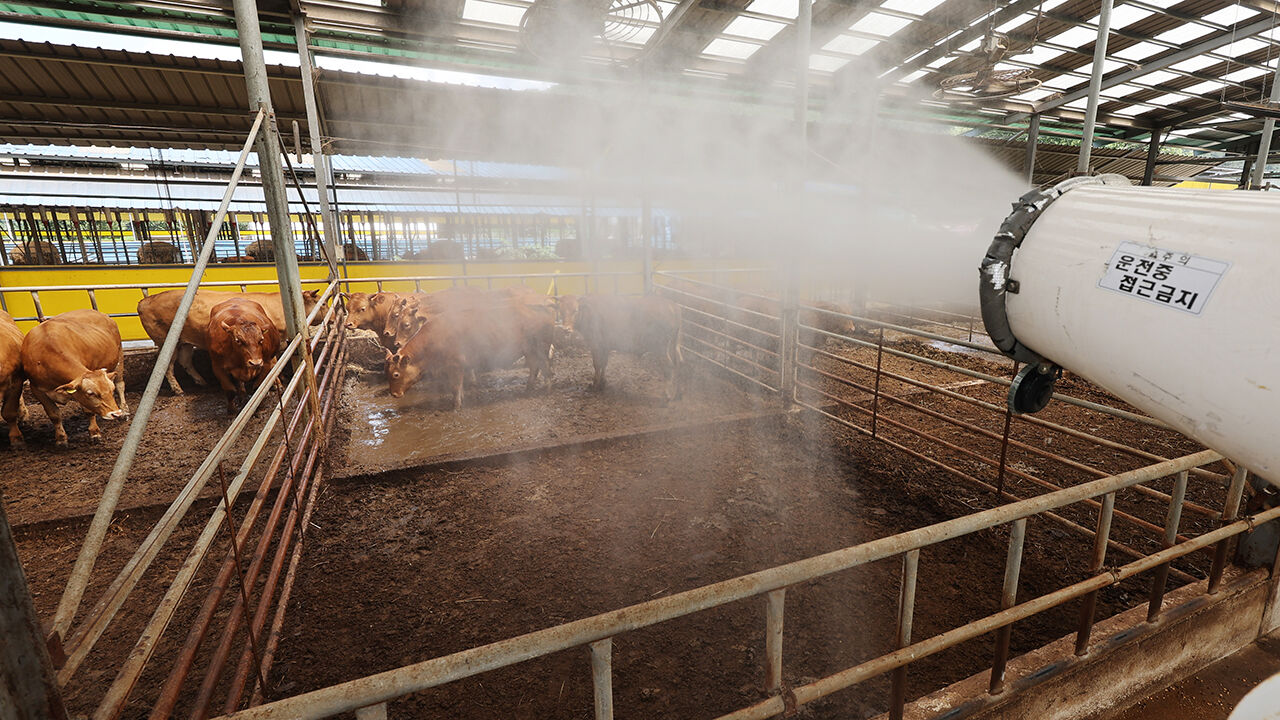
They are using vehicle-mounted high-pressure water spraying equipment to drench barn roofs and outer walls, while providing emergency water supplies to farms facing water shortages to ensure livestock receive a stable supply of water.
They are providing guidance on the ground, such as checking the normal operation of cooling facilities like ventilation systems and blowing fans, ensuring sufficient water supply, adjusting feeding times, and strengthening ventilation.
Feed additives for immunity enhancement are also being provided in preparation for the prolonged heatwave.
Gyeongsangbuk-do and various cities and counties have formed disaster response management teams and technical support groups for the livestock sector to check countermeasures and concentrate efforts on guidance for management tips.
Previously, 16.5 billion won was invested to improve breeding environments by supporting disaster insurance premiums, large fans for heat prevention, misting systems, ventilation facilities including large blowers, and feed additives for immunity enhancement.
An official from Gyeongsangbuk-do said, "As livestock damage is feared to continue with the prolonged heatwave, livestock farms must pay special attention to animal husbandry and barn environmental management."
(Photo: Yonhap News)
※ Please note: This article was translated by AI and may contain errors.


 Video News
 Video News
 Video News
 Video News