KOR
KOR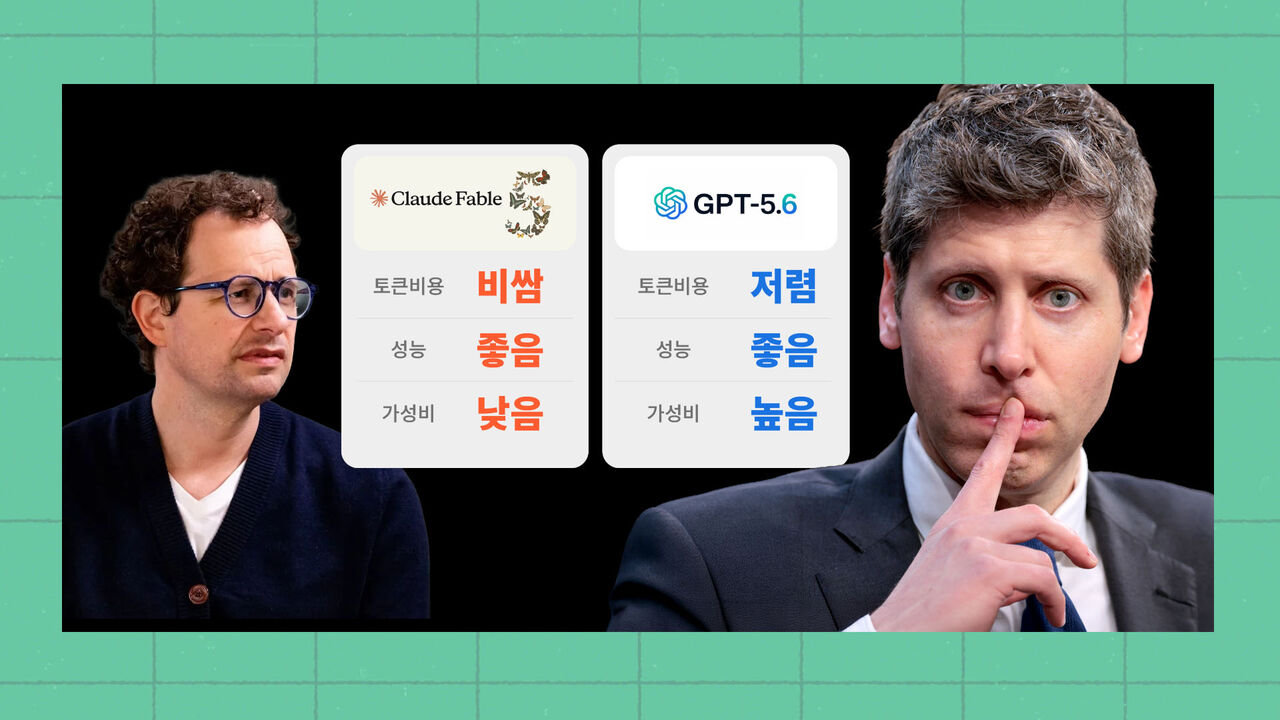
⚡ Key Takeaways
OpenAI's new model, GPT-5.6, has reaffirmed its influence in software development by demonstrating performance that overwhelmed human experts and existing AI in coding competitions.
As performance levels plateau across the enterprise AI market, cost-effective models maximizing token cost efficiency have emerged as a critical variable in securing market share.
While Anthropic struggles with pricing policies due to computing resource limitations, OpenAI and xAI are aggressively competing in the market with high performance at low prices as their weapon.
Hello. I am reporter An Hye-min, who handles and works with data. OpenAI, which had been evaluated as falling behind Anthropic, has sharpened its knives and returned. As praise continues for its new model, GPT-5.6, the AI market is buzzing once again. In today's OhGraph, we prepared the story of GPT-5.6. Let's look through five graphs at why this model is drawing attention and how the AI market is shifting as a result.
Following Chess and Go, Now Coding... Top-Tier Programmers Fall to AI
Before diving into OpenAI, let's first go to Japan. There is a company called AtCoder, founded in 2012. It regularly hosts programming contests where programmers from around the world can showcase their skills. Among them is a tournament where only the top scorers from online qualifiers and regular competitions gather to compete: the World Tour Finals. It is an offline coding competition where the top 12 elite champions in AtCoder rating are invited to Tokyo to compete. This year, the tournament was held once again with top-tier programmers from all over the world.

Twelve programmers participate in each of these two divisions, and since last year, AI models have also been participating and competing. In last year's competition, AI models lost to human programmers in the heuristic category. Although AI's coding capabilities had improved, humans were still superior at the topmost level. The participant who defeated AI at the time was Polish programmer Psyho. How about this year?


Next is the algorithm division. A total of five problems were given in the algorithm division, with victory determined by who solved them correctly first. Looking at the line-up of programmers in the algorithm division, they are all truly remarkable figures in this field. There is tourist from Belarus, who competed in the International Olympiad in Informatics at the youngest age of 11 and set a record as the first in history to win six consecutive gold medals. There is also jiangly, a legendary Chinese programmer with a suspicious anime profile picture. Alongside them, representative programmers from the United States and Canada also participated to compete for supremacy; let's examine the results through a graph.


OpenAI Bounces Back... Delivering Both Performance and Cost-Effectiveness
Despite this narrative, until recently, it was actually Anthropic's models that demonstrated outstanding performance in software development. Many developers were satisfied after using Claude Code, and companies scrambled to use Anthropic's products. Looking at actual enterprise LLM spending, Anthropic overtook OpenAI last year.

Conversely, OpenAI delivered results that fell short of expectations. For example, do you remember GPT-5 released last summer? Many people expected huge performance gains with the transition from 4 to 5, but when opened, reality proved different.
That does not mean OpenAI was standing still. It steadily pushed for performance improvements. Signs of change began to appear in the second half of last year. Let's head to Baku, the capital of Azerbaijan, in September 2025. It was the finals of the International Collegiate Programming Contest (ICPC) held in Baku. Roughly 3,000 universities participated, with only the top 139 teams advancing to the finals, where they had to solve 12 algorithm problems within a 5-hour time limit.

OpenAI continued updating its versions following the release of GPT-5. And finally, GPT-5.6 emerged into the world. Of course, this model was not released to the market right away. The U.S. government placed restrictions, allowing only 20 partner organizations approved by the government to use it first. This is only the second time the government restricted access to an AI model in this manner, following Anthropic's Fable and Mythos 5. While accepting the government's request, OpenAI pointed out that such an approach should not become routine. On the other hand, it accepted regulation partly because it was facing an IPO, but also because it internally acknowledged the model's potential risks to a degree.

After negotiations took place between OpenAI and the U.S. government, restrictions were lifted, and GPT-5.6 was officially released to the market. It was released across three tiers: Sol, the highest tier; Terra, a lightweight model; and Luna, an even lighter model. Metrics evaluating model capability show that in coding and finance, it reached the level of Anthropic's Claude Fable 5. Remarkably, in the case of the GPT-5.6 Sol Ultra model, it proved a math problem that had gone unsolved for 50 years in just 1 hour.
Along with performance, what people responded to was the model's cost-effectiveness. As new models emerge everywhere and performance becomes broadly leveled, cost is now what matters. Choices are being driven by which company manages token cost optimization. In terms of cost, GPT-5.6 is evaluated as highly competitive.

Anthropic Feeling the Heat? Fable 5 Free Trial Extended for a Third Time
Faced with this situation, Anthropic could not help but be anxious. Although it unveiled Fable 5 in early June, the service was suspended just three days later due to U.S. government control guidelines, preventing Anthropic from properly enjoying first-mover advantage. With controls lifted and service resuming only on July 1, nearly a month later, Anthropic might well hold a grudge against the U.S. government.

It was under these circumstances that OpenAI's GPT-5.6 was unveiled. With performance on par with Fable 5 and a lower price tag, consumers responded immediately, and Anthropic quickly took notice. The card Anthropic pulled out as a result was extending free trial benefits.

In truth, Anthropic is not unwilling to include Fable 5 in subscription plans. However, the reason for setting up a separate pricing model was insufficient computing resources. If included in subscription plans, Fable 5 usage would surge, and Anthropic does not yet possess the computing resources to handle that load. If that happened, latency would increase and servers would frequently crash, leading to a much worse user experience.

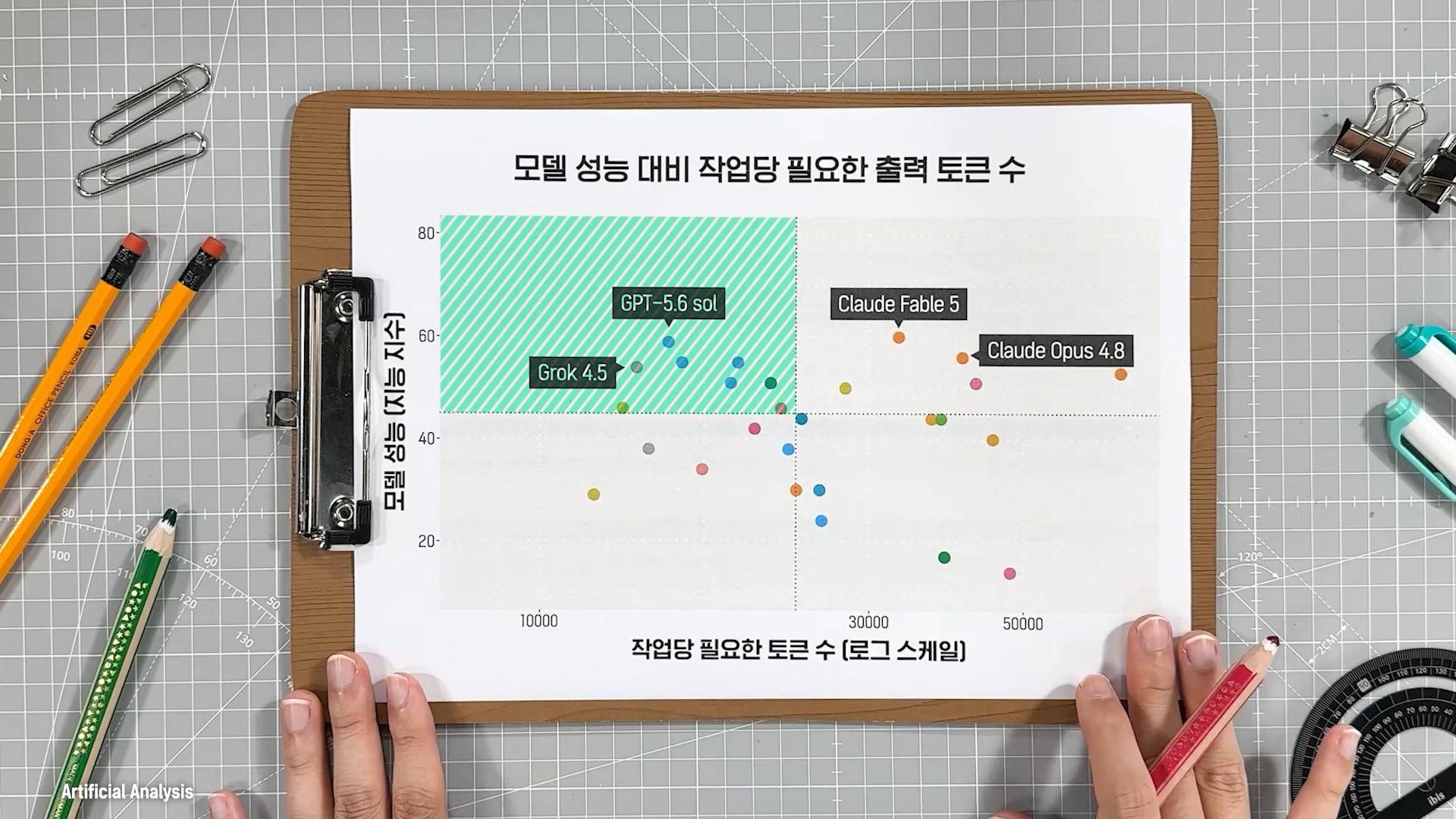
Performance is rising, prices are falling, and the coding market once dominated by Anthropic is entering a new phase. Big tech companies' competition spreading beyond performance into price is not a bad thing for consumers. After all, it means better models can be used at lower costs.
However, the fact that most major AI companies remain unprofitable is a point to ponder. No one can guarantee how long this war of attrition can continue. Who will ultimately emerge as the winner of the frontier model race? That is all for today's OhGraph. Thank you very much for reading this long article to the end.
References
- Psyho(@FakePsyho) | X
- Ethan Knight(@__eknight__) | X
- AtCoder World Tour Finals 2026 Heuristic | AtCoder E
- nterprise LLM API Market Share by Usage | Menlo Ventures
- ICPC 2025 World Finals Baku | ICPC World Finals
- Preparedness Framework | OpenAI
- Artificial Analysis Coding Agent Index v1.1 | OpenAI
- A Proof Of The Cycle Double Cover Conejcture | OpenAI
- Prompt Used For "A Proof Of The Cycle Double Cover Conejcture" | OpenAI
- Vals Index Industry Average Accuracy Comparison | Vals AI
Written by An Hye-min | Design: Ahn Jun-seok | Intern: Shin Yeon-seong
※ Please note: This article was translated by AI and may contain errors.



 Video News
 Video News