
 KOR
KOR
⚡ SBS Premium Summary
The South Korean government has selected semiconductors, physical AI, and AI data centers as its three core areas, launching a nationwide, all-out effort by making massive investments to build infrastructure.
In particular, to ensure security and minimize latency during the AI inference stage, the government plans to build domestic AI data centers and package them for export as a new business model.
For the success of this mega project, it is essential to establish measures for supplying massive amounts of power and water that exceed existing basic power supply plans, as well as to flexibly adjust strategies to respond to rapidly changing AI technology trends.
Hello. I am reporter Ahn Hye-min, who handles and analyzes data. On June 28, the government announced a massive project. Named the "Three Mega Projects for South Korea's Great Leap Forward," it unveiled large-scale investment plans across three sectors: semiconductors, physical AI, and AI data centers. In today's OhGraph, we will break down this mega project. We will look at what the project entails, the background behind this decision, and the key points that must not be missed for this project to succeed, using various data and graphs.
Overwhelming Semiconductors... Widening the Gap with a Speed Battle
The very first area among the three major projects is semiconductors. As semiconductors are used everywhere in the AI era, OhGraph has mentioned multiple times that the world is suffering from supply shortages. At the Computex Taipei held in June, SK Chairman Chey Tae-won predicted that the memory shortage would continue until 2030. SK Hynix and Samsung Electronics, the overwhelming leaders in the memory sector, already had plans to expand their fab factories in Yongin to meet the supply shortage.

For reference, SK Hynix's plan for the Yongin semiconductor cluster was first introduced in February 2019, but ground was broken only six years later, in February last year. Foundation work began in April this year. Samsung Electronics has not even broken ground yet. Therefore, the government's strategy for the semiconductor project is a "speed battle."


The reason South Korea is speeding up despite already leading in the memory semiconductor sector is that competitor nations are all running fast. As AI transformation takes place across various industries and semiconductors emerge as core infrastructure, demand has surged, leading to bottlenecks and congestion everywhere. Consequently, many semiconductor companies are building factories extremely aggressively. This has evolved beyond mere investment competition between companies into an all-out national war.
Representative examples include the United States and China. Let's look at the investment situation of Micron Technology in the U.S. through the first graph.

The situation in China, as well as the U.S., is also unusual. ChangXin Memory Technologies (CXMT), China's largest DRAM maker, is making its presence felt with its first-quarter revenue this year surging by more than 700% year-on-year. While it previously produced DRAM at its Hefei and Beijing plants, it has recently been building a new DRAM fab in Shanghai. CXMT plans to list on the Shanghai Stock Exchange to secure the funds needed to expand its production lines. Not only CXMT, but other Chinese semiconductor companies, such as YMTC and Baidu's AI semiconductor subsidiary Kunlunxin, are also preparing for IPOs to secure funds as they join the expansion race.
Capturing the Physical AI Market with the Advantage of a Manufacturing Powerhouse
Next is physical AI, which refers to AI that understands and makes decisions in the physical environments of the real world.

The key to determining the performance of an AI model is data. The same goes for physical AI. However, compared to the Large Language Models (LLMs) we commonly use, data for physical AI is severely lacking. This is because while the internet is full of text data that companies can easily scrape, manufacturing data does not exist on the internet. This data is on the factory floor.
The government plans to drive AI transformation in the manufacturing sector by utilizing crucial data held by South Korean manufacturers, such as the temperature and pressure under which products are manufactured on each production line. Furthermore, since South Korea is already a robotics powerhouse where robots are deployed throughout various industries, it has the advantage that AI transformation can directly lead to increased productivity.

However, the problem is that South Korea only uses robots. While other countries are racing into the physical AI era and producing robots like humanoids, South Korea is merely buying and using them. In the meantime, South Korea has focused only on utilizing robots well and has produced very little. Meanwhile, the humanoid market is dominated by China and the United States.

Through this mega project, the government plans to develop industry-specific AI robots and supply more than 1,000 units to work sites every year. It also plans to secure technological competitiveness in the components used to build robots and the AI that will serve as the robot's brain.
The key company in the physical AI sector is undoubtedly Hyundai Motor Group. The processes of welding and assembling car bodies and the processes of manufacturing robots are highly similar, overlapping by 70% to 80%.

Building Domestic AI Data Centers and Even Exporting Them
If one had to choose the most necessary core infrastructure in the great AI transition, it would undoubtedly be AI data centers. This is because they are required to train models and perform inference. Looking at large-scale national projects, most of them are related to AI data centers. For instance, the U.S. Stargate project, which involves an investment of 500 billion USD, is about building AI data centers. It is also reported that China plans to invest 2 trillion CNY over the next five years to build AI data centers.
The government plans to build AI data centers across the country so that they can also contribute to regional revitalization. First, in Phase 1, it plans to build 8.4 GW of AI data centers in cooperation with SK, GS, and Naver.

The number 1 GW is mentioned so often that it might be hard to grasp, but it is actually an enormous amount. A 1 GW-class AI data center requires the equivalent of one standard nuclear power plant. Currently, xAI and Amazon are the only ones operating gigawatt-class AI data centers globally.

For reference, SK plans to go further and expand its AI data center capacity to 15 GW by 2035. If this happens, a total of 18.4 GW of AI data centers will be built in South Korea by 2035. Furthermore, the government plans to export these AI data centers to other countries. One might wonder what we can sell with AI data centers that haven't even been built yet. The key lies in "inference."
As mentioned earlier, AI data centers are needed to train models and use them in the inference process. In reality, there is little room for South Korea to break into the training stage. Although the country is developing models through projects like "Dokpamo" (Independent AI Foundation Model project), realistically, state-of-the-art AI models are tightly controlled by U.S. big tech companies that possess massive quantities of Nvidia's cutting-edge GPUs. However, the AI inference stage, where actual services are delivered after training is complete, could be different.

In other words, the AI data centers where inference computations take place must be located near the users, and for security reasons, they need to be processed within domestic infrastructure. Since every country will likely need its own AI inference infrastructure in the future, South Korea aims to target this niche.

The Hurdles the Mega Project Must Overcome Are Also 'Mega' Sized
No one would object to the direction of actively participating in the AI transition, which has already become a reality, while simultaneously adhering to the principle of balanced regional development. However, because it is literally a mega-scale project involving a massive amount of capital, quite a few people are concerned about whether it can run smoothly without issues.

For reference, the government forecasts power demand and establishes response policies every two years. It began establishing the 12th Basic Plan for Electricity Supply and Demand late last year and disclosed its forecast in April this year. The problem is that none of the aforementioned AI mega projects were reflected in this plan. Let's look at the graph to see how big the difference is.

Therefore, experts say that a major revision of the 12th Basic Plan for Electricity Supply and Demand is necessary. They predict that the forecasts could be raised significantly, and the existing plan centered on renewable energy could also be revised. Nuclear power, which can stably supply large-scale power demand without emitting carbon, is emerging as an alternative. Indeed, the Korean Nuclear Society is arguing that new nuclear power plants and Small Modular Reactors (SMRs) must be additionally reflected.

Most big tech companies only disclose how much water they use for server cooling in their environmental reports. However, according to a recent report by a national laboratory under the U.S. Department of Energy, indirect water costs are substantial. An analysis by the Lawrence Berkeley National Laboratory revealed that the amount of water consumed by power plants to generate the electricity used by data centers is, on average, 12 times higher. In other words, running AI infrastructure hides a much larger consumption of water than what is visible.


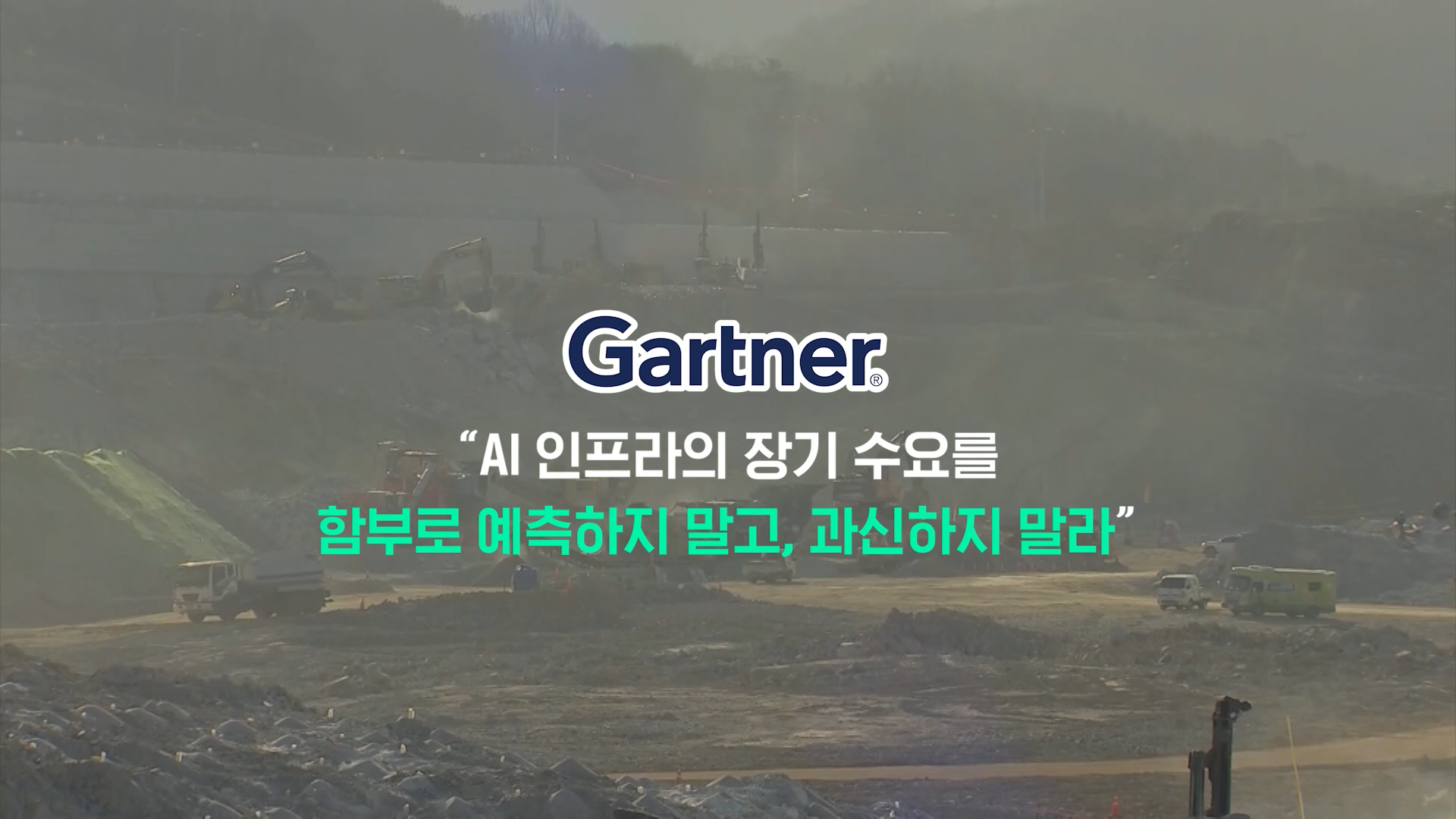
For instance, designing various scenarios to respond flexibly and building plans based on them could be one approach. Alternatively, a strategy could be established to secure diverse options even when adding infrastructure, such as adding infrastructure in a modular fashion and investing in stages.
Meanwhile, critics also point out that compared to the hardware into which massive amounts of money are being poured, the software strategy to run on top of it is relatively lacking.
The mega project has taken its first step. While they say a good start is half the battle, the future seems even more critical. Countless countries around the world are jumping into the AI infrastructure race, and the market landscape is changing day by day. Sincerely hoping that this project can flexibly adapt to such changes, I will wrap up today's OhGraph here. Thank you very much for reading this long article to the end.
References
- Report from the National Report Meeting on the Three Mega Projects for South Korea's Great Leap Forward
- Presentation from the Public Hearing on the 12th Basic Plan for Electricity Supply and Demand
- Micron global expansion: 2026 and Beyond | trendforce
- Global Robot Density in Factories Doubled in Seven Years | IFR
- General-Purpose Embodied Robot Market Radar | Omdia
- Google Environmental Report 2026 | Google
- 2026 Environmental Sustainability Report | Microsoft
- 2024 United States Data Center Energy Usage Report | Lawrence Berkeley National Laboratory
- Top 10 AI Data Center Myths Debunked | Gartner
Reported by Ahn Hye-min | Designed by Ahn Jun-seok | Intern: Shin Yeon-sung
※ Please note: This article was translated by AI and may contain errors.


 Video News
 Video News
 Video News
 Video News
 Video News