
 KOR
KOR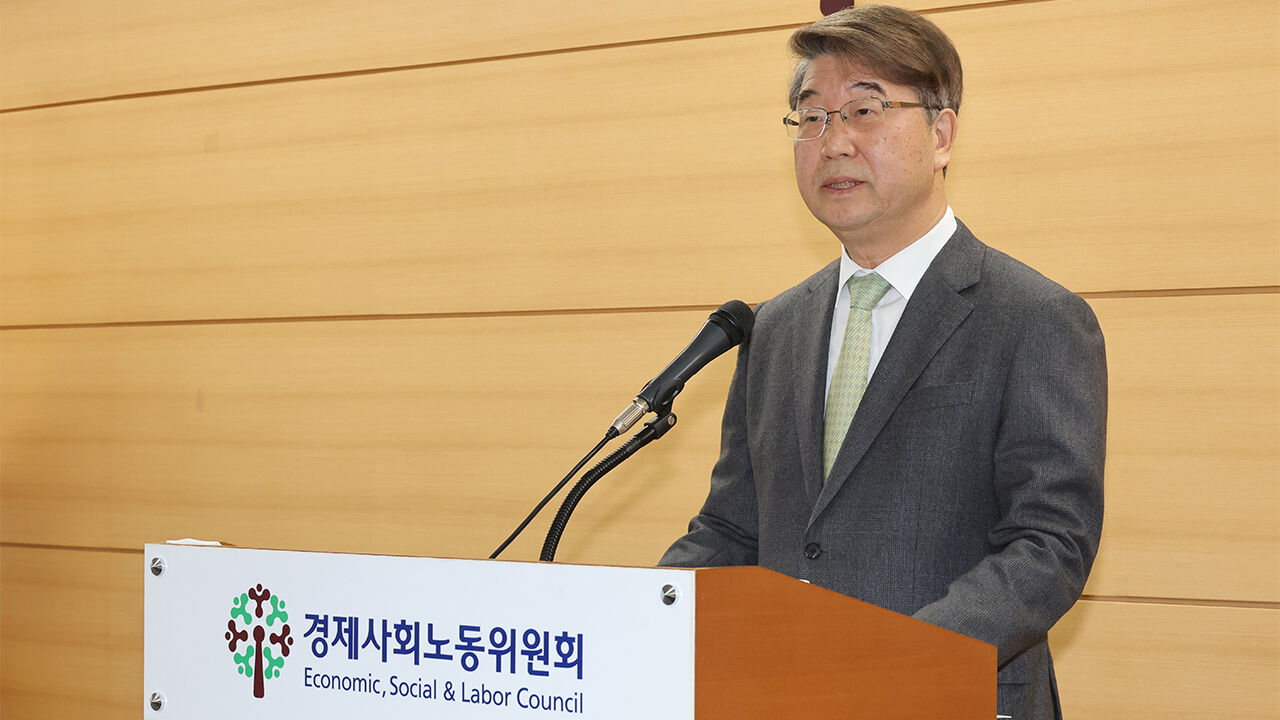
▲ Kim Ji-hyung, Chairman of the Economic, Social & Labor Council (ESLC), speaks at a briefing for the launch of the first term of the new administration's ESLC at the council's conference room in Jung-gu, Seoul, on March 18.
A tripartite special committee representing labor, management, and government launched today (July 16) to explore the impact of demographic changes—such as low birth rates and an aging population—on the job market and to discuss sustainable response measures.
The Economic, Social & Labor Council (ESLC) held the inauguration ceremony and the first plenary meeting of the Special Committee on Demographic Change and Jobs at its conference room in Jongno-gu, Seoul, on this day.
Kim Ji-hyung, Chairman of the ESLC, will serve as the head of the special committee.
The committee consists of 15 members in total, including labor representatives such as Ryu Ki-seop, Secretary General of the Federation of Korean Trade Unions (FKTU); management representatives such as Lee Dong-geun, Executive Vice Chairman of the Korea Enterprises Federation (KEF); government officials including Kwon Chang-jun, Vice Minister of Employment and Labor, and Lee Hyung-il, First Vice Minister of Economy and Finance; and public interest member Lee Chul-hee, a professor of economics at Seoul National University.
Representatives from civil society were also appointed, including Baek Mi-soon, Co-representative of People's Solidarity for Participatory Democracy; Park Jong-hyun, President of the Journalists Association of Korea; and Won Gyu-hee, head of the youth policy platform "Yeolgodatgi."
The special committee will operate for six months, with a possible three-month extension if necessary.
The committee plans to focus its discussions on key agendas such as "win-win jobs" that harmonize the continued utilization of older workers with the entry of young people into the labor market, and "lifelong jobs" that allow individuals to work without interruption throughout their labor life cycle.
The ESLC explained that the committee will not operate by asking for approval or disapproval of pre-determined plans, but rather by seeking feasible solutions together with citizens.
The committee also decided to introduce a method of collecting opinions from a large number of citizens online regarding job conflicts and gaps, and then using artificial intelligence (AI) to identify key themes.
A "mini-public deliberation" process involving one-on-one conversations with 50 citizens will also be conducted.
The committee meetings will be held as openly as possible, and a record summarizing the public's opinions in a systematic manner will be produced once the activity period concludes.
During the inauguration ceremony, Chairman Kim Ji-hyung said, "The special committee will seek concrete action plans for the overall job system to ensure that there are no conflicts or gaps during the 'entry' of youth into their first jobs and the 'movement, transition, and re-entry' processes of middle-aged and older workers."
Vice Minister Kwon Chang-jun stated, "The Ministry of Employment and Labor recently presented our problem awareness and principles in the 'Basic Plan for Industrial Transition and Employment Stability,' but it was not a complete plan. I hope the discussions in this special committee will fill in the specific parts that are still missing from this plan."
Labor and management also expressed high expectations for the committee's discussions.
Secretary General Ryu Ki-seop said, "It is meaningful that the special committee is taking a different path from the existing labor-management-government agreement method to solve difficult problems such as concerns about 'workplaces without labor' and income polarization. As the scope of participation is broad, I hope it will establish itself as a social dialogue platform where the voices of the people are translated into actual policies."
Executive Vice Chairman Lee Dong-geun suggested, "To build a balanced job system amidst demographic changes, we must improve rigid labor market institutions. The direction should shift from stability within a single workplace to ensuring sustainable employment across the entire labor market."
(Photo: Yonhap News)
※ Please note: This article was translated by AI and may contain errors.


 Video News
 Video News
 Video News
 Video News
 Video News