
 KOR
KOR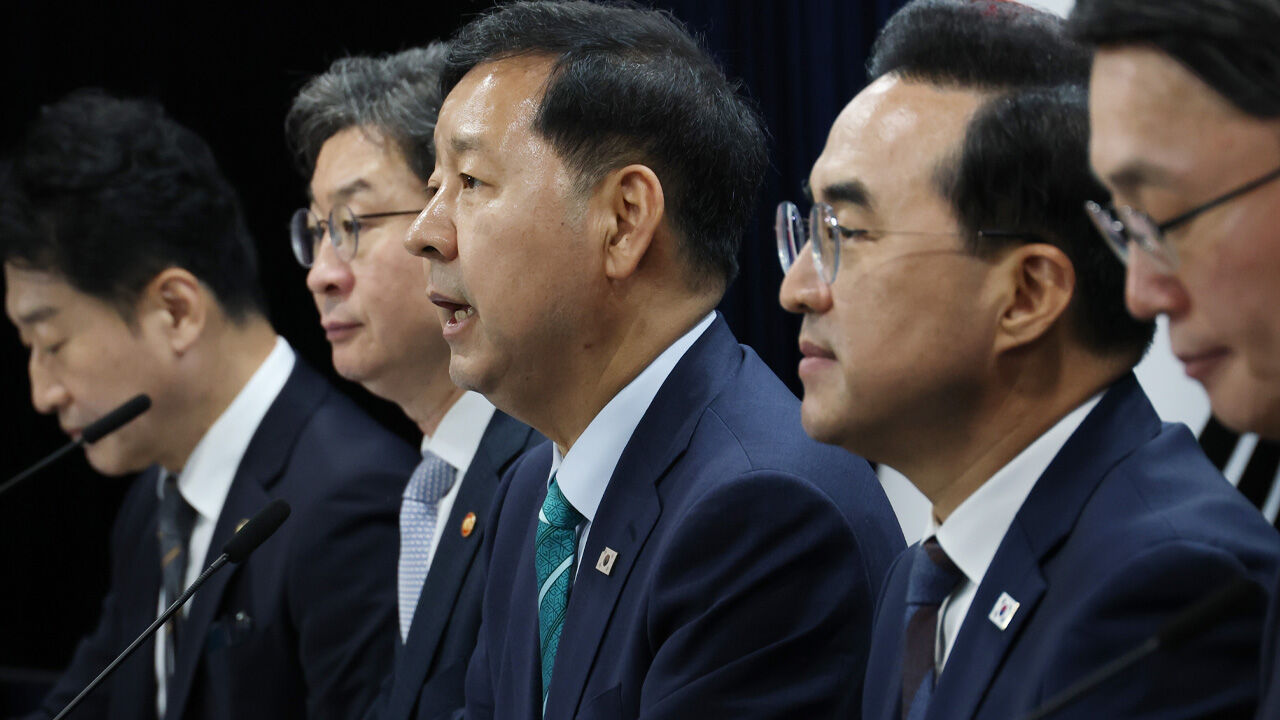
▲ Deputy Prime Minister and Minister of Economy and Finance Koo Yoon-cheol holds a joint briefing with relevant ministries on the economic growth strategy for the second half of the year at the Government Complex Seoul on July 14.
Deputy Prime Minister and Minister of Economy and Finance Koo Yoon-cheol predicted that "creating a virtuous cycle where additional tax revenue generated from the three major mega-projects is used to support vulnerable groups will help resolve polarization."
During a joint briefing with relevant ministries held this afternoon to announce the economic growth strategy for the second half of the year, Deputy Prime Minister Koo gave this response when asked if he believed the current policies would be sufficient to resolve polarization.
The government projects that the real gross domestic product (GDP) growth rate for this year will reach 3.0%.
Regarding concerns over K-shaped polarization and "jobless growth," as the semiconductor industry, which has a low employment-inducing effect, is leading the growth, Deputy Prime Minister Koo stated, "It is certain that the demand for entry-level labor utilizing AI will decline during the AI transformation process, so the government intends to provide large-scale AI training for young people and others."
Addressing the so-called "3-4-5 Vision" announced today—a 3% potential growth rate, becoming the world's 4th largest exporter, and reaching a per capita national income of 50,000 dollars—he said, "A 3% potential growth rate is a challenging task," but added, "It reflects our policy determination to fundamentally transform the industrial structure from the current memory semiconductor-centered model and ensure we achieve a 3% potential growth rate."
Financial Services Commission Chairman Lee Eog-weon said regarding loan regulations, "The government's basic principle is to limit speculative demand for housing, protect actual demand, and swiftly promote housing supply."
On loan regulations, he stated, "We will maintain our consistent stance on household debt management," but added, "We will minimize concerns about side effects by making micro-policy adjustments to resolve difficulties for ordinary people with actual housing needs."
When asked when the effects of policies such as the National Growth Fund and measures to revitalize the KOSDAQ would become visible, given that the KOSDAQ index has fallen to 700, he replied, "The policy direction for the capital market is to fundamentally improve the market's structure, establish a foundation that can better withstand crisis situations and market volatility, and strengthen the basis for further development."
Chairman Lee added, "We will continue our policy efforts to build a more robust market through structural reforms, such as implementing a segment system that allows high-quality companies to be properly evaluated and general companies to leap forward through a promotion and relegation system."
Minister of Planning and Budget Park Hong-keun stated, "We will re-examine the performance of all projects from scratch and improve the fundamental structure of fiscal health, going beyond simple downsizing through high-intensity expenditure restructuring."
He further noted, "In this process, we will also begin full-scale innovation of mandatory expenditures, which have previously been considered off-limits for restructuring, such as reforming the local education finance grant to reflect environmental changes and enhance investment stability."
(Photo: Yonhap News)
※ Please note: This article was translated by AI and may contain errors.


 Video News
 Video News
 Video News
 Video News
 Video News