
 KOR
KOR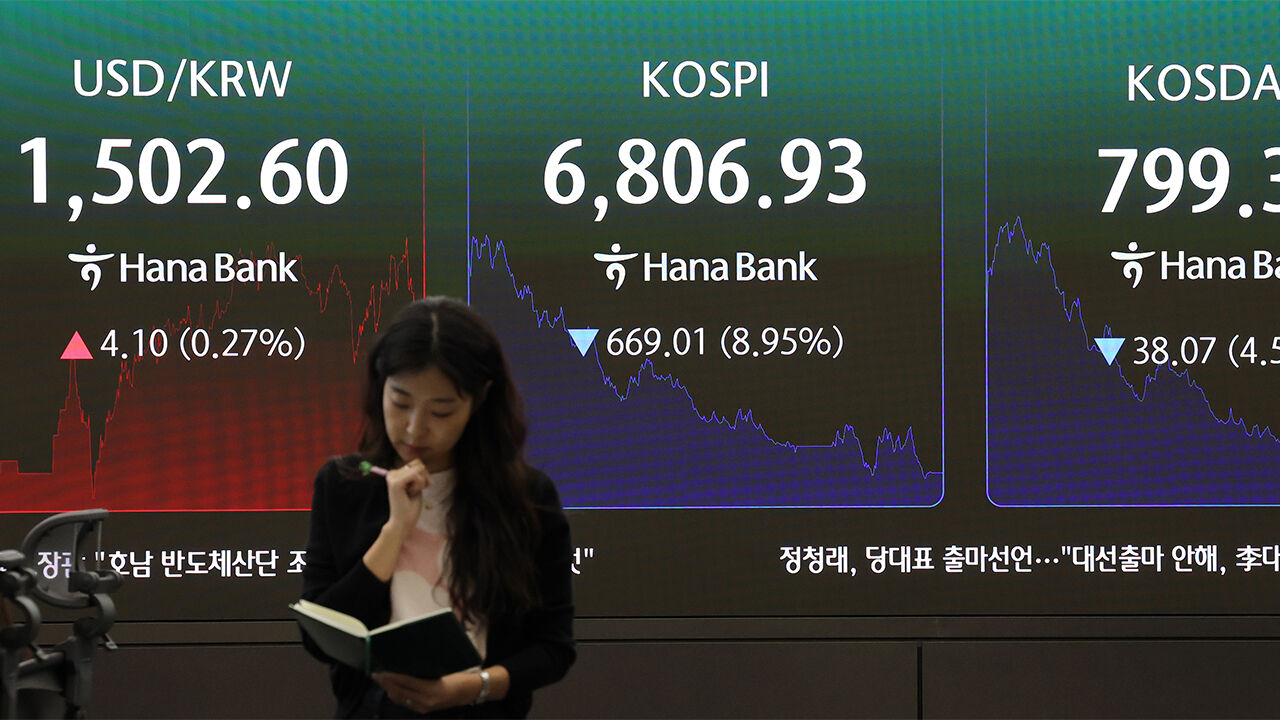
▲ The KOSPI, KOSDAQ, and won-dollar exchange rate are displayed at the dealing room of Hana Bank headquarters in Jung-gu, Seoul, on the 13th, as the KOSPI plunged nearly 9% and fell below the 7,000 mark.
The won-dollar exchange rate closed slightly higher as safe-haven demand increased due to geopolitical risks in the Middle East.
In the Seoul foreign exchange market today (July 13), the won-dollar exchange rate closed at 1,503.4 won, up 2.0 won from the previous trading day's closing price as of 3:30 p.m.
The exchange rate opened at 1,498.5 won at 6:00 a.m., fell to 1,497.2 won around 9:00 a.m., and rose to 1,508.9 won around 3:10 p.m.
Based on the intraday low, the exchange rate has fallen below 1,500 won for four consecutive trading days.
It is the first time in about a month and a half since May 29 (1,508.7 won) that the intraday high has fallen below 1,510 won.
Safe-haven sentiment stemming from Middle East geopolitical risks is acting as a factor strengthening the dollar and pushing up the exchange rate.
As the United States and Iran exchange a series of attacks and retaliations over control of the Strait of Hormuz, the ceasefire negotiations between the two countries, which were arranged last month, are effectively on the verge of collapse.
On the 12th (local time), the U.S. condemned Iran's attack on merchant ships and launched large-scale airstrikes hitting not only the coast of the Strait of Hormuz but also western and central Iran. In retaliation, Iran successively struck countries in the Gulf region that have security cooperation ties with the U.S.
The U.S. Central Command (CENTCOM) announced that it began additional airstrikes at 5:00 p.m. U.S. Eastern Time that day (6:00 a.m. KST on the 13th) to weaken Iran's ability to attack civilian vessels passing through the Strait of Hormuz.
Net selling by foreign investors is also a factor pushing up the exchange rate.
On this day, the KOSPI plunged 8.96% to close at 6,806.93 in the stock market.
Foreign investors sold 1.7021 trillion won worth of domestic stocks, marking their second consecutive day of net selling.
However, expectations for dollar supply related to the American Depositary Receipt (ADR) listing of SK Hynix are preventing further rises in the exchange rate.
On the 10th, SK Hynix raised approximately 26.5 billion dollars (about 40 trillion won) through the issuance of ADRs.
The dollar proceeds from the public offering will be paid to SK Hynix on the 14th, when the public offering process is completed.
As expectations grow that the funds raised through the listing will be converted into local currency, leading to a drop in the exchange rate, there is a movement among exporters and others to sell dollars in advance.
The dollar index, which measures the value of the dollar against six major currencies, is at 100.094, down 0.127.
The yen is showing weakness.
The yen-dollar exchange rate is 162.300 yen, up 0.35%.
The won-yen cross rate is 926.51 won per 100 yen, down 2.78 won from the closing price at 3:30 p.m. on the previous trading day.
(Photo: Yonhap News)
※ Please note: This article was translated by AI and may contain errors.


 Video News
 Video News
 Video News
 Video News
 Video News