
 KOR
KOR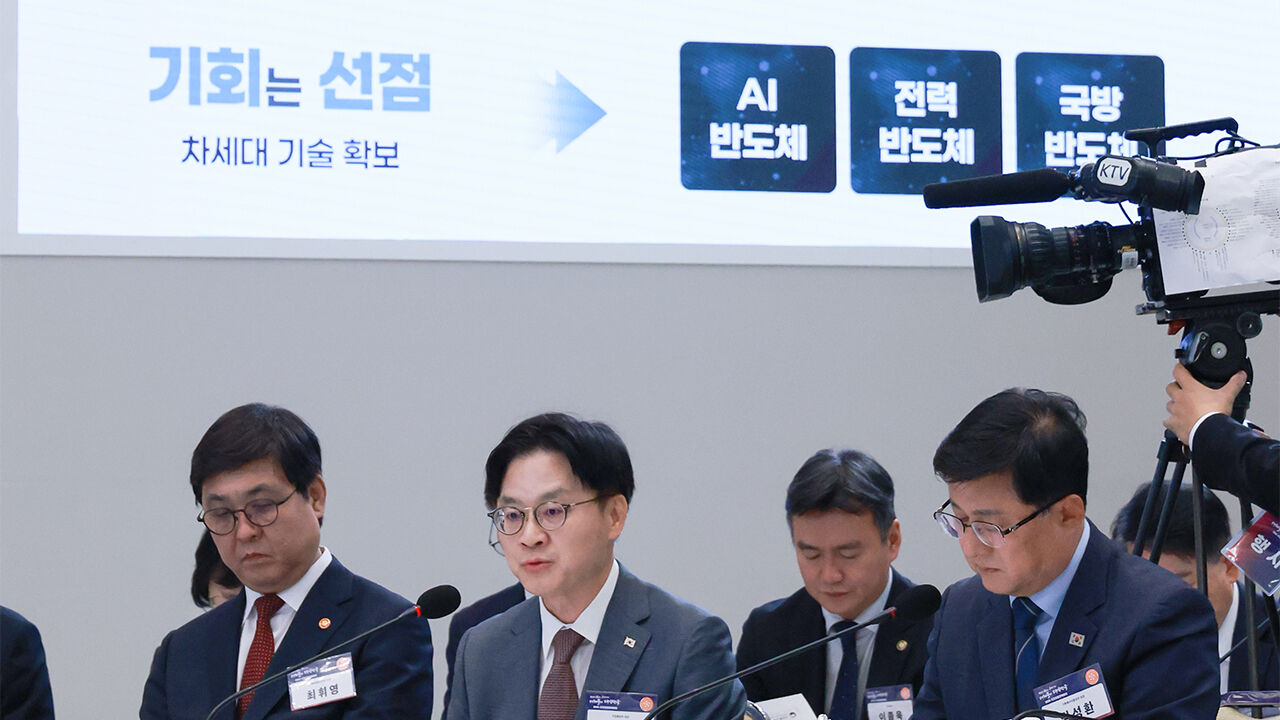
▲ Minister of Trade, Industry and Energy Kim Jeong-gwan announces support measures for semiconductors and AI robots during the National Fiscal Strategy Meeting presided over by President Lee Jae-myung at the Blue House on July 13.
The government is set to provide financial support that exceeds that of competing nations to back large-scale private sector semiconductor investments amounting to approximately 957 trillion won.
Kim Jeong-gwan, Minister of Trade, Industry and Energy, announced the "Mega Project: Semiconductor and AI Robot" strategy, which centers on this initiative, at the National Fiscal Strategy Meeting held at the Blue House on July 13.
"Major countries, including China with 152 trillion won, Japan with 95 trillion won, and the United States with 80 trillion won, recognize the semiconductor competition as a war for national survival and are pouring astronomical amounts of fiscal resources into it," Minister Kim said. "South Korea also needs to provide financial support at a level equal to or greater than that of our competitors."
The government's semiconductor support strategy consists of three main pillars.
First, it will provide full-scale support for infrastructure such as land, water, and electricity to ensure that large-scale private investments are implemented with speed.
Through this, the completion date of the Yongin Semiconductor Cluster will be moved up by 12 years, and a new semiconductor cluster in the Honam region is targeted to begin operations between 2030 and 2031.
Second, the government aims to compensate for weaknesses by fostering the domestic materials, parts, and equipment (Sobu-jang) sectors, as well as the packaging and foundry industries, which are relatively vulnerable.
The government's assessment is that unless robust materials, parts, and equipment companies provide support, the fruits of large-scale investments will be reaped by foreign firms.
Third, the government plans to secure next-generation technologies, such as AI semiconductors, power semiconductors, and defense semiconductors.
To achieve this, the government plans to concentrate support on large-scale research and development (R&D) projects worth 1 trillion won to gain a preemptive edge in the next-generation semiconductor market.
Along with financial support, institutional backing will also be provided.
First, the government will enact the "Mega Special Zone Act" within this year to grant the highest level of regulatory exemptions to semiconductor investment companies and prepare a comprehensive support package that includes tax incentives, investment promotion, and infrastructure.
The existing "Special Act on Semiconductors" will also be transformed into a powerful "execution-oriented special act" responsible for implementing large-scale national projects like the mega project.
A plan to foster the "AI robot" industry, another pillar of the AI transformation era, was also unveiled.
According to the Ministry of Trade, Industry and Energy, the budget for humanoid robots in the single city of Shenzhen, China (900 billion won), overwhelms South Korea's entire budget (100 billion won).
In terms of market share, China holds 86%, while South Korea accounts for only 1%, making bold and preemptive fiscal investment an urgent necessity.
Accordingly, the government will build "data factories" by sector across the country to develop a Korean-style robot foundation model and will establish dedicated R&D support for core components with low localization rates, such as actuators and robotic hands.
In addition, the government plans to develop specialized humanoids for 10 major industries and deploy them to industrial sites.
A roadmap was also presented for the government to open the market through preemptive purchases to create initial demand.
Last year, the Chinese government purchased 45% of the humanoids produced in the country to induce mass production investment, whereas government procurement in South Korea was 0%.
To improve this, the government will operate a "pan-ministerial robot demand discovery team" to actively purchase AI robots for research purposes and expand budgets for verification and procurement subsidies to promote private demand.
"Now that the private sector is racing ahead, we will ensure that bold and full-scale financial and institutional support is carried out quickly to complete South Korea's great leap forward," Minister Kim said.
(Photo: Yonhap News)
※ Please note: This article was translated by AI and may contain errors.


 Video News
 Video News
 Video News
 Video News
 Video News