
 KOR
KOR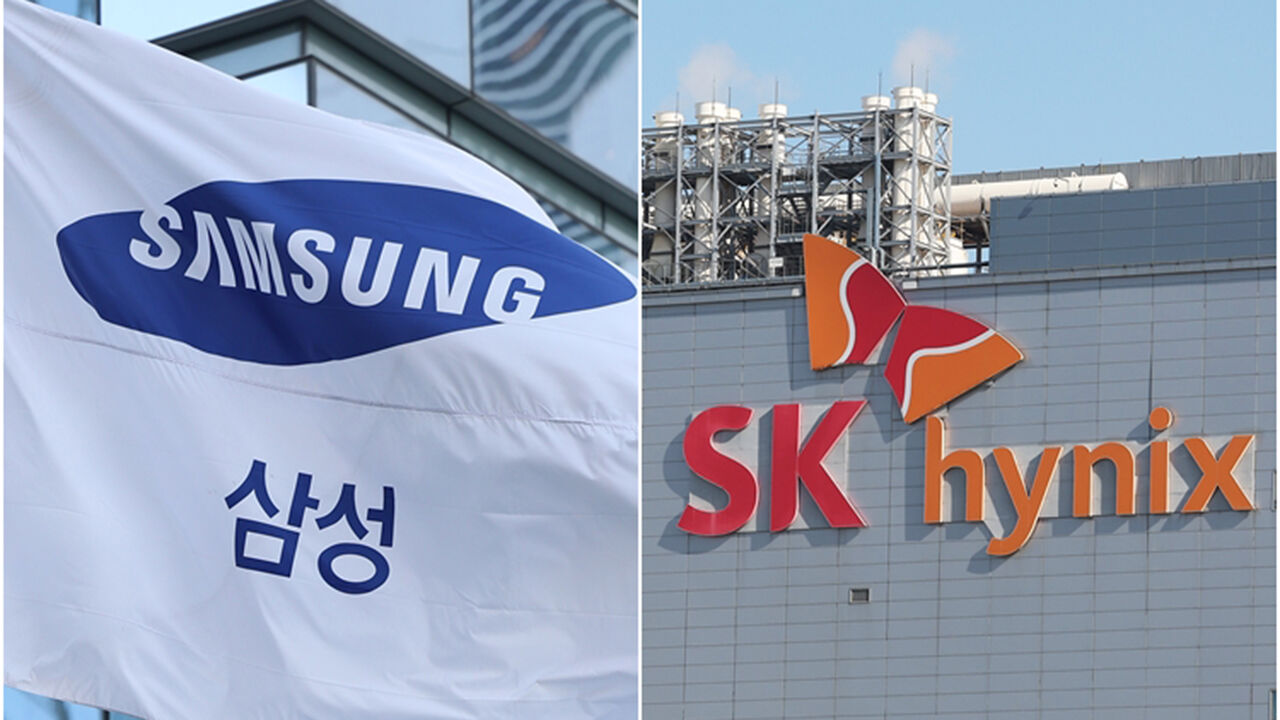
▲ Samsung Electronics and SK Hynix
The combined trading volume of Samsung Electronics and SK Hynix has surged from 30% to 51% of the total domestic stock market over the past month and a half.
When 16 types of single-stock leverage and inverse products are added to this, the proportion jumps to 83%.
According to the Korea Exchange on July 9, the trading volume of Samsung Electronics (9.5563 trillion won) and SK Hynix (15.256 trillion won) accounted for 51.0% of the total domestic stock market (48.0609 trillion won combined for KOSPI and KOSDAQ) as of July 8.
This is a 21.0 percentage point increase from 30.0% on May 26, the day before the listing of single-stock leverage and inverse products.
Furthermore, when including the trading volume of the 16 single-stock leverage and inverse products (15.6045 trillion won) as of July 8, the share of Samsung Electronics, SK Hynix common stocks, and single-stock leverage products in the domestic stock market reached 83.1%.
However, as the trading volume of exchange-traded funds (ETFs) is not included in the KOSPI and KOSDAQ trading volume, the proportion is bound to increase when the trading volume of the 16 products is added.
Even considering this, it is interpreted that while Samsung Electronics and SK Hynix already exert significant influence on the domestic stock market, single-stock leverage products have drastically amplified that impact.
In particular, the KOSPI is inevitably forced to move in tandem with the stock prices of Samsung Electronics and SK Hynix.
In fact, when the stock prices of Samsung Electronics and SK Hynix fell together on July 7 and 8, the KOSPI also declined, with similar rates of decrease.
On July 7, Samsung Electronics and SK Hynix fell by 6.92% and 6.06%, respectively.
On the same day, the KOSPI closed at 7,656.31, down 4.91%.
On July 8, Samsung Electronics and SK Hynix fell by 6.25% and 5.68%, respectively, while the KOSPI dropped 5.35% to 7,246.79.
The proportion of Samsung Electronics and SK Hynix in the securities lending balance, a leading indicator for short selling, which bets on price declines, is also growing.
Short selling refers to a transaction where stocks are borrowed in advance using securities lending to be sold, and then repurchased at a lower price to be returned when the stock price actually falls.
On May 26, the securities lending balances for Samsung Electronics and SK Hynix were 23.6666 trillion won and 23.9763 trillion won, respectively.
These accounted for 15.9% and 16.2% of the total balance of 147.9867 trillion won.
However, as of July 8, the balances were 23.524 trillion won and 29.0041 trillion won, respectively, increasing to 17.4% and 21.5% of the total balance of 134.6574 trillion won.
During this period, the securities lending balance of SK Hynix increased by more than 5 trillion won, pushing the combined balance share of the two stocks from 32.1% to 38.9%, nearing 40%.
This means that while the overall scale of borrowed stocks in the market has decreased, the proportion of borrowed shares for Samsung Electronics and, in particular, SK Hynix has actually increased.
Concerns continue to be raised in and around the securities industry regarding the excessive concentration on semiconductors and the increased volatility following the introduction of single-stock leverage.
In a written response submitted to Representative Park Sung-hoon of the People Power Party on July 5, the Bank of Korea stated, "In a situation where the market capitalization and trading volume of Samsung Electronics and SK Hynix have expanded significantly to account for more than half of the stock market, the expansion of single-stock leverage investment has the potential to exacerbate this concentration phenomenon."
The Financial Supervisory Service held the 3rd Consumer Risk Response Council on July 6 to inspect the state of consumer protection across the financial sector, and decided to continue monitoring the market impact of single-stock leverage and, if necessary, inspect whether asset management companies are engaging in excessive marketing.
However, some view that the concentration on semiconductors has eased to some extent through recent adjustments.
Kang Jin-hyuk, a researcher at Shinhan Securities, noted, "A rotation from semiconductors to non-semiconductors is taking place amidst a trend of easing concentration on large-cap stocks," adding, "In particular, profit momentum is strengthening, and sectors such as banking, cosmetics, and retail have performed relatively well."
Kim Yong-gu, a researcher at Yuanta Securities, said, "As the political sphere continues to criticize the supply and demand concentration issues of single-stock leverage, if institutional improvements such as strengthened trading management, tracking error regulations, and higher barriers to entry for investors are accompanied, we can expect a dispersion effect on the extreme supply and demand concentration of individual investors."
(Photo: Yonhap News)
※ Please note: This article was translated by AI and may contain errors.


 Video News
 Video News
 Video News
 Video News
 Video News