
 KOR
KOR
▲ Algal bloom in an irrigation channel
As the algal bloom in the lower reaches of the Nakdong River spreads, green-tinted water is flowing into nearby rice paddies through irrigation channels, raising growing concerns among local farmers.
According to the Yangsan branch of the Korean Federation for Environmental Movement and other sources on Tuesday (July 7), green water covered in algae is flowing through irrigation channels near rice fields in Hwaje-ri, Wondong-myeon, Yangsan, Gyeongsangnam-do.
This water is used for agriculture, supplied to the paddies after flowing from the Nakdong River through the irrigation network.
A farmer in his 50s, who has been growing rice in the region for over a decade, expressed his concern, saying, "Since early July, thick, algae-filled water has been entering the paddies. I have never seen anything like this before." He added, "It has not been long since the rice planting, and the plants are in a critical growth phase, yet they are being submerged in water affected by the algal bloom from the early stages of growth."
"The bloom was severe in 2022 as well, but that was after the rice had already grown to a certain extent," he continued. "I am worried about how the continuous absorption of this water by young rice plants will affect the yield and quality of the harvest."
Sagong Hye-seon, secretary-general of the Yangsan Korean Federation for Environmental Movement, stated, "We are also concerned about the health of farmers who work in close proximity to the algae-contaminated water."
Although there has been rainfall from the monsoon season in the Nakdong River basin recently, the precipitation has not been sufficient to dilute the algal bloom, and water temperatures have not dropped significantly, allowing the bloom to persist.
According to the Water Environment Information System of the Ministry of Climate, Energy and Environment, the concentration of harmful cyanobacteria cells at the Mulgeum and Maeri points of the Nakdong River, located between Gimhae and Yangsan, surged from 29,101 cells per milliliter on June 29 to 165,880 cells per milliliter on July 2.
While the count decreased to 74,028 cells per milliliter on July 6, it remains well above the 10,000 cells per milliliter threshold for the "Alert" level of the algal bloom warning system.
Algal bloom warnings are issued in stages: "Attention" when the number of harmful cyanobacteria cells is 1,000 or more per milliliter for two consecutive measurements, "Alert" at 10,000 or more, and "Mass Proliferation" at 1 million or more.
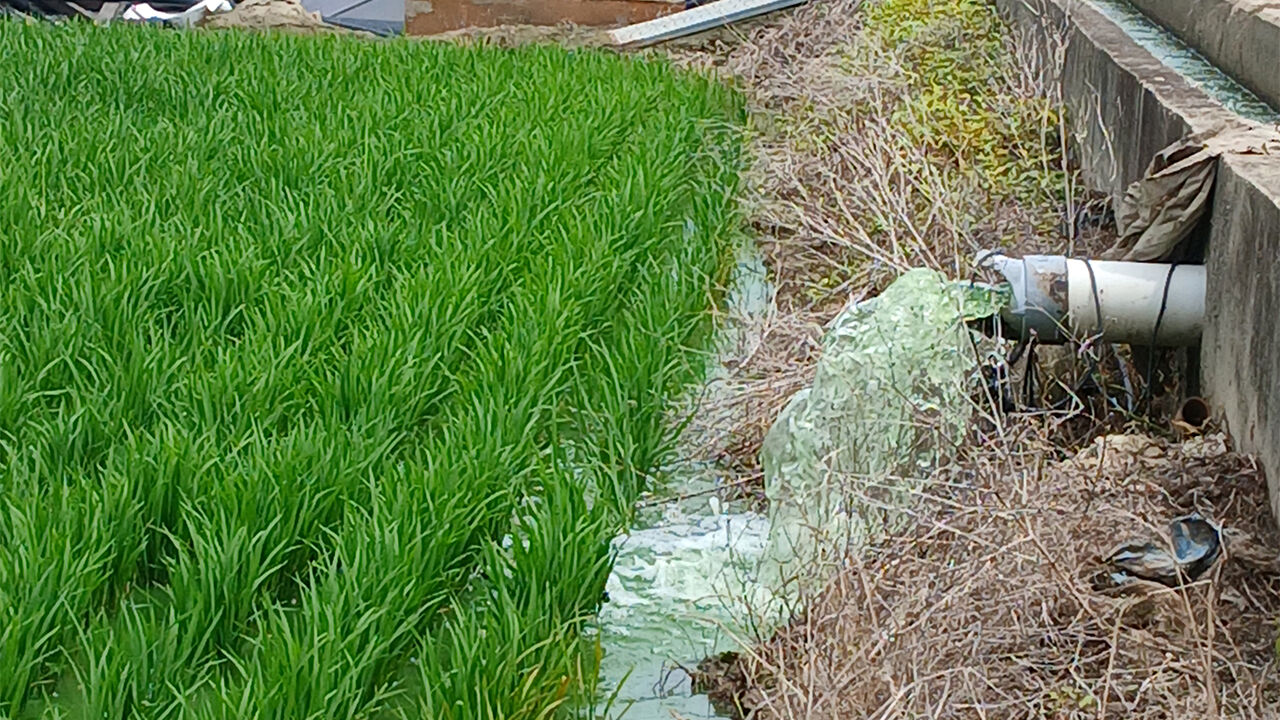
Farmers fear that the continued supply of agricultural water mixed with algae could lead to stunted rice growth and reduced quality.
Harmful cyanobacteria can produce microcystin, a representative type of algal toxin.
In 2022, researchers from Pukyong National University published a study reporting that this toxin was detected in cabbages, radishes, and rice grown using water from the Nakdong River, raising the possibility of crop contamination through agricultural water.
Lee Seung-jun, a professor of Environmental Life Chemistry at Kyungpook National University, explained, "There are many studies globally showing that toxins from algae-contaminated agricultural water are absorbed by crops." He added, "Microcystin can affect the liver even in small amounts, which is why Australia has established guidelines for crops. Algae-contaminated agricultural water also affects crop production yields."
He emphasized, "As climate change leads to recurring localized heavy rains, the environment will become increasingly favorable for the spread of algal blooms year after year. Since the algal bloom issue has the potential to escalate into a crop contamination problem, there is a need for a cross-ministerial investigation and countermeasures involving not only the Ministry of Climate, but also the Ministry of Agriculture and the Ministry of Food and Drug Safety."
(Photo courtesy of Yangsan Korean Federation for Environmental Movement, Yonhap News)
※ Please note: This article was translated by AI and may contain errors.


 Video News
 Video News
 Video News
 Video News
 Video News