
 KOR
KOR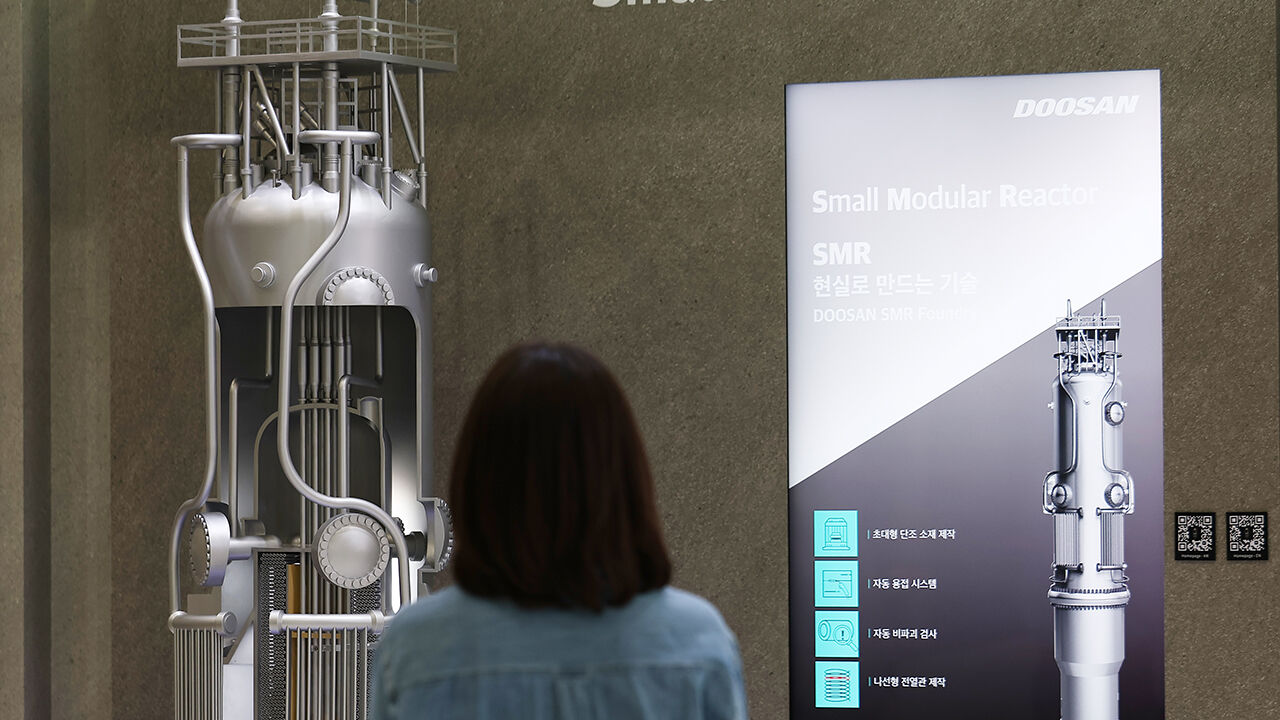
▲ Visitors look at a model of a Small Modular Reactor (SMR).
The construction of South Korea's first Small Modular Reactor (SMR), which is drawing attention as a next-generation energy source, has officially gotten on track.
With global competition for SMR leadership intensifying, expectations are rising that South Korea's nuclear export territory could expand beyond large-scale reactors to SMRs.
Korea Hydro & Nuclear Power (KHNP) announced on Wednesday, June 17, that it has selected Gijang County in Busan as the candidate site for the construction of one SMR unit, which is reflected in the 11th Basic Plan for Electricity Supply and Demand.
SMRs generally refer to reactors with a capacity of 300 megawatts (MW) or less that are manufactured in modules and assembled and installed on-site.
They have shorter construction periods and lower investment burdens compared to large-scale nuclear reactors, which typically have a capacity of 1,000 to 1,700 MW per unit.
While large reactors produce massive amounts of power at once to serve as base-load power sources for major cities, SMRs are distributed and deployed near power demand centers, such as industrial complexes and data centers.
Consequently, they have emerged as an alternative to reduce transmission and distribution costs in countries with vast territories, such as the United States and Saudi Arabia.
Recently, they have also drawn attention as a next-generation power source to meet the surging demand for electricity driven by the expansion of artificial intelligence (AI).
The SMR to be built in Gijang County, Busan, is the Innovative Small Modular Reactor (i-SMR), which is currently being developed under government leadership.
According to the i-SMR Technology Development Agency, the i-SMR is based on 170-MW pressurized water reactor (PWR) technology, and up to four modules can be installed in a single reactor building, capable of supplying up to 640 MWe of electricity.
It fundamentally eliminates the possibility of a large-break loss-of-coolant accident (LOCA) and guarantees safety even in the event of a power outage.
Through this, the goal is to secure a safety level 1,000 times higher than that of conventional reactors.
Kim Sung-whan, Minister of Climate, Energy and Environment, stated last year regarding SMRs, "Our current plan is to complete the design by 2028, obtain a license by 2030, and begin power generation by 2035."
As SMRs emerge as a next-generation energy technology and global competition to secure an early lead intensifies, observers say this construction project could serve as a stepping stone to boost the competitiveness of K-SMRs.
According to the UK National Nuclear Laboratory and the World Economic Forum, the SMR market size is projected to reach 400 trillion to 600 trillion won by 2035 and grow at an annual average rate of 22% until 2040.
According to the Korea Energy Economics Institute, as of February last year, a total of 127 SMRs were under development worldwide.
An analysis of 74 of these showed that the United States had the most with 27, followed by France (10), Japan (6), China and Russia (5 each), and South Korea (4).
In the United States, TerraPower, founded by Bill Gates, recently received approval from the Nuclear Regulatory Commission (NRC) to construct a commercial advanced nuclear power plant and is preparing to break ground in Wyoming.
It aims to begin operations in 2030.
In addition, nuclear power is a sector highly discussed as the first investment project in the U.S. under last year's South Korea-U.S. tariff agreement.
In the case of Japan, it is pursuing SMRs as its second investment project in the U.S.
Yoo Seung-hoon, a professor at Seoul National University of Science and Technology, said, "If we succeed in installing SMRs second only to the United States, demand will pour in from all over the world, and it could become a major export driver for us," adding, "We must actively complete technology development."
(Photo: Yonhap News)
※ Please note: This article was translated by AI and may contain errors.


 Video News


 Video News