Presidential Approval Rating Drops to 50s Range for First Time in 4 Months; Sharp Shifts in Seoul and Youth
Son Suk-minSeoul
Published2026.06.12 17:14ViewView Count
안내
We only offer this video to viewers located within Korea(해당 영상은 해외에서 재생이 불가합니다)
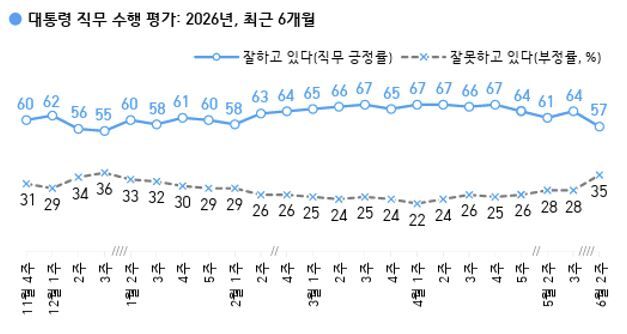
Following the June 3 local elections, a regular poll by Gallup Korea showed that positive evaluation of President Lee Jae-myung's job performance has dropped to 57%. This is a 7 percentage point drop from the previous survey, marking the first time in four months that the presidential approval rating has fallen into the 50% range. Evaluations of the local elections and the ballot paper shortage incident appear to have influenced the results.
Approval Rating at 57%, Falling to 50s Range for First Time in Four Months
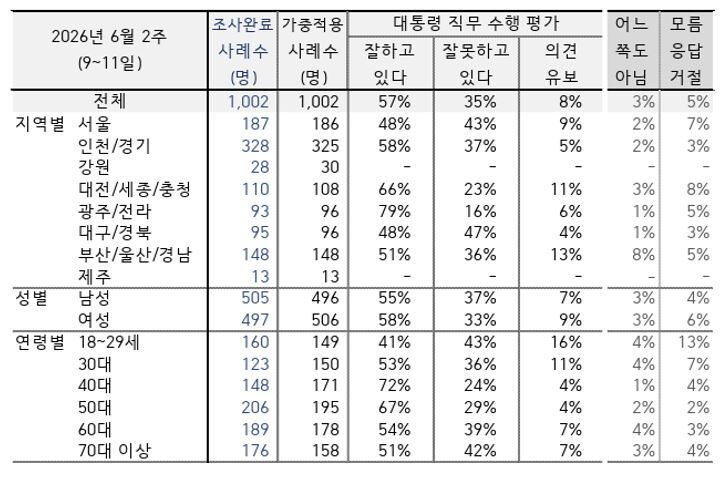
In the Gallup Korea survey conducted between June 9 and 11 following the local elections, 57% of respondents said President Lee is doing a good job, while 35% said he is doing a poor job. Positive evaluation fell by 7 percentage points from 64% in the third week of May (the last survey before the local elections), while negative evaluation rose by 7 percentage points from 28%. Looking at the trend, the positive evaluation, which had remained in the 60% range since rising to 63% in the second week of February, dropped to the 50% range for the first time in four months. Meanwhile, this is the first time the negative evaluation has risen to the 30% range since the fourth week of January.
By region, positive evaluation was highest in the Honam region (Gwangju/Jeolla) at 79%, followed by the Chungcheong region (Daejeon/Sejong/Chungcheong) at 66%. These are regions where the Democratic Party swept the gubernatorial and mayoral elections. The evaluations in Seoul and the Daegu/Gyeongbuk region, where the People Power Party won, were different. In Daegu/Gyeongbuk, positive and negative evaluations were 48% and 47%, respectively, while in Seoul, positive evaluation was 48% and negative was 43%, within the margin of error. Compared to the previous survey, the change in Seoul was distinct. Positive evaluation, which was 63% in the third week of May, plummeted by a whopping 15 percentage points. Negative evaluation increased by 12 percentage points. Seoul showed the highest volatility among all regions.
Youth Aged 18–29 Show Biggest Shift in Approval Rating
By age group, positive evaluation was prominent among those in their 40s (72%) and 50s (67%), while negative evaluation exceeded 40% among those aged 70 and older. What stands out is the evaluation by youth under the age of 29. Their positive evaluation was the lowest among all age groups at 41%, and their negative evaluation was 43%, which was numerically higher than that of the group aged 70 and older. Considering that the positive and negative ratings were 49% to 35% in the previous survey in the third week of May, this is the age group that showed the most dramatic shift in evaluation.
'Economy/Livelihood' Cited for Positive Evaluation... 'Poor Election Management/NEC Issues' for Negative
Respondents were also asked about the reasons for their positive or negative evaluations. Among the 570 respondents who evaluated the president positively, "economy/livelihood" (21%), "diplomacy" (12%), and "doing well overall" (9%) were cited as the top reasons. Among those who evaluated him negatively (352 respondents), "poorly managed/fraudulent election/National Election Commission (NEC) issues" (16%) was the top reason, followed by "economy/livelihood/high exchange rate" (14%) and "real estate policy" (9%).
Democratic Party at 41%, People Power Party at 29%... "PPP Reaches Highest Level Since Inauguration of Current Administration"
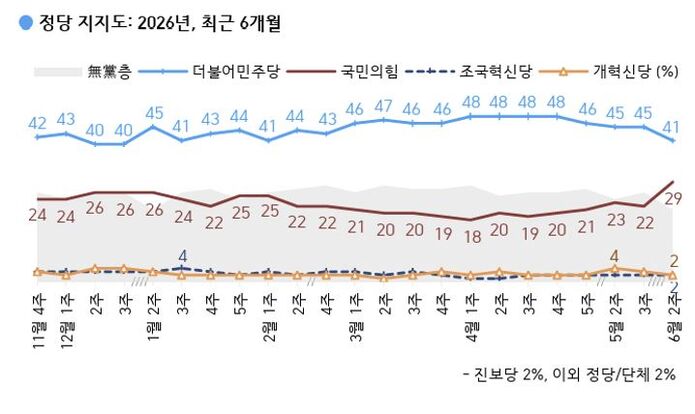
Party support ratings showed a decline for the Democratic Party and an increase for the People Power Party (PPP). The Democratic Party's support rating fell by 4 percentage points from 45% in the survey right before the local elections to 41%. The PPP's rating rose by 7 percentage points from 22% to 29%. Gallup Korea stated that the PPP's support rating, which had hit a low of 18% in the first week of April, reached its highest level since the inauguration of the current administration. The gap between the two parties narrowed from 30 percentage points in early April to 23 percentage points before the local elections, and to 12 percentage points this week.
Ballot Paper Shortage: 67% Say 'Poor Management' vs. 25% Say 'Fraudulent Election'
Survey results regarding the ballot paper shortage during the local elections were also released. First, regarding how they view the ballot paper shortage, 67% of respondents answered that it was "poor management and an infringement on voting rights," more than double the 25% who viewed it as "evidence of illegal election interference and attempts at a fraudulent election." By party support, 87% to 8% of Democratic Party supporters overwhelmingly chose "infringement on voting rights," while among PPP supporters, the responses were within the margin of error at 44% for "infringement on voting rights" versus 50% for "evidence of attempts at a fraudulent election."
Tight Split on 'Full Re-election'... 20s and 30s Overwhelmingly Support Re-election
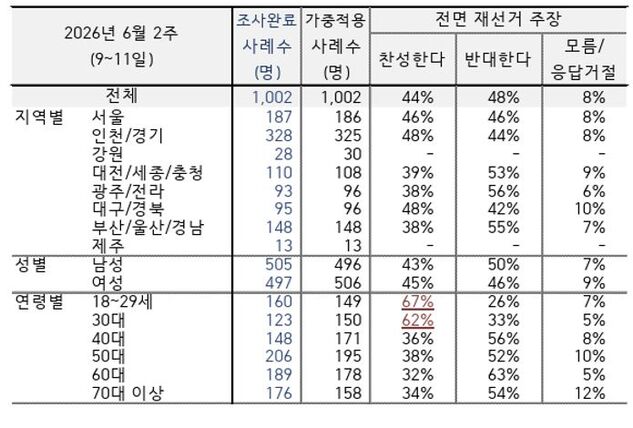
Regarding the demand for a full re-election, which has gained momentum following the voting rights protests at Seoul Olympic Park, approval and opposition were neck-and-neck at 44% and 48%, respectively. What is noteworthy is the response from the 20s and 30s generations. While opposition to a re-election was the majority in other generations, approval was 62% among those in their 30s, and was highest among those aged 29 and under at 67%, meaning two out of three supported it. This aligns with the analysis that the 20s and 30s generations view the ballot paper incident as an issue of widespread unfairness in society and are leading the protests.
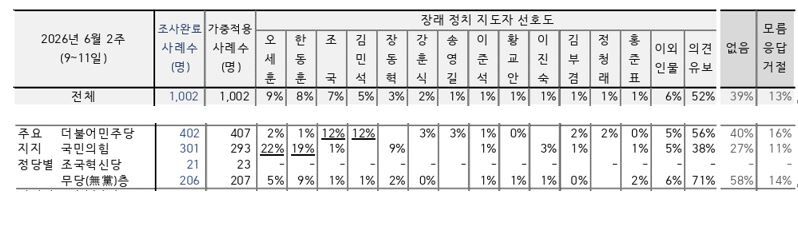
Future Leaders: Oh Se-hoon 9%, Han Dong-hoon 8%, Cho Kuk 7%, Kim Min-seok 5%
Regarding preferences for future presidential candidates, Seoul Mayor Oh Se-hoon received 9%, Representative Han Dong-hoon 8%, former Rebuilding Korea Party Leader Cho Kuk 7%, and Prime Minister Kim Min-seok 5%. Among Democratic Party supporters, Cho and Prime Minister Kim each received 12%, while Democratic Party Leader Jung Chung-rae received 2%. Among PPP supporters, Mayor Oh received 22%, Representative Han 19%, and PPP Leader Jang Dong-hyeok received 9%.
Survey Agency: Gallup Korea (self-commissioned)
Survey Period: Second week of June 2026 (June 9 – 11), Third week of May (May 19 – 21)
Respondents & Methodology: 1,002 nationwide aged 18 and older, telephone interviewer interviews
Margin of Error: ±3.1 percentage points (95% confidence level)
For further details, refer to the Gallup Korea website or the National Election Survey Deliberation Commission website.
※ Please note: This article was translated by AI and may contain errors.
Copyright Ⓒ SBS & SBSi. All rights reserved. Copying, redistribution, and unauthorized use in AI training are strictly prohibited.

 KOR
KOR



 Video News
 Video News