SBS뉴스

▲ Mourners attending the funeral of Ali Khamenei
Questions regarding the health and grip on power of Ayatollah Seyyed Mojtaba Khamenei, who has succeeded to the position of Iran's Supreme Leader, are mounting after he failed to appear at his father's funeral, foreign media outlets including Reuters reported on July 5 (local time).
According to foreign reports, at the funeral prayer for the late Supreme Leader Ayatollah Seyyed Ali Khamenei held in Tehran that day, three of Khamenei's other sons—Mostafa, Masoud, and Meysam—stood by the coffins to offer prayers. However, Mojtaba, the second son who succeeded as Supreme Leader, did not appear.
Iranian state television broadcasted the three brothers praying beside the coffins of their father and four other family members without Mojtaba present.
Khamenei and some of his family members were killed in an airstrike on February 28, the first day of a war that began when the United States and Israel attacked Iran.
Mojtaba is known to have suffered facial injuries and severe leg wounds in that attack.
Mojtaba has not appeared in public since that time.
Some mourners at the funeral could not hide their disappointment at the absence of the new Supreme Leader.
Iran's Tasnim News Agency reported that one young woman said, "I hoped until just before the prayers started that Mojtaba would come out in person. That was our only wish."
Some experts speculate that Mojtaba is avoiding public appearances due to concerns over assassination attempts by the United States or Israel.
To demonstrate national unity, Iranian authorities have been holding a large-scale state funeral since July 4, which also marks the 250th anniversary of the founding of the United States.
On July 5, tens of thousands of people, including soldiers, seminary students, and ordinary citizens, visited the Imam Khomeini Grand Mosalla, a large prayer venue in Tehran, to pay their respects.
They waved national flags and chanted slogans calling for revenge against the United States and Israel.
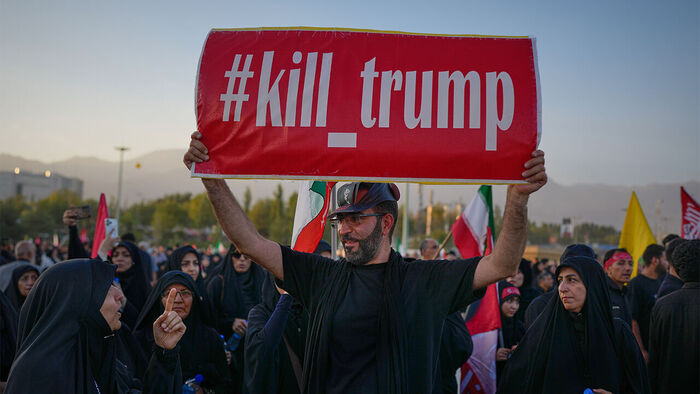
The British newspaper The Guardian reported that chants of "Death to Donald Trump" were also heard repeatedly.
In a poetry recitation held just before the farewell prayer, poet Mohammad Rasouli said, "The world is no longer a good place for Trump," adding, "Why should we not kill the person who killed our Imam? If we do not do so, that would be a disgrace."
State media reported that the funeral events, originally scheduled to end at 9:00 p.m., were extended until 10:00 p.m. due to the large number of attendees.
Tehran's subway authorities stated that approximately 7 million rides were recorded from the night of July 4 to the morning of July 5.
The funeral schedule will continue until July 9.
A funeral procession will take place in Tehran on July 6, and a funeral prayer attended by high-ranking Shiite clerics will be held in the religious city of Qom in central Iran on July 7.
The body will be transported to the Shiite holy sites of Karbala and Najaf in Iraq for funeral services on July 8, and will be interred on July 9 in Mashhad, northeastern Iran, which is the hometown of Ayatollah Khamenei and a holy city for Shiites.
Meanwhile, according to CNN, Khamenei's eldest son, Mostafa, who appeared at the funeral that day, is currently 64 years old. He has engaged in little political activity and does not currently hold a position within the Iranian government.
However, he is known to be an influential figure in religious circles.
The third son, Masoud, 52, leads the Office for the Preservation and Publication of Ayatollah Khamenei's Works, which is responsible for preserving and promoting the Supreme Leader's speeches.
The youngest son, Meysam, 48, appears in public less frequently than his brothers.
Meysam has previously worked at the Office for the Preservation and Publication of Ayatollah Khamenei's Works.
(Photo: AP, Yonhap News)
※ Please note: This article was translated by AI and may contain errors.
Copyright Ⓒ SBS. All rights reserved. 무단 전재, 재배포 및 AI학습 이용 금지