SBS뉴스
SME Wages Half of Large Firms, Contributing to Delayed Youth Employment
입력 : 2026.06.28 11:20

▲ Trends in average monthly wages by company size
An analysis has found that the wage gap between large corporations and small and medium-sized enterprises (SMEs) is delaying the entry of young people into the labor market.
The Korea Institute for Industrial Economics & Trade (KIET) stated this in a report titled "Labor Market Dual Structure and Youth Employment: Focusing on the Wage Gap Between Large Corporations and SMEs," released today (June 28).
According to the report, which conducted a full analysis of the job status of wage earners aged 15 to 64 using the employment activity registration database, the average monthly wage at SMEs was 3.51 million won in 2024, which is about half that of large corporations (7.16 million won).
While the ratio of SME wages to those of large corporations has effectively improved from 0.43 in 2015 to 0.49 in 2024, the gap in nominal wages has widened from 2.98 million won to 3.65 million won during the same period.
Citing the recent distribution of performance bonuses in the semiconductor industry as an example, the report explained that the widening nominal wage gap between large corporations and SMEs is making entry into large companies increasingly important.
The wage gap widens rapidly as seniority increases, and the report analyzed that entering a large corporation provides an absolute advantage of over 1 billion won in lifetime income compared to starting at an SME.
Moving from an SME to a large corporation is becoming increasingly difficult.
While the rate of job mobility for SME employees is observed to be more than twice as high as that of large corporation employees, most moved to other SMEs. Even among those in their 20s, who have the highest job mobility, the proportion of those moving from an SME to a large corporation was only about 5 to 6 percent.
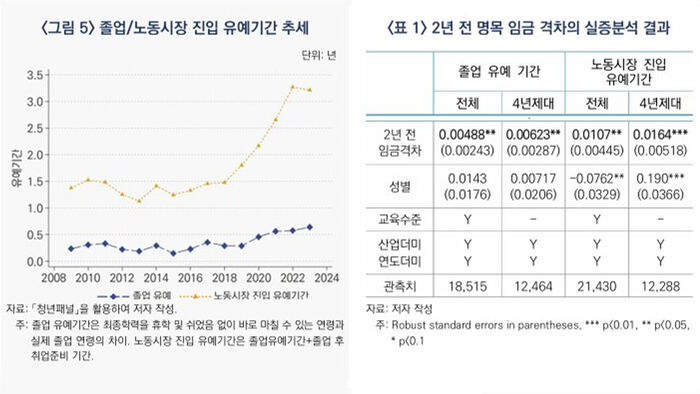 The report identified that young people are delaying their entry into the labor market due to the widening wage gap between large corporations and SMEs and the difficulty of moving between jobs.
Estimating the impact based on the 2024 wage gap between large corporations and SMEs, it was found that graduates of four-year universities delay graduation by approximately one month and entry into the labor market by about 3.6 months due to the dual structure of the labor market.
Min Soon-hong, an associate research fellow at KIET, interpreted this by saying, "Young people are making efforts to enter better jobs even if it means extending their job preparation period."
He further suggested that the government should implement policies to improve the actual working conditions for young people entering SMEs.
"Programs that provide subsidies to companies to boost youth employment, such as the Youth Job Leap Subsidy, need to be improved in a way that increases the actual wages of young people," Min explained. "It would be more effective to provide subsidies directly to young people to encourage their initial entry into the workforce."
He added, "Similar youth support programs are being changed with only their names altered, so they need to be improved in a way that maintains the sustainability of youth policies."
(Photo: Provided by KIET, Yonhap News)
※ Please note: This article was translated by AI and may contain errors.
Copyright Ⓒ SBS. All rights reserved. 무단 전재, 재배포 및 AI학습 이용 금지