SBS뉴스

▲ The exterior wall of a building in Kofu, Yamanashi Prefecture, collapsed following an earthquake on the night of June 26.
A magnitude 5.6 earthquake struck Yamanashi Prefecture on the main island of Honshu on the night of June 26 (local time), prompting Japanese media and the public to focus on a potential link to Mount Fuji.
The epicenter was in the Fuji Five Lakes region in the eastern part of Yamanashi Prefecture, near Mount Fuji.
Mount Fuji straddles both Yamanashi and Shizuoka prefectures.
This led to widespread speculation about whether the earthquake was a precursor to a volcanic eruption or if it was caused by volcanic activity.
However, the Japan Meteorological Agency (JMA) stated during a press conference early on June 27 that the earthquake does not appear to be related to volcanic activity at Mount Fuji.
The JMA explained, "There have been no particular changes observed in volcanic activity or monitoring data at Mount Fuji since the earthquake, and there is no situation that warrants immediate concern regarding an eruption."
Experts expressed similar views.
Takahiro Okura, a professor at the Volcano Research Center at Kyoto University, told the Nikkei newspaper that "the epicenter is far from the base of Mount Fuji, so it is unlikely to be related to volcanic activity."
Kazunari Obara, a researcher at the National Research Institute for Earth Science and Disaster Resilience, noted that the eastern part of Yamanashi Prefecture, where the quake occurred, is "a region where seismic activity is naturally very high." He added, "While earthquakes have frequently occurred in the surrounding area, no link to volcanic activity has been confirmed."
Aitaro Kato, a professor at the Earthquake Research Institute at the University of Tokyo, also stated, "I believe it is unlikely that this earthquake was caused by volcanic activity at Mount Fuji."
However, Professor Kato pointed out that "underground magma storage areas could be affected in some way," adding that "it is necessary to watch the situation carefully."
Despite these explanations, NHK reported that fake news claiming a connection between the earthquake and Mount Fuji is circulating online.
The Japanese government and the academic community have been closely monitoring the possibility of an eruption at Mount Fuji.
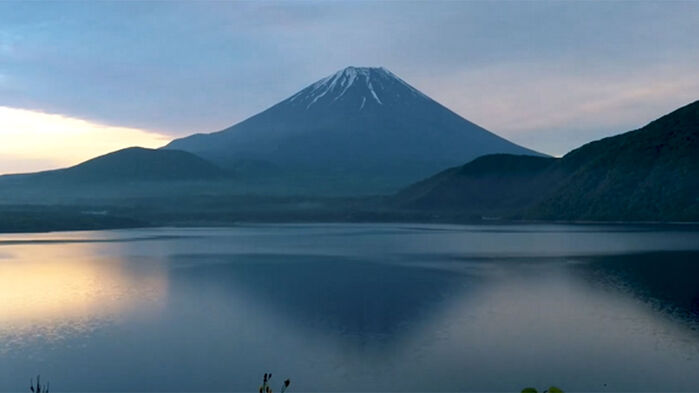
▲ Mount Fuji
It is believed that Mount Fuji has erupted on average once every 30 years over the past 5,600 years.
However, it has remained dormant since its last eruption, the Hoei eruption, about 300 years ago.
Meanwhile, the earthquake on June 26 caused various damages in the affected areas.
The Fire and Disaster Management Agency of the Ministry of Internal Affairs and Communications reported that 10 people sustained minor injuries across Yamanashi, Kanagawa, and Shizuoka prefectures.
Chief Cabinet Secretary Minoru Kihara, the government spokesperson, said in a press conference early on June 27 that power outages affected 2,860 households in Yamanashi, Ibaraki, and Saitama prefectures following the quake.
Kihara also explained that water supply has been cut off in Yamanakako Village, Yamanashi Prefecture.
NHK reported that in Kofu, Yamanashi Prefecture, building exterior walls collapsed and bottles fell and shattered in liquor stores.
Heavy rain is expected in eastern and western Japan due to a typhoon that made landfall in Japan today.
The JMA urged caution, noting that the earthquake has weakened the ground, increasing the risk of landslides.
Concerns are also growing over the series of magnitude 5 to 7 earthquakes that have recently struck Japan.
A magnitude 5.5 earthquake occurred in Gunma and Saitama prefectures on June 16.
On June 25, a magnitude 7.2 earthquake struck Aomori Prefecture in the north.
Yesterday, a magnitude 5.8 earthquake occurred in the northeastern part of Chiba Prefecture during the day, followed by the earthquake in Yamanashi Prefecture at night.
Notably, three of these events occurred in areas near the capital region.
However, Akiyuki Ebita, director of the Earthquake and Tsunami Observation Division at the JMA, stated that the Chiba earthquake and the Yamanashi earthquake are not considered to be directly related.
When asked if the recent string of relatively large earthquakes indicates that seismic activity is becoming more intense, Ebita replied, "Four tectonic plates collide around Japan, exerting constant pressure, which results in an average of about 2,000 earthquakes of seismic intensity 1 or higher per year."
He explained, "While it may feel like a high or low frequency to us, nature has undergone these fluctuations for a long time, and such periods do occur."
He added that while earthquakes are more likely to occur following a large tremor, it is best to understand these events within the scope of natural long-term fluctuations.
(Photo: Jiji Press, Yonhap News)
※ Please note: This article was translated by AI and may contain errors.
Copyright Ⓒ SBS. All rights reserved. 무단 전재, 재배포 및 AI학습 이용 금지