SBS뉴스
US Oil Sanctions Waiver Could Net Iran Up to 4.7 Trillion Won in 60 Days
입력 : 2026.06.24 16:46

▲ US Treasury Secretary Scott Bessent briefs at the White House
An analysis shows that the Iranian economy could reap significant benefits as the United States temporarily waives sanctions on Iranian crude oil exports under a memorandum of understanding (MOU) aimed at ending the Iran war.
The measure is estimated to allow Iran to generate up to $3.06 billion (approximately 4.71 trillion won) in additional revenue over a 60-day period, offering a lifeline to the Iranian economy, which had been pushed to the brink of collapse by the war.
According to the U.S. weekly news magazine Newsweek on June 23 (local time), Brett Erickson, managing principal of geopolitical risk advisory firm Obsidian Risk Advisors, estimated that Iran could earn an additional $37.4 million to $51 million (approximately 57.6 billion to 78.5 billion won) per day.
Erickson analyzed that assuming Iran can sell all of its available crude oil inventories, it could generate a total of $2.24 billion to $3.06 billion (approximately 3.45 trillion to 4.71 trillion won) in additional revenue during the 60-day sanctions waiver period.
Earlier, the U.S. Treasury Department issued a 60-day temporary general license on June 22, allowing the production, delivery, and sale of Iranian crude oil.
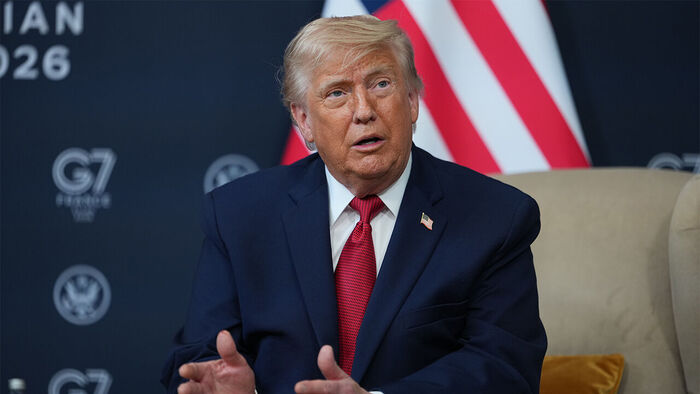
This marks a 180-degree turn from the pressure-only policy of U.S. President Donald Trump, who had been squeezing Iran with high-intensity sanctions since scrapping the Joint Comprehensive Plan of Action (JCPOA) during his first term in 2018.
Due to U.S. sanctions, Iran had previously been able to export crude oil to only a handful of countries, such as China, and even then, had to accept steep discounts and navigate complex, circuitous routes.
Erickson pointed out, however, that this cannot be viewed simply as a "financial windfall."
"Iran was already selling oil, but it was paying a sort of 'sanctions tax' in the form of operating a so-called 'shadow fleet,' illicit money laundering, and intermediary fees," he said.
In other words, the analysis suggests that the sanctions waiver did not create a new source of income, but rather maximized the profitability of existing sources.
Before the outbreak of the Iran war on February 28, Brent crude was priced at around $66 (approximately 101,640 won) per barrel, but Iran had been selling its oil at a discount of about $10 (approximately 15,400 won).
With this measure, Iran is now able to sell its oil at prices closer to market rates.
In particular, as circuitous costs—such as shadow fleet operations, uninsured risks, and money laundering through shell companies—which amounted to about $7 (approximately 10,780 won) per barrel, are reduced, Iran's actual take-home revenue has effectively increased by about $11 (approximately 16,940 won) per barrel in total.
Erickson estimated that even if Iran sells only 2.3 million barrels per day—70% of its supply capacity—it could still earn about $1.5 billion (approximately 2.31 trillion won) more than it would have if sanctions had remained in place.
Currently, Iran holds an inventory of approximately 180 million barrels of crude oil.
Its production, which had dropped to 2.3 million barrels per day in the aftermath of the war, is also recovering rapidly, making it likely that Iran could sell up to 201.5 million barrels within the 60-day waiver period.
However, experts remained cautious about whether this short-term revenue boost would translate into long-term economic benefits.
"Once they clear out all their inventories this month, next month's production will fall short of pre-war levels, which could cause revenues to plummet," Erickson said. He projected that even if the sanctions waiver were extended for a year instead of 60 days, the maximum annual additional profit would be capped at around $10 billion (approximately 15.4 trillion won).
Ben Cahill, a nonresident senior fellow at the Atlantic Council, a think tank, also emphasized that what matters most is "what happens after the 60 days."
"The key question is whether Iran can sell more crude oil to countries other than China," Cahill said.
Ultimately, the crux of the matter is whether the memorandum of understanding (MOU) signed separately last week by President Trump and Iranian President Masoud Pezeshkian will be implemented.
This MOU includes provisions for the U.S. and Iran to cooperate toward the ultimate lifting of sanctions on Iranian oil.
Cahill predicted that if this temporary 60-day measure becomes permanent, it would have a highly positive impact on the Iranian economy.
"If Iran recovers its export volumes to 2015–2017 levels and oil prices are assumed at $70 (approximately 107,800 won) per barrel, Iran could generate a massive additional oil export revenue of up to $35 billion (approximately 53.9 trillion won) annually," he projected.
(Photo: AP, Yonhap News)
※ Please note: This article was translated by AI and may contain errors.
Copyright Ⓒ SBS. All rights reserved. 무단 전재, 재배포 및 AI학습 이용 금지