SBS NEWS
Financial Services Commission to Supply 4.5 Trillion Won in Guaranteed Loans for Regional SMEs, Capping Settlement Period at 60 Days
Published : Nov 2, 2026 2:22 PM

▲ Financial Services Commission
The Financial Services Commission (FSC) is expanding financial support for regional businesses, including the supply of 4.5 trillion won in guaranteed loans over three years to small and medium-sized enterprises (SMEs) and mid-sized companies in the "5-plus-3" mega-regions (five super-regions and three special self-governing provinces).
The measures also aim to ensure swift and secure collection of delivery payments by shortening the settlement period for collateralized accounts receivable loans to within 60 days and abolishing recourse obligations.
The FSC announced these regional SME and mid-sized enterprise support measures during the 6th Productive Finance Great Transformation Meeting held today.
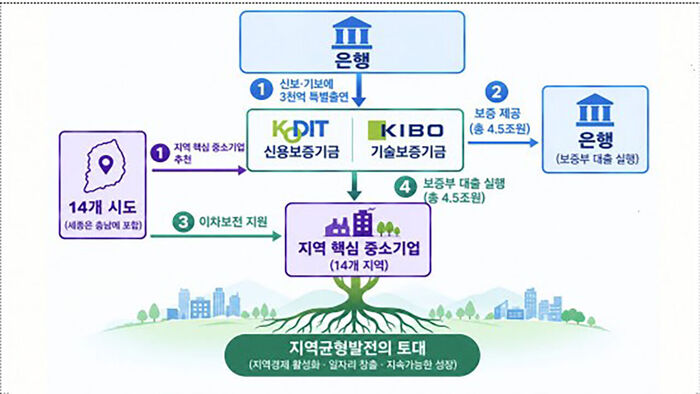
Under the plan, the banking sector will make a special contribution totaling 300 billion won over three years, enabling the Korea Credit Guarantee Fund and the Korea Technology Finance Corporation to provide 15 times that amount—4.5 trillion won—in partnership guarantees.
The financial authorities estimate that approximately 9,000 regional companies will benefit from this initiative.
Unlike previous programs, local governments will also participate in the initiative.
When local governments recommend key regional SMEs and mid-sized companies, the Korea Credit Guarantee Fund and the Korea Technology Finance Corporation will grant preferential evaluations, while local governments will independently provide local budget subsidies for interest rates.
The interest rates on the guaranteed loans will be determined later based on the scale of the local governments' budget allocations and other factors.
Local governments will be selected by a separate evaluation committee that comprehensively assesses their project capabilities, regional financial vulnerability, and policy alignment.
The program targets a total of 13 municipal and provincial governments excluding the capital area (with Sejong included in South Chungcheong Province). Funds will be differentially allocated to ▲ 3 top-tier regions (450 billion won), ▲ 5 excellent regions (350 billion won), and ▲ 5 average regions (280 billion won).
To encourage participation from the banking sector, the supply performance of guaranteed loans for regional SMEs will be reflected as a scoring factor in regional reinvestment evaluations.
The FSC plans to open project applications for local governments by the end of this year, conduct evaluations and select grades in January next year, and supply the guaranteed loans starting in the first quarter.
Regarding concerns over potential insolvencies, Shin Jang-soo, Director General of the Banking Division at the FSC, stated during a briefing, "Guarantee institutions will screen companies with repayment capabilities through guarantee reviews."
During the meeting, a business agreement (MOU) was also signed by 18 institutions (16 banks, the Korea Credit Guarantee Fund, and the Korea Technology Finance Corporation) to support key SMEs and mid-sized companies in the 5-plus-3 regions.
The financial authorities are also improving the systems for accounts receivable and collateralized accounts receivable loans to help SMEs recover delivery payments more quickly.
Accounts receivable are commercial claims issued by purchasing companies after selling companies have successfully delivered goods.
Collateralized accounts receivable loans are a means for selling companies to cash in their delivery payments early using accounts receivable as collateral.
Starting in February next year, the maturity periods for accounts receivable, collateralized accounts receivable loans, and mutually beneficial claims—which are similar to accounts receivable—will be shortened to within 60 days.
Under current laws such as the Act on Fair Transactions in Subcontracting, the delivery payment settlement period is principled at 60 days, but up to 90 days had been permitted in certain transactions.
Critics pointed out that this delayed delivery payment collection and exacerbated financial difficulties for SMEs.
The authorities expect that this system improvement will enable the early encashment of accounts receivable worth approximately 117 trillion won, saving companies about 36.3 billion won in annual interest burdens.
Starting in January next year, banks' recourse obligations on collateralized accounts receivable loans will be abolished in principle.
However, if a selling company explicitly wishes to have recourse obligations assigned, it will be permitted on a limited basis.
While the repayment obligation for collateralized accounts receivable loans lies with the purchasing company, banks have imposed recourse obligations on selling companies for about 50 percent of newly handled annual volumes for risk management purposes.
The authorities expect that the abolition of recourse obligations will alleviate SME guarantee liabilities worth approximately 463,000 cases and 26.9 trillion won, while preventing the spillover of insolvency from purchasing companies.
However, addressing concerns that collateralized accounts receivable loans might shrink, Director General Shin said, "Banks have stated that considering their capabilities, they can operate without a contraction in these loans."

In addition, when purchasing companies make early repayments on collateralized accounts receivable loans, the recipients of prepaid interest refunds will be unified to the selling companies.
Accordingly, an estimated 8.3 billion won in annual interest previously paid to purchasing companies is expected to be refunded to selling companies.
In the case of mutual-growth settlement—which allows selling companies to cash in accounts receivable early based on the credit of the top-tier purchasing company—the scope of eligible purchasing companies will be expanded.
Incentives for companies utilizing mutual-growth settlement will also be expanded, such as raising deposit account interest rates and offering preferential rates on general loans.
FSC Chairman Lee Eog-weon emphasized, "Amid rising delinquency rates among SMEs recently, we must proactively resolve bottlenecks in capital flows so that companies can minimize shocks from interest rate hikes and fluctuations. We need to overhaul the foundation of productive finance to ensure that funds are sufficiently supplied where they are needed."
Meanwhile, as of the end of July, a total of 264.3 trillion won in productive finance funds had been supplied by the financial sector.
(Photo provided by Financial Services Commission, Yonhap News)
※ Please note: This article was translated by AI and may contain errors.
Copyright Ⓒ SBS. All rights reserved. Unauthorized reproduction, redistribution, and use for AI training are prohibited.