SBS NEWS
Is Netanyahu Extending Political Life Through 'Rigged Election' Claims?
Published : Oct 30, 2026 11:50 AM

▲ Israeli Prime Minister Benjamin Netanyahu
Israeli Prime Minister Benjamin Netanyahu, who failed to secure a majority in the general election, continues to push claims of a "rigged election."
Some critics point out that Prime Minister Netanyahu is stirring up election fraud controversies to block the opposition from forming a coalition government and to extend his political career.
Prime Minister Netanyahu is claiming that massive vote rigging took place in this general election, centered around Arab parties in Israel.
The controversy further escalated after a leaked letter showed that Israel's Central Election Committee chairman instructed the head of Shin Bet, the domestic intelligence agency, to immediately investigate "suspicions of foreign election interference."
Israeli media subsequently identified Qatar as the country that attempted election interference.
The allegations suggest that Qatar funded one of the Arab parties in an attempt to boost voter turnout among Arab voters.
The ruling Likud party described this as an "attack on democracy," claiming that "foreign powers are trying to take over the Knesset (Israeli parliament), Islamize Israel, and overthrow right-wing rule."
It emphasized, "No Zionist party should cooperate with Arab parties in replacing the Knesset Speaker or forming a new government after the new parliament is launched."
However, foreign media reported that the ruling party has not presented concrete evidence to support these claims.
This is why critics argue that the ruling party is effectively utilizing "election fraud theories" to prevent the opposition from forming a coalition government.
As a result of this general election, Israel's ruling bloc secured 53 seats and the opposition bloc 48 seats, with neither side securing a majority.
On the other hand, Arab parties secured 19 seats, their highest number ever, emerging as a "casting vote" holding the key to future coalition government formation.
If the opposition successfully allies with Arab parties to form a coalition government in the future, Prime Minister Netanyahu could be ousted, and current Knesset Speaker Amir Ohana, a member of the Likud party, could also be replaced.
In this scenario, the likelihood of establishing an inquiry committee to hold Prime Minister Netanyahu accountable for security failures also grows.
The opposition is pushing to establish a committee to investigate security failures during Hamas's attack on Israel on October 7, 2023, while Prime Minister Netanyahu has opposed the establishment of the committee over the past two years.
However, if the formation of a coalition fails, Israel will have to hold another general election, and in the meantime, Prime_Minister Netanyahu will continue to serve as Prime Minister of a caretaker government.
Ultimately, attacking the legitimacy of Arab parties through election fraud theories could serve as a useful tool for Prime Minister Netanyahu to maintain power.
This has drawn criticism not only from the Israeli opposition but also from the head of state, the president.
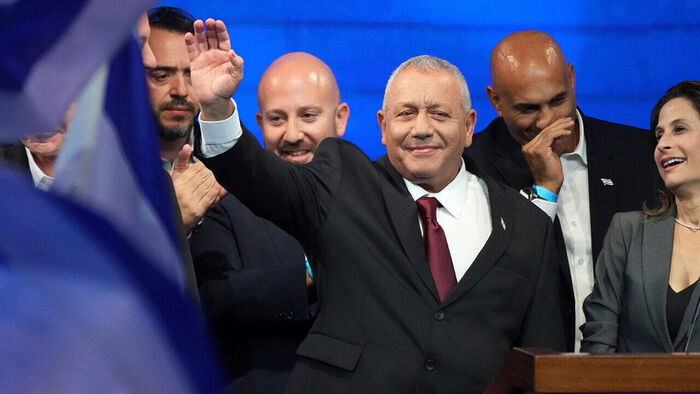
Opposition leader Gadi Eisenkot criticized in a video message that "it is already clear that the Likud party and Netanyahu have launched an organized and systematic campaign to undermine the legitimacy of the election results," arguing that the ruling bloc is effectively trying to nullify the election.
He added that the investigation into this election interference should not become a reason to delay the opening of parliament.
Ahmad Tibi, a leader of the Joint List, an Arab left-wing party alliance, told Reuters, "All these claims are aimed at Eisenkot," adding, "It is an attempt to blackmail and intimidate him so that he does not form a government reliant on Arab support."
Israeli President Isaac Herzog urged the political circle, "Avoid actions that tarnish the honor of an entire community that sought to exercise its right to vote and actively participate in democracy."
Din Livne, acting administrative director of the Israel Central Election Committee (CEC) in charge of election management, stated, "There is no basis for allegations that there was a systematic effort to undermine the integrity of the election."
Israel's domestic intelligence agency Shin Bet also clarified that the investigation does not target the entire community that legally participated in voting, and Qatar, identified as an external election interference force, likewise stated through a prime ministerial adviser that it "firmly" denies the allegations.
However, as the ruling bloc has raised suspicions of election interference, the controversy is unlikely to be resolved anytime soon.
In addition, forecasts suggest that forming a coalition government between the opposition bloc led by Eisenkot and Arab parties will not be easy.
Previously, Eisenkot stated that he would not form a coalition government with parties that do not meet certain criteria, such as failing to designate the Palestinian militant group Hamas as a terrorist organization.
Hamas, based in the Gaza Strip, infiltrated Israel on October 7, 2023, killing about 1,200 people and triggering the war.
Qatar is a country that has served as a funding and diplomatic hub for Hamas, including hosting an office for its political leadership.
According to The Wall Street Journal (WSJ), about 60% of Jewish Israelis expressed opposition to Arab parties participating in a coalition government in a recent poll.
According to a Hebrew University poll, supporters of the opposition bloc also preferred forming a government with the Ra'am party, classified as moderate among Arab factions, while receiving outside support from the Joint List without them participating in the coalition.
(Photo: Getty Images)
※ Please note: This article was translated by AI and may contain errors.
Copyright Ⓒ SBS. All rights reserved. Unauthorized reproduction, redistribution, and use for AI training are prohibited.