SBS NEWS
Collapse of Ulsan Thermal Power Plant That Killed 7 Caused by 'Excessive Column Cutting'
Published : Oct 30, 2026 10:44 AM

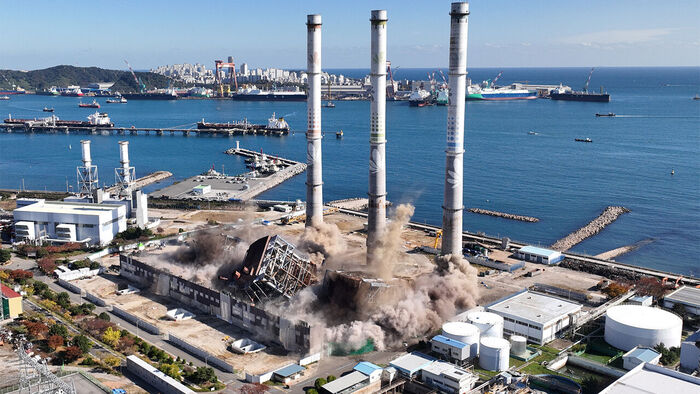
▲ Officials from the Central Accident Countermeasure Headquarters inspect the site to resume the search for missing persons after the controlled demolition of Units 4 and 6 of the Ulsan Thermal Power Plant boiler tower on the afternoon of November 11 last year.
The collapse of the Ulsan Thermal Power Plant boiler tower in November last year, which resulted in the deaths of seven workers and injuries to two others, was directly caused by cutting away too many columns prior to the controlled demolition, an investigation showed.
Flawed structural reviews—such as overestimating the load-bearing capacity of the columns and underestimating the weight of the structure—were cited as the root causes of the accident.
The Ministry of Land, Infrastructure and Transport announced the findings of the Ulsan Thermal Power Plant Boiler Tower Collapse Accident Investigation Committee today (October 30).
The committee determined that excessive cutting of the boiler tower columns caused them to fail under the weight of the upper structure, leading to the collapse.
At the time of the accident, a "pre-weakening" process was underway, which involved cutting parts of structures such as columns and beams in advance before demolishing the boiler tower via explosives.
However, the excessive cutting caused a "local buckling" phenomenon where the remaining parts bent and snapped under the upper load, leading to a progressive collapse of the entire structure, according to the findings.
The excessive column cutting occurred because data errors and insufficient technical reviews during the structural review process resulted in miscalculations of the safe cutting limits, the investigation showed.
The boiler tower was structured such that the steel plate thickness of the columns decreased toward the top, but thickness measurements were taken at only one ground-floor location and uniformly applied to all upper columns.
The column thickness at the 26.2 to 27.2-meter height where the actual collapse began was 15 millimeters, but the structural review calculated it as 24 millimeters.
Conversely, the weight of the structure was calculated at 3,005.8 tons, which is about 520 tons lighter than the actual weight of 3,525.8 tons.
In effect, the load-bearing capacity of the columns was overestimated while the actual weight the columns had to bear was underestimated.
Additionally, the possibility of local buckling due to column cutting was not reviewed, and no safety margins were secured to prepare for deformation or work-related damage in the aging structure.
The committee stated that a simulation of the collapse process reflecting the actual column thickness and structural weight showed that the columns bent and failed at the 26.2 to 27.2-meter height where the actual collapse began.
The deformation patterns of the columns shown in the simulation also matched those identified at the actual collapse site.
Management and supervision by the constructor and the client were also found to be insufficient.
The committee stated that the primary contractor, HJ Shipbuilding & Construction, relied on the judgment of specialized subcontractors and failed to sufficiently verify whether the detailed construction drawings matched actual site conditions, while the client, Korea Dongseo Power, failed to comprehensively and systematically manage the participating entities in the project.
To prevent recurrences, the committee proposed ▲ strengthening field inspections at demolition sites, ▲ establishing technical standards for demolition work, ▲ strengthening design and construction management for high-risk demolition work, and ▲ enhancing client responsibilities.
The committee plans to submit its final report to the Ministry of Land, Infrastructure and Transport next month, and the report will be made public through the ministry's website and the Construction Safety Management Information System.
The Ministry of Land, Infrastructure and Transport plans to formulate measures to improve demolition work systems by synthesizing the results of this investigation with the investigation into the Seosomun Overpass demolition collapse accident, and intends to notify relevant agencies of the findings to facilitate prompt administrative dispositions and investigations regarding legal violations.
On November 6 last year, Unit 5 of the 63.4-meter-tall boiler tower at the Ulsan Thermal Power Plant in Nam-gu, Ulsan, collapsed during pre-weakening work, killing seven workers and injuring two.
(Photo: Yonhap News)
※ Please note: This article was translated by AI and may contain errors.
Copyright Ⓒ SBS. All rights reserved. Unauthorized reproduction, redistribution, and use for AI training are prohibited.