SBS NEWS
Seoul Mayor Oh Se-hoon: Citizens' Tax Burden Highest, Government Subsidies Lowest in the Country
Published : Oct 29, 2026 11:26 AM

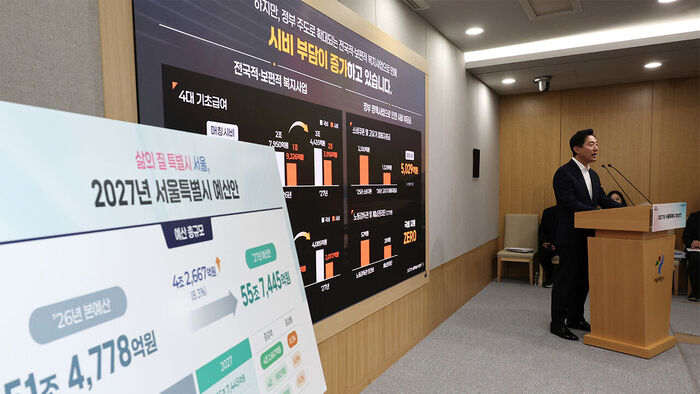
▲ Seoul Mayor Oh Se-hoon presents the city's 2027 budget plan at Seoul City Hall on October 29.
Seoul Mayor Oh Se-hoon has pointed out that Seoul's fiscal burden is growing increasingly heavy due to the central government's expansion of welfare programs and imbalances in state funding.
Mayor Oh made the remarks during a press briefing on the 2027 Seoul city budget plan, stating, "While the tax burden per Seoul citizen is at the highest level in the country, state funding is at the lowest level."
"The city's fiscal burden is growing due to the government's expansion of welfare programs that do not fully take regional characteristics into account," Mayor Oh explained. "Seoul's mandatory matching burden for the four major basic subsidies and childbirth support is increasing, and city funds are also being poured into government policy projects such as consumption coupons and subsidies for damages from high oil prices."
He added, "There are also projects funded exclusively by the city without any state support, such as labor inspector labor costs and arrears management task forces."
In particular, Mayor Oh emphasized, "The additional burden caused by differential subsidies has grown to the 3 trillion won range annually."
This indicates that Seoul is bearing a relatively heavy financial burden compared to other regions due to the application of differential subsidy rates for national treasury assistance projects, prompting him to call for adjustments from the government.
He also pointed out the lack of state support for investments in aging infrastructure as a problem.
"With the country's highest number of public facilities older than 30 years, essential safety investments such as improving aging sewage pipes and subway facilities are urgent," Mayor Oh noted. "However, there is no state support for major aging facility improvement projects and the compensation of losses from free urban railway rides."
According to the Seoul Metropolitan Government, Seoul's city-funded burden for next year will increase by 1.17 trillion won compared to this year due to the expansion of national treasury assistance projects by the central government, such as marriage and child-rearing support.
Amidst such increasing mandatory expenditures, Seoul has formulated next year's budget at 55.7445 trillion won, an 8.3 percent (4.2667 trillion won) increase from this year.
However, the city plans to manage its debt scale without increasing it, keeping it at 11.5690 trillion won, similar to this year.
Policy project expenditures—excluding support for offices of education and autonomous districts, as well as administrative operational expenses—were expanded by 9.0 percent from this year to 31.5752 trillion won.
Seoul Mayor Oh Se-hoon stated, "Even under these difficult conditions, we have not increased the debt that future generations must repay. While managing the debt that surged during the previous administration, we have continued investments for our citizens."
He went on to emphasize, "Sound finance does not simply mean cutting spending. It means reducing waste and properly investing where it is truly needed."
The Seoul Metropolitan Government will submit this budget plan to the city council tomorrow, and the city council is scheduled to review next year's budget during its regular session opening on November 2.
(Photo: Yonhap News)
※ Please note: This article was translated by AI and may contain errors.
Copyright Ⓒ SBS. All rights reserved. Unauthorized reproduction, redistribution, and use for AI training are prohibited.