SBS NEWS
Inje Residents Protest Government Regional Classification as "Discrimination, Not Favoritism"
Published : Oct 27, 2026 10:56 AM

▲ Inje residents protest against the local preferential index evaluation.
Residents of Inje County, Gangwon Province, have launched large-scale collective action in opposition to their exclusion from population-declining areas and their classification into Group 2 of the local preferential index.
The Emergency Countermeasure Committee against the Group 2 Designation of the Local Preferential Index held its first rally this morning at the Inje Grass Stadium, shouting, "Completely reexamine the government's decision that ignores the reality of Inje County."
About 1,000 residents who participated in the rally repeatedly condemned the government's regional classification results.
Kim Do-hyung, speaker of the Inje County Council and head of the emergency committee, raised his voice, asking, "How much more underdeveloped do we need to be to be considered a struggling region, and how many more people must leave before we are in crisis?"
"Even if the authority to evaluate lies with the government, it is the residents who must bear the consequences," Kim emphasized. "Do not evaluate the reality of Inje County—which has endured various regulations for a long time for national security and environmental conservation—solely based on remaining numbers."
He added, "We cannot pass down sighs of despair that life is too frustrating to bear even to our children," urging, "The Ministry of the Interior and Safety should not try to brush this off with mere words of 'reviewing it,' but clearly state how it will be corrected."
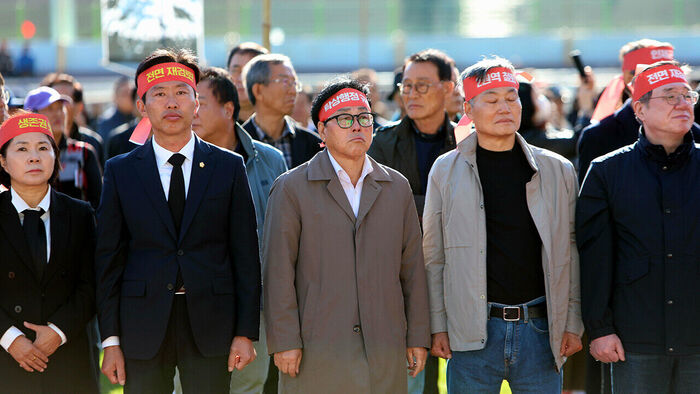
Kim Keun-sung, head of the Inje County Association of Village Heads, also criticized the situation, stating, "Local preferential treatment that fails to properly examine the difficulties of the region is not preferential treatment, but another form of discrimination." He added, "We can never accept an unfair system where sacrifices for the state return as disadvantages and the reality of the region is ignored."
Residents urged a complete reexamination of the calculation method for the local preferential index, which ignores local realities, as well as a review of the Group 2 designation that reflects actual underdevelopment and the unique characteristics of border regions.
They also demanded the full disclosure of all evaluation results and calculation grounds—from Inje County's initial designation as a population-declining area to redesignations and the local preferential index—and a clear explanation of why Inje County ended up disadvantaged.
The residents resolved, "We will mobilize all legitimate means and fight strongly to the end until the unreasonable calculation standards of the local preferential index are improved and the Group 2 designation is reexamined."
In the afternoon, the emergency committee will relocate in front of the main gate of the National Assembly to continue its second protest rally.
In particular, County Mayor Choi Sang-ki, Emergency Committee Head Kim Do-hyung, and Village Heads Association Head Kim Keun-sung are scheduled to participate in a head-shaving ceremony to express strong protest against the government's unreasonable regional classification.
Tomorrow, an additional rally involving about 200 people, including Mayor Choi, will be held in front of the National Assembly steps.
Tomorrow, heads of local social organizations also plan to shave their heads and deliver letters of protest to the chairperson of the Special Committee on Budget and Accounts and the chairperson of the Public Administration and Security Committee of the National Assembly.
This protest rally stems from the recent announcement by the Ministry of the Interior and Safety regarding the redesignation of population-declining areas and the classification results of the local preferential index.
Announcing the results of the population-declining area redesignation on October 7, the Ministry of the Interior and Safety excluded Inje County from population-declining areas and instead classified it as a population vitality plus area. This was followed by the local preferential index announcement on October 20, which classified Inje into Group 2 alongside Chuncheon, Wonju, Gangneung, and Sokcho.
Inje County is a border region with a population of only about 30,000, and its regional development has long been constrained by military facility protection zones and various environmental regulations.
In fact, the resident registration population decreased by 1,529 people, dropping from 32,165 at the end of 2021 to 30,636 in September 2026.
The regional underdevelopment index also remains stagnant at 151st out of 167 cities and counties nationwide.
Inje County maintains that it is unreasonable to bundle the county into the same category as cities that have massive differences in population size and levels of regional development.
It argues that the straight-line distance from Seoul used to calculate the local preferential index fails to fully reflect actual travel times and traffic conditions, and that the unique characteristics of border and mountainous regions, as well as access to living services such as medical care and education, must be comprehensively considered.
Residents express concern that if the local preferential index is fully applied starting in 2027, differentiated support by region will be implemented across various government projects—such as support for issuing local love gift certificates—widening the gap in support between Inje and other cities and counties regarding residents' lives and the overall local economy.
(Photo: Yonhap News)
※ Please note: This article was translated by AI and may contain errors.
Copyright Ⓒ SBS. All rights reserved. Unauthorized reproduction, redistribution, and use for AI training are prohibited.