SBS NEWS
Semiconductor Boom and AI Expansion Blamed for Deteriorating Quality of Youth Employment: BOK
Published : Oct 26, 2026 2:26 PM

▲ File photo
The Bank of Korea (BOK) diagnosed that the quality of youth employment is deteriorating due to recent economic growth centered on semiconductors and the expansion of artificial intelligence (AI) technology.
It also presented an analysis that South Korea's employment protection system is rather hindering youth employment.
In a report released today (October 26), the BOK stated, "Structural factors such as the restructuring of industrial ecosystems, changes in AI technology, and a rigid labor market are complexly affecting youth employment issues."
Based on the dual structure of the labor market, the BOK analyzed the current state of youth employment by dividing regular workers as primary labor market participants and temporary or daily workers as secondary labor market participants.
According to the findings, since 2023, young people aged 15 to 29 have tended to lower their job expectations and enter the secondary market rather than waiting to enter the primary labor market, resulting in a deterioration in the quality of employment.
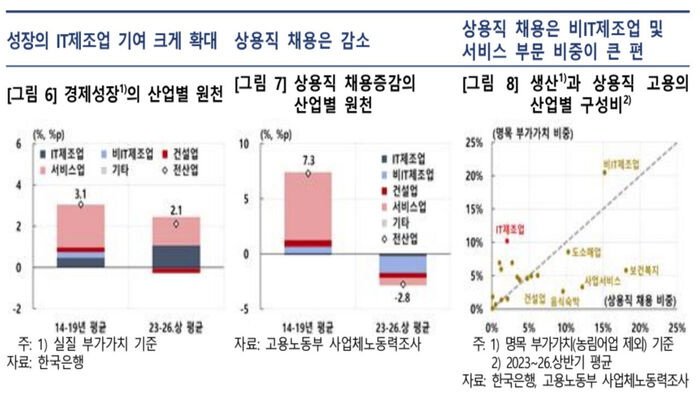
The restructuring of the industrial structure centered on information technology (IT) manufacturing was first pointed out as the background.
While IT manufacturing, which has low regular job creation capacity, leads production, the proportion of non-IT manufacturing and service industries remains high in regular hiring, meaning that economic growth ultimately does not lead to the expansion of primary labor market demand.
Furthermore, this stagnation in labor demand tended to be concentrated among young people rather than being distributed across all age groups.
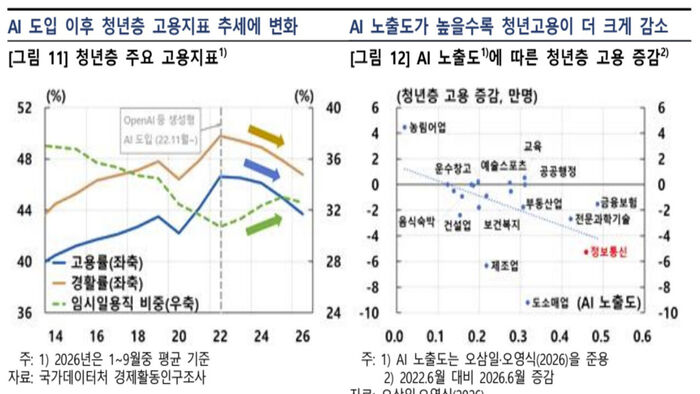
The introduction of generative AI at the end of 2022 also created an inflection point for youth employment.
As preference for experienced workers has strengthened, centering on jobs and industries with high AI exposure, the demand for entry-level and basic tasks primarily handled by young people has rapidly contracted.
The BOK analyzed that these changes in the hiring structure can act as structural barriers restricting young people from entering the labor market in industry groups with high AI exposure, such as finance and insurance, professional, scientific, and technical services, and information and communications.
The "secondary market lock-in effect" has also intensified, with the proportion of young people moving from the secondary labor market to the primary labor market (transition rate) dropping from the 8% range in 2014–2019 to the 5% range in 2023–2024.
This is why there are concerns that even if labor demand recovers in the future, improvements in youth employment may be delayed due to a lack of accumulation of job competencies and upward mobility paths.
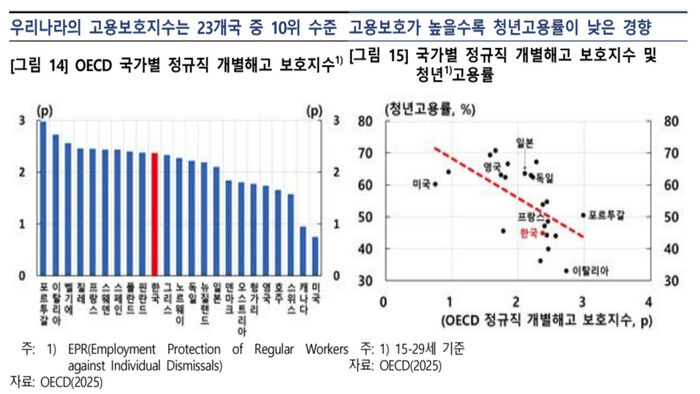
In addition, the BOK pointed out that the so-called "rigid" labor market structure is one of the factors blocking young people from entering the labor market.
According to Organisation for Economic Co-operation and Development (OECD) statistics, countries with higher levels of employment protection tend to have lower youth employment rates, and the BOK cited the fact that South Korea's "regular worker individual dismissal protection index" is relatively high at around 10th out of 23 major countries.
Accordingly, the BOK stated, "There is a limit to fundamental solutions relying solely on job policies, which are labor supply-side measures," adding, "A comprehensive approach that combines industrial policies and labor market structural improvements is required."
It then presented solutions such as creating conditions for the spillover of IT manufacturing growth, organic linkages between education and industry, and greater flexibility in employment systems.
(Photo: Provided by BOK, Yonhap News)
※ Please note: This article was translated by AI and may contain errors.
Copyright Ⓒ SBS. All rights reserved. Unauthorized reproduction, redistribution, and use for AI training are prohibited.