SBS NEWS
Lula Wins Fourth Term in Brazil Presidential Election; Bolsonaro Refuses to Accept Results
Published : Oct 26, 2026 2:54 PM

▲ Brazilian President Luiz Inácio Lula da Silva
Incumbent Brazilian President Luiz Inácio Lula da Silva (81), the godfather of Brazil's left wing, secured a historic fourth term by defeating Senator Flávio Bolsonaro in the presidential runoff held yesterday (October 25) local time.
According to Brazil's Superior Electoral Court, with 99.99% of the votes counted, President Lula secured his victory with 51.78% of the vote, edging out candidate Flávio Bolsonaro, who finished with 48.22%, by a margin of 3.56 percentage points.
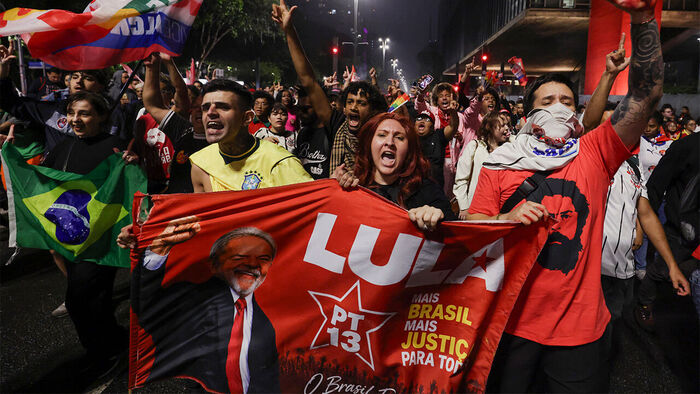
With this win, President Lula has claimed his fourth presidential term since taking office for the first time in 2003, setting a milestone as the first four-term president in modern Brazilian political history.
Since his first presidential run in 1989, he holds a record of 4 wins and 3 losses (four victories, three defeats) across seven bids for the presidency.
On the other hand, candidate Flávio Bolsonaro—who aimed to become Brazil's first father-son presidential duo following his father, former President Jair Bolsonaro—showed strong performance early in the vote count but ultimately faced defeat after allowing a late comeback.
Additionally, a brake has been applied to the "blue tide" (a wave of right-wing governments) that has swept across the Latin American continent following the inauguration of U.S. President Donald Trump.
There had been no instances of right-wing defeats in Latin American presidential elections during the year following the launch of Trump's second term in 2025, but the left-wing faction has now won a presidential election in Brazil, the largest country in Latin America, for the first time.
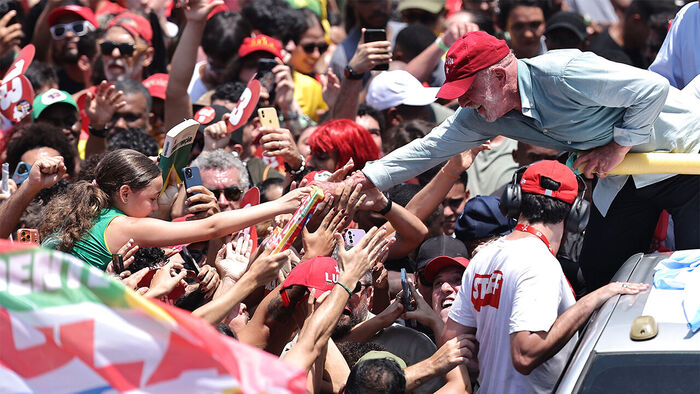
Icon of Resilience Lula Sets Four-Term Milestone... First Four-Term Success Since Democratization
Although he has wielded formidable influence in Brazilian politics for decades, unlike Flávio Bolsonaro, whom he faced in this election, he did not come from an influential family guaranteed high status from birth; he came from a poor background.
When Lula was a child, his parents, who were impoverished sharecroppers with no viable way to make a living, left their hometown behind and migrated to São Paulo, Brazil's largest economic city.
Pernambuco, the northeastern state where Lula was born, was known as an impoverished region.
Starting to make a living at the age of 7, he sold peanuts and shined shoes. He learned to read at age 10, dropped out of school in the 5th grade of elementary school, and began working as a factory worker at a metal company in São Bernardo do Campo, near São Paulo, at age 14.
In 1964, at the age of 19, he lost his left pinky finger in a workplace accident.
Five years later, he was bereaved of his first wife, who had worked at the same factory.
At the time, his wife was pregnant and suffering from an industrial-related illness, and it is known that Lula could not take her to the hospital because he lacked the money for medical treatment.
Later, in 1975, Lula took the lead as the chairman of the metalworkers' union representing 100,000 union members, successfully leading successive strike struggles despite oppression such as imprisonment.
In 1980, he gained nationwide fame by leading the largest strike in Brazilian history, which involved unions from three regions near the city of São Paulo.
Having founded the Workers' Party (PT) in the early 1980s by bringing together industrial unions and left-wing intellectuals, Lula ran for governor of São Paulo in 1982 but was defeated.
Devoting himself to the struggle to win direct presidential elections starting in 1984, he debuted in politics by being elected as a federal lawmaker in 1986.
In the first direct presidential election held in 30 years in 1989, Lula ran as the Workers' Party candidate but lost to Fernando Collor, and he bowed to conservative candidates in the 1994 and 1998 presidential elections as well.
In the 2002 presidential election, Lula finally won the presidency on his fourth try after three previous failures, and capitalized on that momentum to successfully secure consecutive terms in 2006.
Having driven economic growth while also achieving success in poverty relief, his approval rating reached the 80% range when he stepped down after finishing his term in 2010.
However, after his retirement, political corruption centered around his close associates erupted.
He was arrested in 2016 on bribery and money laundering charges, receiving a 9-year and 6-month prison sentence in the first trial the following year and a 12-year and 1-month sentence in the second trial in 2018, serving 590 days in prison.
Although his health had deteriorated significantly due to multiple bouts of cancer and chemotherapy treatments, he returned from prison and rallied his forces once again.
Ultimately, making another bid in the 2022 presidential election, he defeated then-incumbent President Jair Bolsonaro, a hardline right-wing leader with a military background, to reclaim the presidency.
And even in this election, where everyone expected Lula's defeat, he overcame a first-round loss to secure a victory of a historic fourth term by defeating former President Jair Bolsonaro's son, Flávio Bolsonaro, in the runoff.
While incumbent President Luiz Inácio Lula da Silva succeeded in winning a fourth term in the Brazilian presidential runoff held on the 25th local time, his competitor, Senator Flávio Bolsonaro, hinted at non-acceptance of the election results.
Bolsonaro Declares "Cannot Accept Vote Results"... Declares Non-Acceptance
Candidate Bolsonaro took issue with the fact that the runoff voting deadline was extended by two hours due to public transportation dispatch issues and other factors.
Earlier, Brazil's Federal Supreme Court extended the runoff voting deadline from its original 5:00 PM to 7:00 PM.
This decision accepted a request from Lula's camp arguing that public transportation dispatches for voters' movement in major metropolitan cities were severely lacking, infringing upon their right to vote.
Candidate Bolsonaro's side had also previously requested an extension of voting hours citing bad weather in three states including São Paulo.
However, Bolsonaro argued that extending voting hours was an unprecedented measure and that he could not accept the election results stemming from it.
(Photo: AP, Yonhap News, Getty Images)
※ Please note: This article was translated by AI and may contain errors.
Copyright Ⓒ SBS. All rights reserved. Unauthorized reproduction, redistribution, and use for AI training are prohibited.