SBS NEWS
A Painkiller from Elon Musk: Will a Year-End Relief Rally Come?
Published : Oct 22, 2026 5:31 PM
Eyes on AI "Debt-Fueled Bets": A Critical Juncture in Big Tech Earnings

Following late last year, interest rates remain the primary driver behind the stock market enduring its third major bout of severe "AI growing pains." While there is little doubt about the continuous development and expansion of the AI industry, the vicious cycle of war, high oil prices, high interest rates, funding cost pressures, and mounting anxiety over massive capital spending demonstrates that only the actual performance of hyperscalers—who operate both AI models and data centers—can calm the waters. In particular, the upcoming earnings releases from Alphabet (Google), Microsoft, and Amazon concentrated at the end of this month are signaling a crucial turning point for current market momentum.
AI Rather than Space? High Hopes for SpaceX's Value Chain
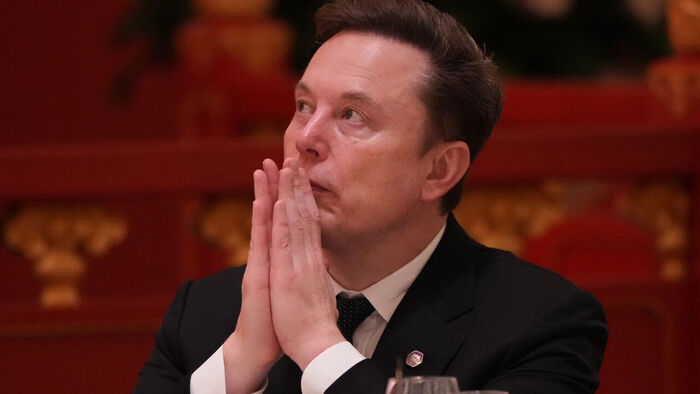
Yet SpaceX is no exception to massive capital expenditure (CAPEX) requirements. The company plans to deploy $19.6 billion (approximately 27 trillion won) in the third quarter and up to $40 billion (approximately 55 trillion won) in the fourth quarter. The market must now wait and see whether Musk's assertion that "demand is explosive enough for investments in AI compute facilities to be recovered in less than one year" will prove true.
Will Investments Synergize with Core Business? Mixed Views on Meta
 Meta's capital expenditures for building data centers and securing AI semiconductors in the third quarter alone reached $34.9 billion (approximately 46 trillion won), surging 80% compared to the same period last year. Nevertheless, the company raised its full-year capital expenditure forecast to a range of $135 billion to $145 billion, setting a target above the market consensus of $138.2 billion. Chief Financial Officer Susan Li acknowledged that realizing bottom-line returns from new AI investments could take longer than traditional business lines, confirming that the mismatch in timing between investment and monetized returns will remain an extended campaign. Interpreting this as a signal that record-breaking facility investments will persist, the market pushed Meta's shares sharply higher in after-hours trading.
What stood out even more than Meta's new AI model "Muse" during this release was the performance of its core advertising business. Ad impressions increased by 10% year-on-year, while the average price per ad rose by 14%. The company explained that enhanced recommendation algorithms powered by AI boosted user dwell time and advertising efficiency. This demonstrated the potential for a "virtuous cycle" where AI technology directly translates into advertising revenue for its primary business. Although some praised this as proof that AI investments are reinforcing the fundamentals of Meta's core operations, views remain divided on exactly when these benefits will offset the staggering capital costs.
Gartner Analysis Rekindles Bubble Fears: Is CoreWeave Safe?
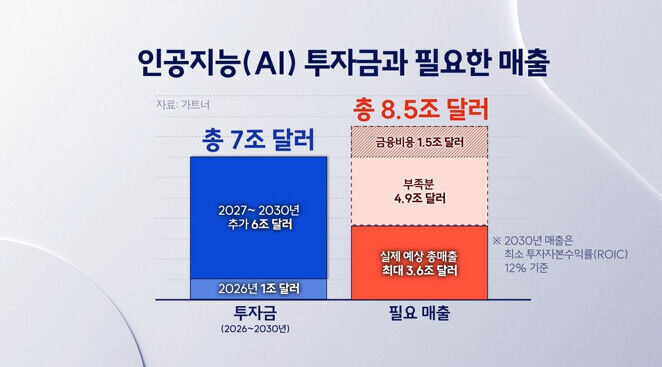
A pessimistic outlook on AI investment profitability by prominent market research firm Gartner served as the catalyst. Gartner projected that AI firms will invest approximately $1 trillion in capital spending in 2026, followed by an additional $6 trillion (approximately 800 trillion won) from next year through 2030. To cover resulting financial expenses like interest and achieve a 12% return on invested capital (ROIC), Gartner estimated that $8.5 trillion in revenue would be required by 2030, whereas actual data center-related revenue would reach at most around $3.6 trillion. If this scenario materializes, Gartner predicted that more than 80% of debt-laden neo-cloud operators like CoreWeave—unlike diversified Big Tech players—would fail to survive independently.
 The report immediately dragged down CoreWeave's stock and bond prices, as the heavily leveraged, infrastructure-heavy neo-cloud sector increasingly stands out as the "weak link" unlikely to endure rising interest rates. Even among relatively cash-rich Big Tech giants, it remains an undeniable reality that the pace of AI facility spending is outrunning the pace of revenue generation. Companies are issuing corporate bonds to borrow money from the markets to construct data centers. If Alphabet, Amazon, Microsoft, Oracle, and Meta are categorized as the top five Big Tech firms, their AI infrastructure investment next year is projected to reach $1.2 trillion (approximately 1,600 trillion won). Over 35% of this spending is expected to be financed through debt rather than cash reserves.
Some analysts suggest that South Korea's recent steep stock sell-off reflects aggressive net selling and profit-taking by offshore hedge funds pricing in these broader trends. Goldman Sachs noted that hedge funds' net selling of global AI and semiconductor equities for five consecutive trading days from October 8 to 14 represented a risk-off retreat against the backdrop of key political variables and uncertainties like the U.S. midterm elections, a strengthening U.S. dollar, and a firmer Korean won. In effect, hedge funds appear to have liquidated in a single week all net long positions in AI equities accumulated since 2025. Speculation suggests these funds are largely withholding fresh capital allocations until after major hyperscalers report earnings in late October and the U.S. midterms conclude.
Earnings "Superweek" in Late October: Turning Point for Year-End Markets
Coincidentally, the earnings reports of Microsoft (October 28), Alphabet (October 28), Amazon (October 29), Apple (November 2), and Nvidia (November 18)—which will serve as the litmus test for the market's most pressing question: "Are companies generating returns commensurate with their AI infrastructure investments, or are there clear signs of profitability?"—are coinciding with the U.S. midterm elections that could trigger meaningful shifts in geopolitical conflicts like the prolonged Middle East war, as well as summits among the leaders of the United States, China, and Russia, heralding a breathless, roughly three-week "superweek."
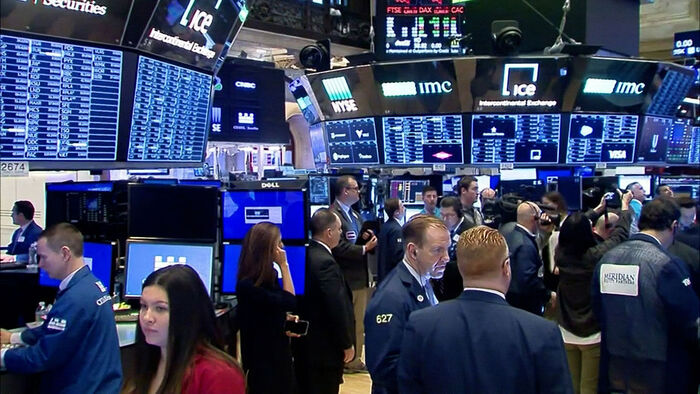 Whether stock prices rebound from November onward appears contingent not only on whether wars determining international oil prices come to an end, but also industrially on "whether concerns over AI financing spill over into actual reductions in capital expenditures" and "whether memory semiconductor profit forecasts through 2028 remain intact." Wall Street's key checkpoints for the upcoming earnings reports are: (1) ROI (return on investment) versus capital spending or early signs of profitability, (2) reasonable cost management and discipline, and (3) future investment guidance. For example, regarding Microsoft, attention is focused on revenue growth and enterprise customer expansion for its corporate cloud service "Azure," and especially on the rising profitability of its monetized AI software "Copilot." For Google, which rolled out "AI Overviews" in its flagship search engine, market reaction is expected to hinge on whether it can showcase revenue and growth in the search advertising market like Meta, and whether it has managed to reduce costs by deploying its in-house AI semiconductor, the TPU, compared to relying on Nvidia chips.
※ Please note: This article was translated by AI and may contain errors.
Copyright Ⓒ SBS. All rights reserved. Unauthorized reproduction, redistribution, and use for AI training are prohibited.