SBS NEWS
BOK: Semiconductor Boom Expected to Expand Consumption Recovery Through Trickle-Down Effect
Published : Oct 22, 2026 3:16 PM

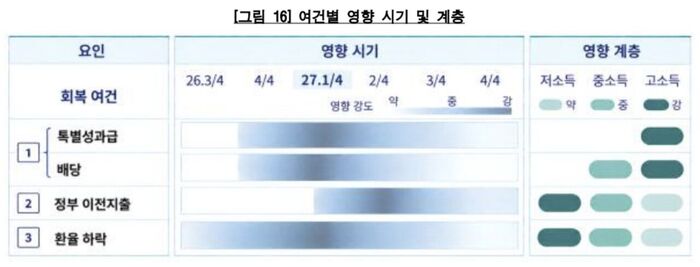
▲ Chart on Timing and Strata Impacted by Conditions for Broadening Consumption Recovery
The Bank of Korea (BOK) projected today (October 22) that the booming semiconductor industry will bolster the recovery of private consumption through a "trickle-down effect" that improves household spending capacity via various channels.
In a report released on this day, the BOK forecasted that "as we head into next year, the ripple effects of the semiconductor boom will spread, gradually expanding the recovery trend in private consumption."
The BOK analyzed the conditions for spreading consumption recovery by categorizing them into income, fiscal policies, and exchange rates.
First, estimating that special performance-based bonuses from major corporations in sectors such as semiconductors, automobiles, and shipbuilding will reach approximately 60 trillion to 70 trillion won, it projected that household consumption will increase significantly starting early next year.
The assumption was made that for every temporary 1 million won increase in income, consumption rises by about 110,000 won.
The BOK also forecasted that large-scale dividend payouts from semiconductor companies will contribute to expanding household consumption from the fourth quarter of this year onward.
In particular, given the recent broadening of the stock-holding base, it anticipates that the consumption-boosting effect of dividends could appear more widely than in the past.
The BOK analyzed that an increase in corporate tax revenue will lead to an expansion in government transfer payments to households, thereby boosting spending capacity.
A significant portion of the increased transfer payments is expected to be utilized to support middle- and lower-income brackets, who have a high marginal propensity to consume—meaning they tend to spend a large proportion of any additional income.
Additionally, the BOK estimated that a 10% decline in the won-dollar exchange rate would improve households' real purchasing power by about 0.35%.
It expressed expectations that a falling exchange rate would lower import prices, thereby enhancing the overall purchasing power of households.
The BOK stated, "While performance bonuses and dividends will mainly boost the spending capacity of high-income earners, expanded household transfer payments and a lower exchange rate will significantly enhance the purchasing power of middle- and lower-income groups."
The BOK noted that "(income) may flow into real estate to a certain extent," while adding that "the majority will be accumulated as financial savings."
However, it pointed out that the growth trend in household debt, sluggishness in the housing construction market, and stock market adjustments are factors constraining the recovery of private consumption.
Regarding stock market adjustments, it forecasted that if expectations for a future rebound in stock prices weaken or if the recovery in sentiment among households facing losses is delayed, constraints on consumption could persist for a certain period.
(Photo courtesy of Bank of Korea, Yonhap News)
※ Please note: This article was translated by AI and may contain errors.
Copyright Ⓒ SBS. All rights reserved. Unauthorized reproduction, redistribution, and use for AI training are prohibited.